Introduction
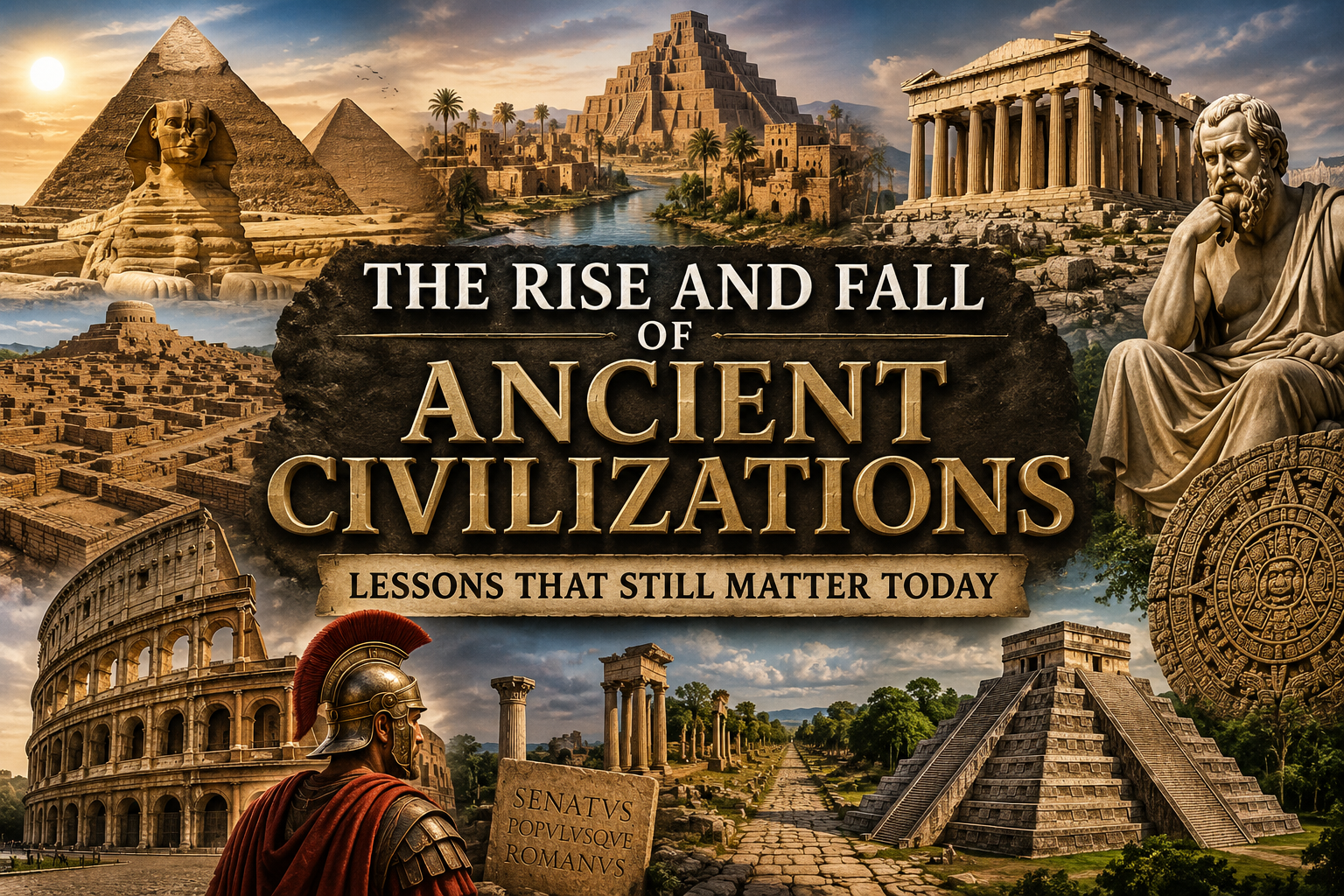
The Rise and Fall of Ancient Civilizations is one of the most fascinating stories in human history. Thousands of years ago, remarkable civilizations emerged across different parts of the world, transforming the way people lived, governed societies, built cities, traded goods, and recorded knowledge. These civilizations laid the foundation for many aspects of modern life, including law, architecture, engineering, mathematics, agriculture, science, and culture.
Although many of these great civilizations eventually declined or disappeared, their achievements continue to influence the modern world. Ancient monuments, written records, advanced engineering techniques, and political systems demonstrate how innovative these societies were despite having limited technology compared to today.
Studying the rise and fall of ancient civilizations allows us to understand why powerful empires succeed, what causes them to collapse, and how history continues to shape the present. Their stories offer valuable lessons about leadership, sustainability, innovation, conflict, and resilience that remain relevant in today’s rapidly changing world.
In this comprehensive guide, we explore the greatest ancient civilizations, their remarkable achievements, the reasons behind their decline, and the lasting legacy they left for future generations.
Understanding the Rise and Fall of Ancient Civilizations helps us appreciate how history continues to shape the modern world.
What Are Ancient Civilizations?
Ancient civilizations were organized societies that developed permanent settlements, governments, social structures, economic systems, religious beliefs, and written languages. Unlike small tribal communities, civilizations established large cities, complex administrations, and impressive architectural projects that reflected their technological and cultural advancements.
Most historians consider a civilization to possess several defining characteristics:
Permanent cities and settlements
Organized governments
Social classes
Written language
Religious institutions
Trade and commerce
Scientific and technological development
Monumental architecture
These features allowed civilizations to grow into powerful societies capable of influencing neighboring regions through trade, diplomacy, warfare, and cultural exchange.
Some civilizations flourished for centuries, while others survived for thousands of years before eventually declining due to internal weaknesses, environmental changes, invasions, or economic challenges.
The Rise and Fall of Ancient Civilizations demonstrates how geography, leadership, innovation, and culture influenced the success of early societies.
Why Ancient Civilizations Still Matter
Ancient civilizations continue to shape nearly every aspect of modern society.
Many legal systems trace their origins to Roman law. Democratic principles developed in Ancient Greece still influence governments worldwide. Modern engineering builds upon techniques pioneered by Egyptians and Romans, while mathematics and astronomy benefited greatly from the contributions of the Maya and Mesopotamians.
Even our calendars, writing systems, architecture, irrigation methods, and urban planning have roots in these remarkable civilizations.
Studying ancient history helps us appreciate humanity’s achievements while also understanding the challenges societies face when resources become scarce, governments weaken, or conflicts escalate.
Their successes inspire innovation, while their failures remind us of the importance of strong leadership, sustainable development, and peaceful cooperation.
Ancient Egypt is one of the best examples of the Rise and Fall of Ancient Civilizations.
Ancient Egypt
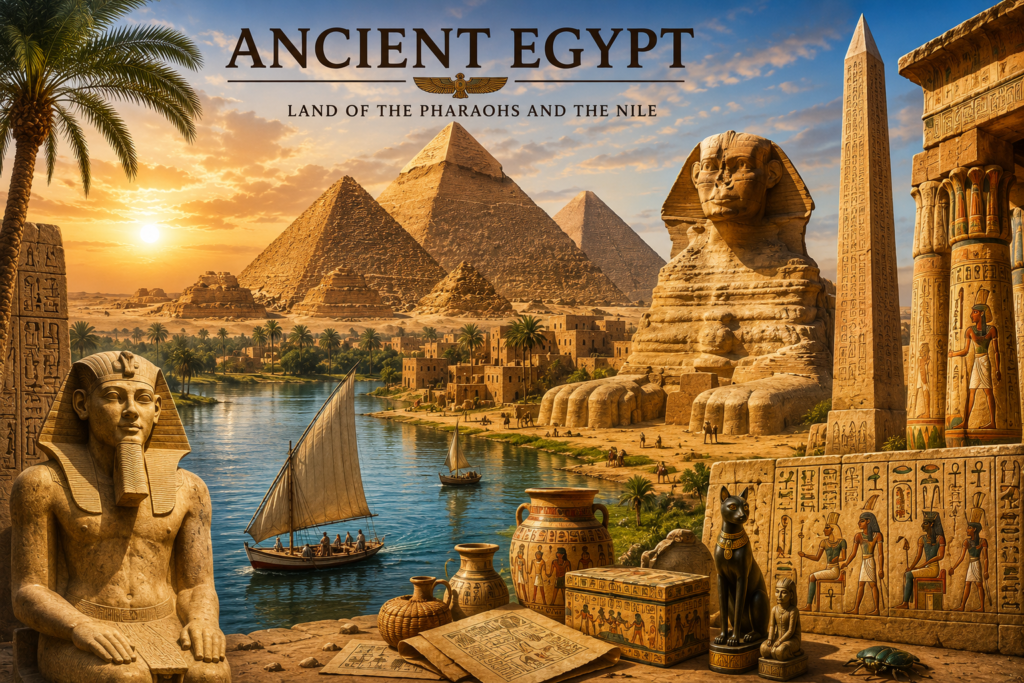
Ancient Egypt is one of history’s longest-lasting civilizations, flourishing for over 3,000 years along the fertile banks of the Nile River. The predictable flooding of the Nile created rich agricultural land that supported millions of people and allowed Egyptian society to prosper.
The civilization became famous for its magnificent pyramids, temples, monuments, and sophisticated religious beliefs centered around numerous gods and the afterlife.
The Great Pyramid of Giza remains the only surviving Wonder of the Ancient World and continues to amaze engineers and historians because of its incredible precision and scale.
Egyptian rulers, known as pharaohs, possessed enormous political and religious authority. They oversaw ambitious construction projects, organized military campaigns, and maintained stability throughout much of Egyptian history.
Beyond architecture, Egypt made significant contributions in medicine, mathematics, astronomy, engineering, and writing. Hieroglyphics allowed Egyptians to preserve historical records, religious texts, and administrative documents for thousands of years.
Their understanding of geometry helped construct massive monuments with remarkable accuracy, while advances in irrigation transformed agriculture.
However, Ancient Egypt eventually weakened due to political instability, foreign invasions, economic decline, and changing trade routes. Despite its fall, Egyptian civilization continues to influence archaeology, architecture, engineering, and popular culture worldwide.
Mesopotamian Civilization
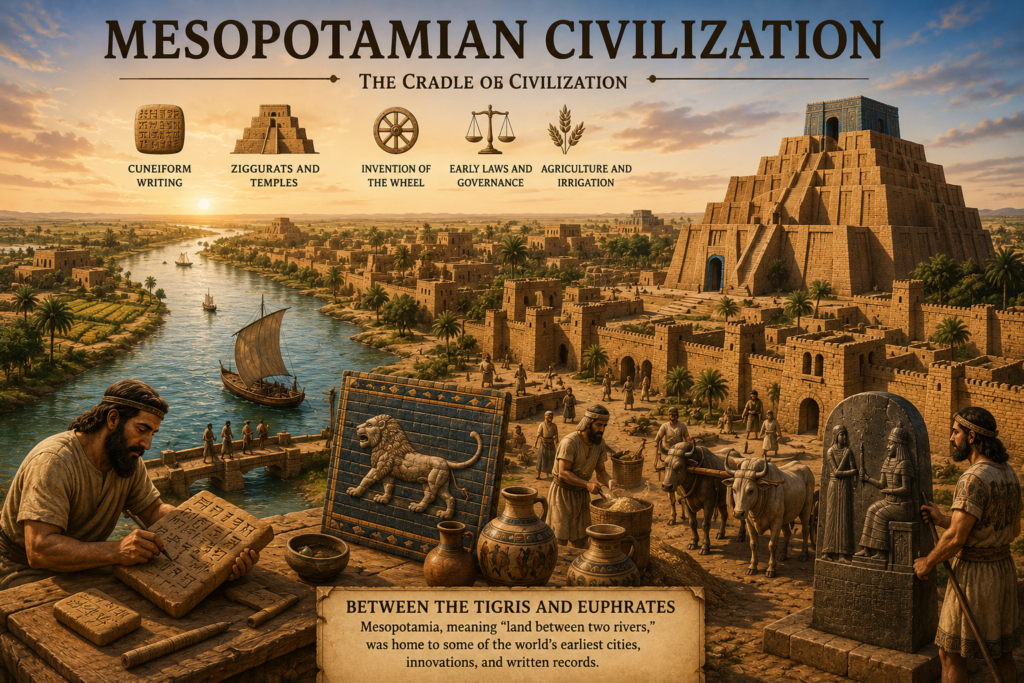
Often called the Cradle of Civilization, Mesopotamia developed between the Tigris and Euphrates Rivers in present-day Iraq.
It was home to some of humanity’s earliest cities, including Ur, Uruk, Babylon, and Nineveh. These cities became centers of commerce, religion, government, and technological innovation.
Mesopotamians created one of the world’s earliest writing systems known as cuneiform. This revolutionary invention allowed governments to maintain records, merchants to conduct business, and scholars to preserve knowledge.
The region also witnessed remarkable developments in mathematics, astronomy, agriculture, irrigation, and law.
One of Mesopotamia’s greatest achievements was the Code of Hammurabi, among the earliest written legal codes in history. It established clear laws and punishments, influencing legal systems for centuries.
Massive ziggurats dominated city skylines, serving both religious and political purposes. These impressive structures demonstrated advanced engineering techniques and architectural planning.
Despite its achievements, Mesopotamia experienced constant warfare between competing kingdoms. Repeated invasions by neighboring empires gradually weakened the region, eventually leading to its decline.
Nevertheless, Mesopotamia’s contributions to writing, law, agriculture, mathematics, and urban civilization remain fundamental to human history.
Indus Valley Civilization
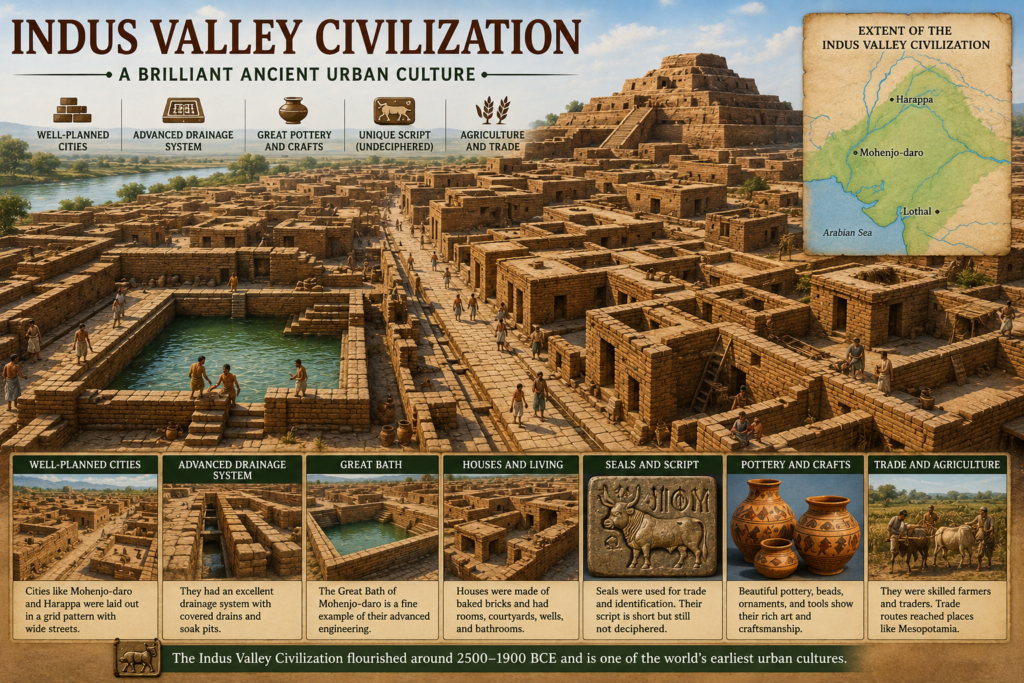
The Indus Valley Civilization emerged around 2600 BCE in present-day Pakistan and northwestern India. It became one of the largest and most advanced civilizations of the ancient world.
Unlike many ancient societies, the Indus Valley Civilization demonstrated exceptional urban planning. Cities such as Mohenjo-daro and Harappa featured straight streets, standardized brick buildings, sophisticated drainage systems, public baths, and organized residential neighborhoods.
The civilization also maintained extensive trade networks with Mesopotamia and other neighboring regions. Archaeologists have discovered seals, jewelry, pottery, and tools that indicate thriving commercial activity.
Perhaps the most remarkable achievement of the Indus Valley Civilization was its sanitation system. Covered drains connected nearly every home, reflecting an extraordinary understanding of public health and urban engineering.
Despite these impressive accomplishments, much about the civilization remains mysterious. Its writing system has not yet been fully deciphered, leaving many aspects of its culture unknown.
Historians believe environmental changes, shifting river systems, declining trade, and climate change gradually contributed to its disappearance around 1900 BCE.
Even so, the civilization’s achievements in city planning, engineering, sanitation, and trade continue to impress modern researchers.
Ancient Greece
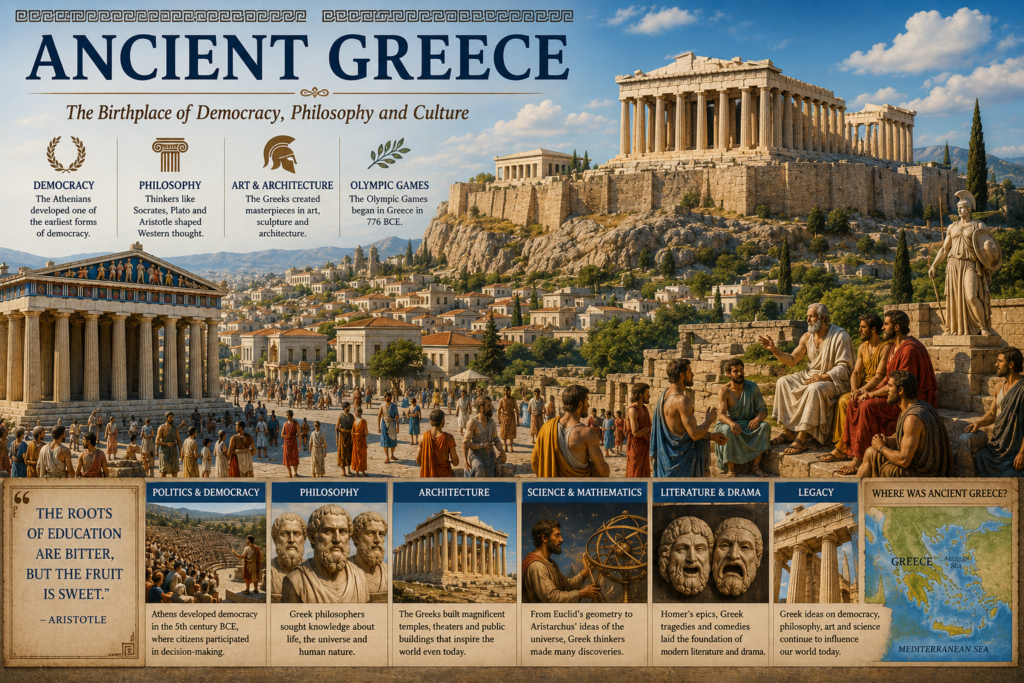
Ancient Greece is often regarded as the birthplace of Western civilization because of its lasting influence on politics, philosophy, science, literature, mathematics, and the arts. Located on the Balkan Peninsula and surrounded by the Mediterranean Sea, Greece developed into a collection of powerful city-states rather than a single unified empire. Among these city-states, Athens and Sparta became the most famous due to their contrasting political systems, military strength, and cultural achievements.
Athens became the center of democracy, education, and philosophy. It introduced one of the earliest democratic systems in which eligible citizens participated in government decisions. Although this democracy differed greatly from modern democratic systems, it inspired political ideas that continue to influence governments worldwide.
Ancient Greece also produced some of history’s greatest thinkers. Philosophers such as Socrates, Plato, and Aristotle asked important questions about ethics, politics, science, and human nature. Their writings continue to be studied in schools and universities today.
Greek achievements extended beyond philosophy. The civilization made remarkable progress in mathematics, astronomy, medicine, architecture, and theater. Mathematical discoveries by scholars like Pythagoras and Euclid formed the foundation of modern geometry. Physicians such as Hippocrates introduced medical principles that influenced healthcare for centuries.
Architecture flourished during this period, with magnificent temples like the Parthenon demonstrating extraordinary engineering and artistic excellence. The Olympic Games also originated in Ancient Greece as a religious festival honoring Zeus and eventually evolved into the international sporting event celebrated today.
Trade played a major role in Greece’s prosperity. Merchant ships connected Greek cities with Egypt, Persia, Italy, and other Mediterranean regions, encouraging cultural exchange and economic growth.
However, constant rivalry between city-states weakened Greek unity. The Peloponnesian War between Athens and Sparta severely damaged both powers, making Greece vulnerable to external conquest. Eventually, King Philip II of Macedonia united much of Greece, and his son, Alexander the Great, expanded Greek culture across Asia, Egypt, and parts of Europe.
Although Ancient Greece eventually lost its independence, its intellectual, political, and cultural achievements remain among the greatest contributions to world civilization.
Roman Empire
The Roman Empire remains one of the greatest examples of the Rise and Fall of Ancient Civilizations because of its remarkable achievements and eventual decline.
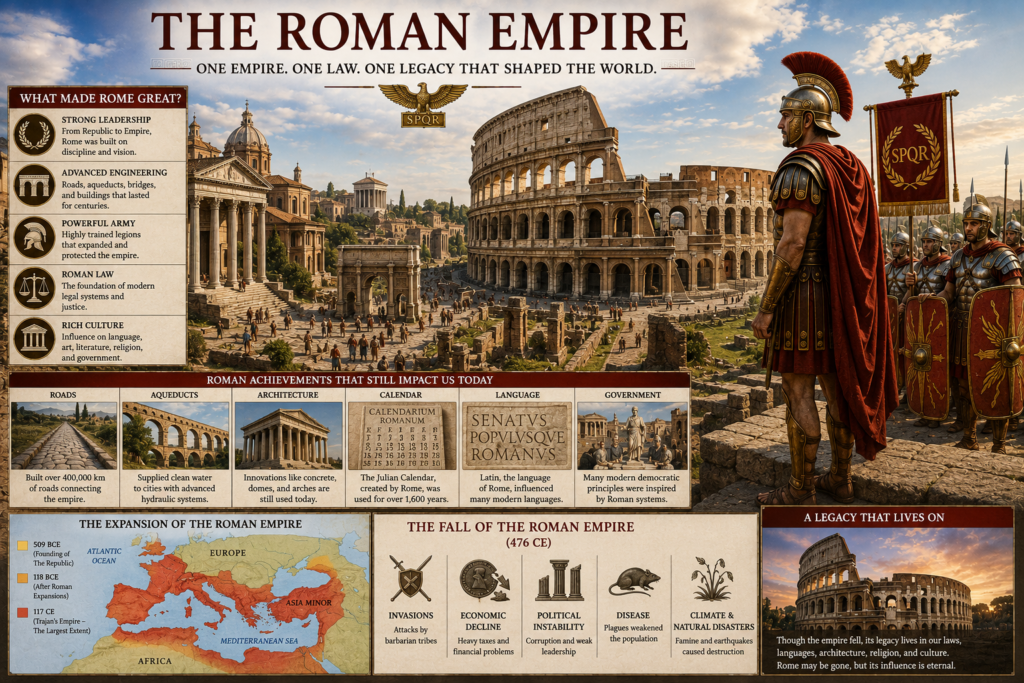
The Roman Empire was one of the largest and most influential civilizations in history. Beginning as a small settlement on the Italian Peninsula, Rome gradually expanded through military conquest, diplomacy, and strategic alliances until it controlled vast territories across Europe, North Africa, and the Middle East.
Roman civilization became famous for its efficient government, disciplined military, advanced engineering, and extensive road network. At its greatest extent under Emperor Trajan around AD 117, the empire stretched from Britain to Egypt and from Spain to Mesopotamia.
One of Rome’s greatest strengths was its legal system. Roman law established principles of justice, property rights, contracts, and citizenship that continue to influence legal systems around the world.
Engineering represented another remarkable achievement. Roman engineers built roads, bridges, aqueducts, harbors, amphitheaters, and public baths using innovative construction techniques. The famous Colosseum remains one of history’s greatest architectural masterpieces.
The Roman army played a central role in maintaining the empire. Highly trained soldiers protected borders, expanded territory, and ensured political stability for centuries.
Economic prosperity was supported by agriculture, trade, taxation, and manufacturing. Roman merchants traded goods including olive oil, wine, spices, silk, and precious metals across Europe, Asia, and Africa.
Despite its extraordinary success, the Roman Empire gradually faced numerous challenges. Political instability, corruption, economic decline, inflation, barbarian invasions, military conflicts, and administrative difficulties weakened imperial authority.
In AD 476, the Western Roman Empire officially collapsed after the last emperor was removed from power. However, the Eastern Roman Empire, also known as the Byzantine Empire, continued for nearly another thousand years.
Today, Roman influence remains visible in architecture, engineering, law, language, government, and urban planning throughout the world.
Maya Civilization
The Maya Civilization developed in present-day Mexico, Guatemala, Belize, Honduras, and El Salvador. It became one of the most advanced civilizations in the Americas, flourishing between approximately 250 and 900 AD.
Unlike many ancient empires, the Maya consisted of independent city-states connected through trade, religion, and shared culture. Major cities included Tikal, Palenque, Copán, and Chichén Itzá.
The Maya achieved remarkable advances in astronomy and mathematics. They accurately tracked planetary movements, predicted eclipses, and developed sophisticated calendars that remain famous today.
Their mathematical system included the concept of zero, an innovation that was rare among ancient civilizations and essential for advanced calculations.
Mayan architecture also demonstrated exceptional skill. Massive stone pyramids, ceremonial temples, observatories, and palaces reflected both engineering expertise and religious beliefs.
Agriculture formed the foundation of the Maya economy. Farmers cultivated maize, beans, squash, cacao, and other crops using advanced farming techniques suited to tropical environments.
Religion influenced nearly every aspect of Mayan life. Elaborate ceremonies honored numerous gods associated with agriculture, rain, astronomy, and creation.
However, the Maya Civilization eventually experienced decline due to a combination of environmental stress, prolonged droughts, warfare between city-states, overpopulation, and political instability. Many major cities were abandoned long before European explorers arrived.
Despite their decline, the descendants of the Maya continue to preserve their languages, traditions, and cultural heritage throughout Central America.
Why Ancient Civilizations Rose
Although each civilization developed under different conditions, several common factors contributed to their rise.
Favorable Geography
Most successful civilizations emerged near rivers or fertile regions that supported agriculture. The Nile, Tigris, Euphrates, and Indus Rivers provided reliable water supplies, fertile soil, and transportation routes.
Agricultural Development
Stable food production allowed populations to grow, encouraging specialization in trade, government, education, and architecture.
Strong Leadership
Capable rulers established political stability, organized public works, defended territories, and promoted economic growth.
Trade Networks
Trade connected civilizations with neighboring regions, allowing the exchange of goods, technology, ideas, and cultural traditions.
Innovation
Advances in writing, engineering, mathematics, astronomy, and construction enabled civilizations to solve complex problems and expand their influence.
Comparing the World’s Greatest Ancient Civilizations
Civilization
Famous Achievement
Approximate Period
Ancient Egypt
Pyramids & Hieroglyphics
3100–30 BC
Mesopotamia
Cuneiform & Code of Hammurabi
3500–539 BC
Indus Valley
Urban Planning & Drainage
2600–1900 BC
Ancient Greece
Democracy & Philosophy
800–146 BC
Roman Empire
Law & Engineering
27 BC–476 AD
Maya Civilization
Astronomy & Mathematics
250–900 AD
Why Ancient Civilizations Fell
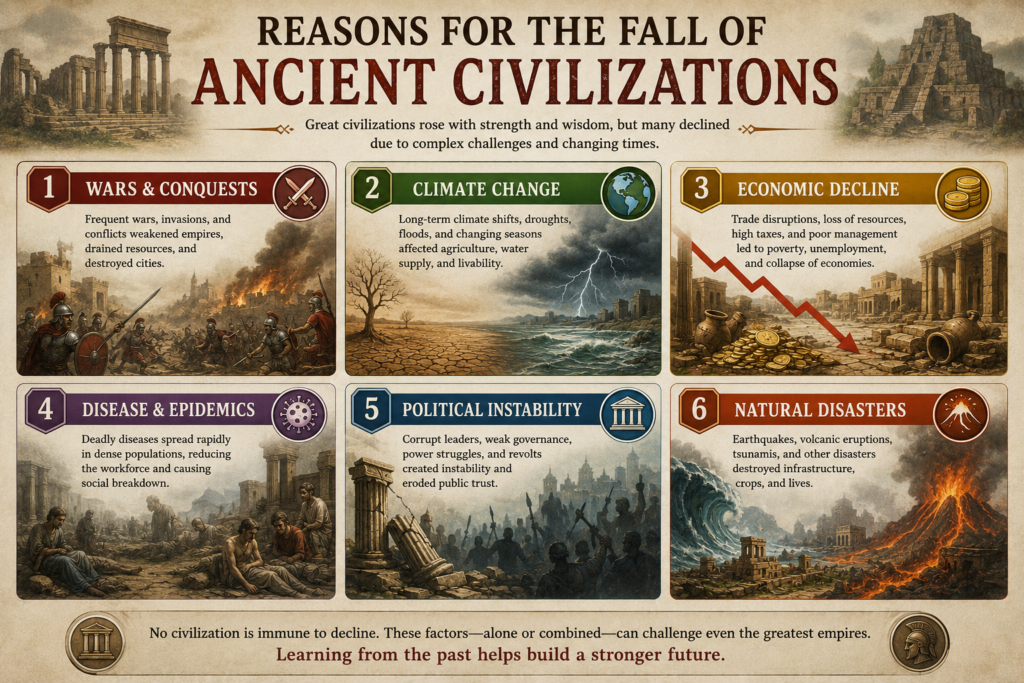
The Rise and Fall of Ancient Civilizations teaches us that no civilization, regardless of its power or wealth, can remain strong forever. While every civilization had its own unique history, historians have identified several common factors that contributed to their decline. In most cases, civilizations did not collapse because of a single event. Instead, a combination of political, economic, environmental, and social challenges gradually weakened them over many years.
1. Wars and Invasions
One of the biggest reasons for the fall of ancient civilizations was continuous warfare. As kingdoms expanded their territories, they often fought neighboring states for land, wealth, and resources. Although victories brought prosperity, constant wars drained military strength, exhausted financial resources, and reduced agricultural production.
For example, the Roman Empire faced repeated invasions by Germanic tribes, while Mesopotamian kingdoms experienced frequent conflicts with neighboring empires. These invasions weakened governments and made it difficult to maintain stability.
2. Climate Change and Environmental Problems
Environmental changes also played an important role in the decline of many civilizations. Long periods of drought, floods, changing river courses, and soil degradation reduced food production and caused widespread famine.
The Indus Valley Civilization may have declined after rivers changed their course, reducing water supplies for farming. Similarly, severe droughts are believed to have contributed to the decline of the Maya Civilization, making agriculture increasingly difficult.
Today, climate change remains one of humanity’s greatest challenges, making these historical lessons especially relevant.
3. Economic Decline
A strong economy is essential for any civilization. As trade decreased, governments collected fewer taxes, inflation increased, and public services deteriorated.
The Roman Empire experienced rising taxes, inflation, and declining trade, making it increasingly difficult to support its army and infrastructure. Economic instability often created dissatisfaction among citizens and weakened governments from within.
4. Political Instability
Effective leadership is crucial for maintaining peace and prosperity. However, many civilizations suffered from corruption, succession disputes, civil wars, and weak rulers.
Frequent changes in leadership reduced public confidence and created opportunities for rival groups to seize power. Internal conflicts often proved just as dangerous as foreign invasions.
5. Disease and Epidemics
Large populations living in crowded cities became vulnerable to disease outbreaks. Epidemics reduced populations, weakened armies, disrupted trade, and damaged economies.
Historical records suggest that several empires suffered devastating disease outbreaks that accelerated their decline.
6. Overuse of Natural Resources
Many civilizations depended heavily on forests, rivers, fertile land, and minerals. Excessive farming, deforestation, and poor resource management gradually damaged the environment.
When natural resources became scarce, agricultural production declined, forcing populations to migrate or compete for limited supplies.
The Rise and Fall of Ancient Civilizations shows that even the most powerful empires faced challenges that eventually led to their decline.
Lessons That Still Matter Today
Although thousands of years have passed, the Rise and Fall of Ancient Civilizations continues to provide valuable lessons for modern societies.
Sustainable Resource Management
Ancient civilizations demonstrate the importance of protecting natural resources. Unsustainable farming, deforestation, and water shortages contributed to several historical collapses.
Modern societies must balance economic development with environmental conservation to ensure future generations inherit a healthy planet.
Strong Institutions Matter
Successful civilizations developed stable governments, fair legal systems, and effective administration.
Countries with transparent institutions, accountable leadership, and public trust are generally better prepared to overcome economic and political challenges.
Innovation Drives Progress
Many ancient civilizations flourished because they embraced innovation.
Egyptians mastered engineering.
Mesopotamians developed writing.
Greeks advanced philosophy and science.
Romans perfected engineering and infrastructure.
The Maya excelled in astronomy and mathematics.
Innovation remains one of humanity’s greatest strengths today.
Education Preserves Knowledge
Written language allowed civilizations to preserve scientific discoveries, historical events, religious beliefs, and cultural traditions.
Without written records, much of human history would have been lost forever.
Modern education continues this tradition by preserving and expanding human knowledge.
Peace Encourages Prosperity
Periods of peace allowed civilizations to focus on trade, science, architecture, and cultural development.
In contrast, prolonged warfare often led to destruction, poverty, and political instability.
Legacy of Ancient Civilizations
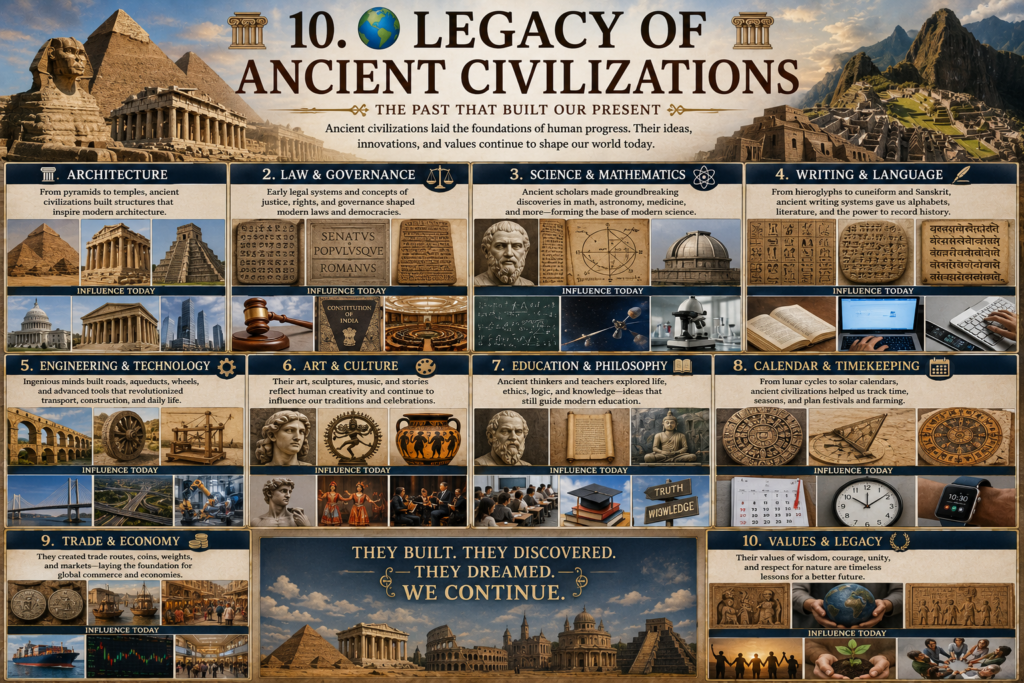
The legacy of ancient civilizations continues to influence modern life in countless ways.
Many modern legal systems are based on Roman law.
Democratic ideas developed in Ancient Greece continue to shape governments worldwide.
Modern engineering still reflects techniques pioneered by Egyptian and Roman builders.
The concept of written law originated in Mesopotamia.
Urban planning introduced by the Indus Valley Civilization remains impressive even by today’s standards.
Astronomical observations made by the Maya contributed significantly to humanity’s understanding of the heavens.
Museums, archaeological sites, universities, and historical monuments preserve these achievements, allowing future generations to appreciate humanity’s remarkable past.
The legacy of the Rise and Fall of Ancient Civilizations continues to influence governments, science, engineering, and culture today.
Ancient Civilizations in the Modern World
Although these civilizations disappeared centuries ago, their influence remains visible everywhere.
Government institutions reflect Greek and Roman political ideas.
Roads, bridges, and public buildings continue to use engineering principles developed thousands of years ago.
Architects still draw inspiration from Greek columns and Roman arches.
Historians, archaeologists, and scientists continue discovering new information that reshapes our understanding of ancient societies.
Technology allows researchers to study ruins using satellite imagery, 3D scanning, and artificial intelligence, revealing details that were previously impossible to discover.
The stories of ancient civilizations remind us that progress depends not only on technology but also on responsible leadership, cooperation, education, and environmental stewardship.
How Ancient Civilizations Continue to Influence the Modern World
Although thousands of years have passed since the fall of the world’s greatest civilizations, their influence remains visible in almost every aspect of modern society. Governments, legal systems, architecture, engineering, science, mathematics, language, and urban planning all reflect ideas first developed by ancient civilizations.
Modern cities still use road networks, drainage systems, and public infrastructure inspired by Roman engineering. Democratic governments continue to follow principles first practiced in Ancient Greece, while many legal traditions have their roots in Roman law. Ancient Egypt’s architectural achievements continue to inspire engineers and architects worldwide, and the Indus Valley Civilization’s advanced city planning remains impressive even by today’s standards.
Similarly, the Maya Civilization made remarkable contributions to astronomy and mathematics. Their understanding of celestial movements helped create highly accurate calendars, demonstrating the scientific capabilities of ancient societies. Mesopotamia introduced writing systems and organized legal codes that transformed the way governments and businesses operated.
These civilizations remind us that innovation and knowledge are timeless. Their achievements continue to influence education, science, architecture, and governance across the globe.
Archaeology: Unlocking the Secrets of Ancient Civilizations
Archaeology has played a crucial role in helping historians understand the rise and fall of ancient civilizations. Every year, archaeologists uncover new artifacts, temples, cities, tools, inscriptions, and human remains that reveal important details about life thousands of years ago.
Modern technologies such as satellite imaging, drones, ground-penetrating radar, LiDAR, carbon dating, and 3D scanning have revolutionized archaeological research. These techniques allow researchers to locate buried cities, reconstruct damaged monuments, and study ancient settlements without disturbing them.
One fascinating example is the discovery of hidden structures beneath dense forests in Central America, revealing that the Maya Civilization was much larger than previously believed. Similar discoveries continue in Egypt, where archaeologists regularly uncover new tombs, temples, and mummies that provide valuable insights into ancient Egyptian society.
Every archaeological discovery helps historians piece together humanity’s shared history and improves our understanding of how civilizations developed, prospered, and eventually declined.
Why Preserving Ancient Civilizations Is Important
Protecting ancient monuments and archaeological sites is essential because they represent humanity’s shared heritage. These sites provide valuable information about our ancestors, their cultures, beliefs, technologies, and achievements.
Unfortunately, many historical sites face threats from natural disasters, pollution, urban development, illegal excavations, and armed conflicts. Governments, archaeologists, museums, and international organizations work together to preserve these priceless landmarks for future generations.
Conservation efforts include restoring damaged monuments, documenting archaeological discoveries, limiting tourism in sensitive areas, and educating the public about cultural heritage. Organizations such as UNESCO help identify and protect sites of outstanding historical importance.
By preserving ancient civilizations, we ensure that future generations can continue learning from the remarkable achievements and valuable lessons of the past.Rise and Fall of Ancient Civilizations
Frequently Asked Questions
Which was the first ancient civilization?
Mesopotamia is widely considered one of the earliest civilizations, developing around 3500 BCE between the Tigris and Euphrates Rivers.
Rise and Fall of Ancient Civilizations
Why did ancient civilizations disappear?
Most civilizations declined because of multiple factors, including wars, political instability, climate change, economic decline, disease, and environmental challenges.
Which ancient civilization lasted the longest?
Ancient Egypt lasted for more than 3,000 years, making it one of the longest-lasting civilizations in history.
Why should we study ancient civilizations?
Studying ancient civilizations helps us understand the origins of modern society and teaches valuable lessons about leadership, innovation, sustainability, and cultural development.
Conclusion
The Rise and Fall of Ancient Civilizations represents one of humanity’s greatest historical journeys. From the fertile valleys of Mesopotamia and the Nile to the magnificent cities of Greece, Rome, the Indus Valley, and the Maya world, these civilizations transformed history through remarkable achievements in architecture, science, engineering, governance, and culture.
Although many eventually disappeared, their influence remains deeply woven into modern society. Our laws, cities, technologies, educational systems, and cultural traditions all carry traces of these remarkable civilizations.
Their stories remind us that prosperity depends not only on power but also on wise leadership, sustainable development, innovation, and cooperation.Rise and Fall of Ancient Civilizations By learning from both their successes and failures, we gain valuable insights that can help shape a stronger and more sustainable future.
The Rise and Fall of Ancient Civilizations reminds us that innovation, responsible leadership, and sustainable development are essential for every society.
Explore More
If you enjoyed learning about the Rise and Fall of Ancient Civilizations, you may also like:
The Seven Wonders of the Ancient World: History, Architecture, and Legacy https://itshk.in/seven-wonders-of-the-ancient-world/
Legends of India: Heroes, Myths, Mysteries, and the Stories That Shaped a Civilization https://itshk.in/legends-of-india/
Haunted Places in India https://itshk.in/haunted-places-in-india/
The Rise and Fall of Ancient Civilizations reminds us of the importance of preserving humanity’s cultural heritage. Many ancient monuments, archaeological sites, and historical landmarks are protected today because of their outstanding cultural and historical value Rise and Fall of Ancient Civilizations. Readers interested in learning more about World Heritage Sites and global conservation efforts can explore the official UNESCO World Heritage Centre. http://UNESCO World Heritage Centre
To explore the history of ancient civilizations Rise and Fall of Ancient Civilizations in greater depth, including their achievements, rulers, cultures, and historical significance, readers can visit Encyclopaedia Britannica. It offers reliable and comprehensive articles written by experts on world history, archaeology, and ancient societies. http://Encyclopaedia Britannica
1 thought on “10 Powerful Lessons from the Rise and Fall of Ancient Civilizations”