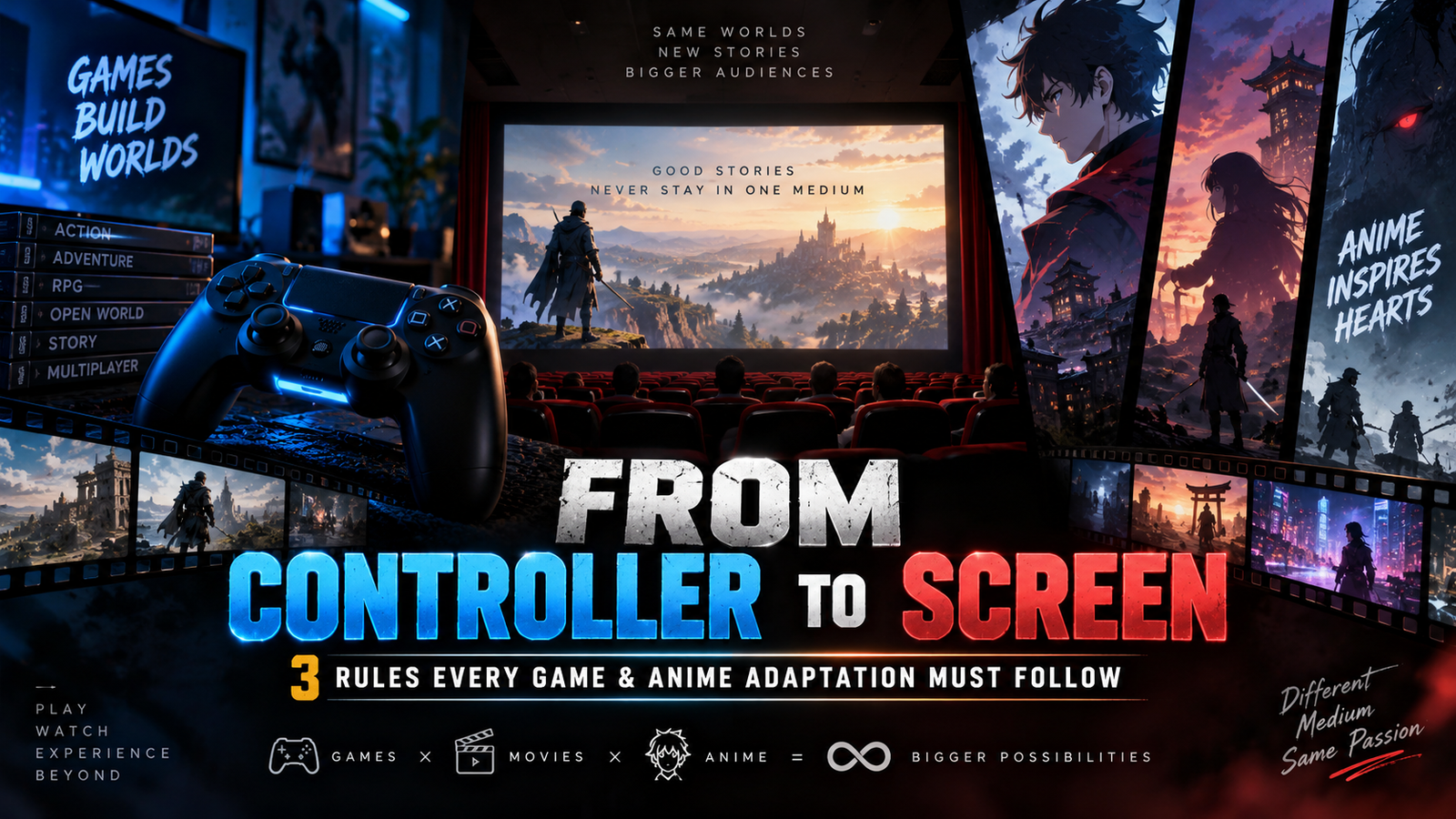
From Controller to Screen: 3 Rules Every Game and Anime Adaptation Must Follow
Introduction: From Controller to Screen
For years, turning a popular video game or anime into a movie sounded like a risky gamble. Fans already knew the characters, worlds and stories they loved, so even a small change could trigger criticism. But in 2026, game and anime adaptations have become a major part of mainstream entertainment, with studios increasingly looking to established franchises for their next big projects.
The success of projects such as Arcane, Fallout and The Super Mario Galaxy Movie has shown that an adaptation doesn’t have to copy its source material scene by scene to connect with audiences. At the same time, upcoming projects such as Sekiro: No Defeat are bringing more game worlds into animation and expanding what an adaptation can look like.
So what actually makes an adaptation work?
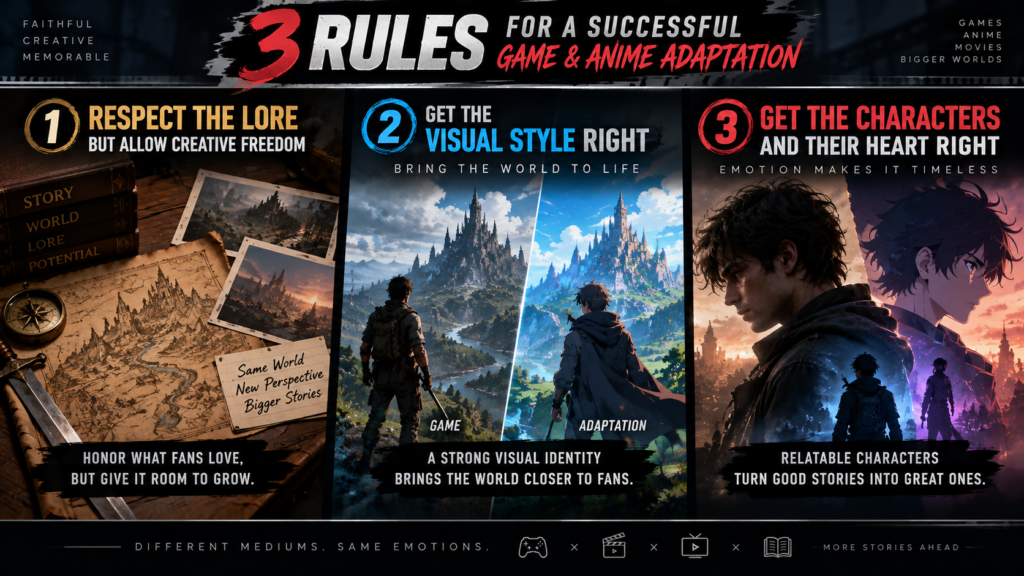
Whether the source is a massive video game franchise or a beloved anime, three things matter most: respecting the original world, capturing its visual identity, and understanding the characters at its emotional core.
These three rules can help explain why some game and anime adaptations feel authentic while others leave fans wondering why the original material was changed in the first place.
Sekiro: No Defeat https://sekiro-anime.jp/?utm_source=chatgpt.com
Rule #1: Respect the Lore, but Allow Creative Freedom
The first challenge for game and anime adaptations is finding the balance between staying faithful to the original and creating something that works naturally on screen.
Fans usually have a strong connection to the worlds they already know. They remember important characters, relationships, locations, conflicts and even small details from the original story. When an adaptation changes these elements without a clear reason, longtime fans can feel that the identity of the original has been lost.
However, being faithful doesn’t mean copying every scene exactly.
A movie or series has different storytelling requirements from a game or anime. A game might take dozens of hours to complete, while a movie may have only two or three hours to tell its story. Some characters or events may therefore need to be combined, shortened or rearranged.
The key is understanding what must remain and what can change.
🎮 What Should Stay?
The core identity of the original should remain recognizable:
Important character personalities
The central themes and conflicts
The rules of the fictional world
Major relationships
The overall tone and atmosphere
For example, Fallout demonstrates how an adaptation can create a new story within an established game universe instead of simply retelling one of the games. The result can introduce newcomers to the world while still giving longtime players familiar elements to recognize.
Similarly, Arcane showed that an adaptation can expand the world and characters connected to League of Legends while presenting a story designed specifically for television.
If you’re interested in how anime can be successfully adapted for different audiences, check out our guide to best anime adaptations better than manga. https://itshk.in/best-anime-adaptations-better-than-manga/
🎬 Where Can Filmmakers Take Creative Freedom?
Creative changes can actually make an adaptation stronger when they serve the story.
A filmmaker might change the order of events, introduce a different perspective, remove a gameplay-focused sequence or expand a supporting character. These changes aren’t automatically a problem—the important question is whether they preserve the spirit of the source material.
That balance is one of the biggest challenges facing modern game and anime adaptations.
The goal isn’t to make a perfect copy.
The goal is to make audiences feel that they’re experiencing the same world in a new way.
Video games already create immersive worlds for players, whether it’s a competitive title like Free Fire or a large story-driven adventure.https://itshk.in/free-fire-lag-high-ping-android/
Rule #2: Capture the Original Visual Style
One of the biggest reasons people connect with a game or anime is its visual identity. The characters, environments, colors, action sequences and overall atmosphere can become just as recognizable as the story itself.
That makes visual style another major challenge for game and anime adaptations.
A successful adaptation doesn’t necessarily need to reproduce every frame from the source material. Instead, it needs to understand why the original looks and feels distinctive.
🎨 More Than Just Expensive Visual Effects
Modern VFX can create enormous worlds, realistic creatures and spectacular action sequences. But impressive effects alone don’t guarantee that an adaptation will feel authentic.
Consider an anime with exaggerated movements, dramatic camera angles and highly stylized combat. Simply making those scenes photorealistic could remove some of what made the original exciting.
The same applies to video games. A fantasy game might have a particular architecture, lighting style or character design that immediately tells players what world they’re in.
The adaptation needs to translate those characteristics rather than simply making everything look realistic.
⚔️ Making Action Feel Familiar
Action is particularly important when adapting games and anime.
Games allow players to control the action, while anime can use animation to exaggerate speed, movement and impact. A movie has to find its own way of creating that same excitement.
This could involve choreography, camera movement, sound design, practical effects or carefully designed CGI.
The best approach is to ask:
“What made this action memorable in the original?”
Once filmmakers understand that, they can recreate the feeling without simply copying the original scene.
🌌 Creating a World Fans Recognize
Visual consistency also matters outside of action.
Costumes, locations, creatures, technology and even small environmental details can help audiences immediately recognize the universe. These details don’t need to be identical to the source, but they should feel like they belong there.
That’s why visual authenticity is about more than expensive CGI. It’s about translating the look and atmosphere that made people care about the original in the first place.
Rule #3: Get the Characters and Their Heart Right
Even perfect visuals and accurate lore cannot save an adaptation if the characters don’t feel right.
People don’t become attached to a game or anime only because of its world. They connect with the characters living inside that world—their personalities, relationships, motivations and struggles.
❤️ It’s More Than Looking the Part
Casting an actor who physically resembles a character is only the beginning. The performance also needs to capture the character’s personality.
A character known for being quiet and intimidating shouldn’t suddenly behave completely differently just because the adaptation needs more dialogue. Likewise, a character’s humor, determination or vulnerability shouldn’t disappear simply because the story has been shortened for a movie.
The costume can make an actor look like the character.
The performance makes audiences believe they are the character.
🎭 The Emotional Core Matters
Adaptations also need to preserve the relationships that make the story meaningful.
A rivalry, friendship, family connection or romance can sometimes be more important than a particular action scene. If those emotional connections are handled well, audiences can become invested even when the adaptation changes parts of the original plot.
This is especially important for anime, where characters often have distinctive personalities and long-running relationships with one another.
⭐ Why Casting Can Make or Break an Adaptation
The right casting can introduce a character to a completely new audience while still satisfying longtime fans.
The actor doesn’t necessarily need to imitate every movement from the original. Instead, they need to understand what makes that character who they are.
That’s the real challenge for game and anime adaptations: translating a character’s personality and emotional journey into a different medium without losing the qualities that made audiences care about them in the first place.
Indian films also show how strong characters and emotional storytelling can connect with audiences, as seen in Hanuman Ansh.https://itshk.in/hanuman-ansh-movie/
What Makes an Adaptation Feel Authentic?
The three rules are closely connected. Lore gives the story its identity, visuals create the world, and characters give audiences a reason to care about it.
When all three work together, an adaptation can attract two different audiences at once: longtime fans who already know the franchise and newcomers experiencing it for the first time.
🎮 Fans Want Recognition, Not Repetition
A good adaptation should give fans moments that make them think, “I know this world.”
That could be a familiar location, a recognizable character trait, a piece of music, a visual reference or an important part of the original mythology.
But the adaptation should still offer something new.
Simply recreating the game or anime scene by scene can make the new version feel unnecessary. The more interesting approach is to take the foundation of the original and build a cinematic experience around it.
Fallout
🍿 New Audiences Matter Too
Not everyone watching an adaptation will know the source material.
That’s why the story needs to work even for someone who has never touched the game or watched the anime. Characters need understandable motivations, the world needs enough explanation, and the plot shouldn’t depend entirely on references that only longtime fans understand.
This balance is one reason some game and anime adaptations can become much bigger than their original audiences.
A successful adaptation shouldn’t make newcomers feel lost while making longtime fans feel ignored.
The sweet spot is simple: familiar enough for fans, accessible enough for everyone else.
The Future of Game and Anime Adaptations
The next generation of adaptations has an interesting advantage: audiences are becoming more familiar with the worlds being brought to the screen.
Studios now have access to better visual effects, animation technology and digital production tools than ever before. At the same time, gaming and anime have become mainstream entertainment rather than niche interests.
That creates more opportunities for filmmakers to experiment with different formats.
🎮 Games Can Become More Than Movies
Not every game needs to become a traditional two-hour film.
Some stories may work better as a television series, while others could benefit from animation or a limited series that gives characters more time to develop.
This flexibility can help filmmakers avoid squeezing a huge game world into a single movie.
🌸 Anime Has Its Own Opportunity
Anime adaptations also have room to explore different approaches.
Live-action can work for stories grounded in realistic settings, while animation can preserve exaggerated character designs, supernatural action and fantasy environments without having to translate everything into live action.
As technology continues to improve, filmmakers have more ways to decide how a story should be adapted rather than simply asking whether it should become a movie.
Ultimately, the future of game and anime adaptations may not be about making everything look realistic. It may be about understanding which parts of the original need to remain recognizable and which parts can be reinvented for a new medium.
Examples of Adaptations That Took Different Approaches
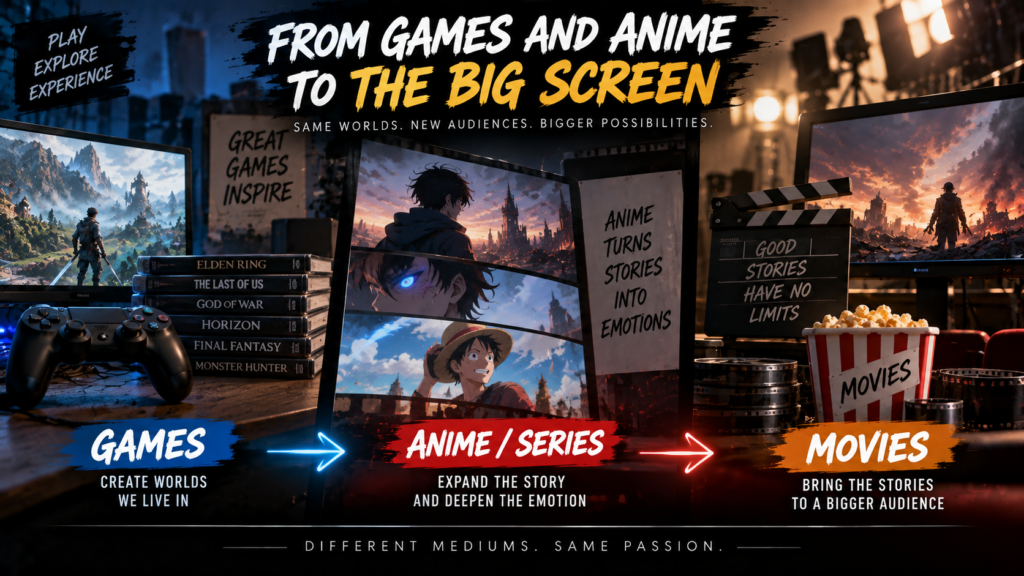
There isn’t just one formula for adapting a game or anime. Some projects closely follow the source material, while others use the original universe as a foundation for a completely new story.
🎮 Fallout: A New Story in a Familiar World
Rather than directly adapting one particular game, Fallout uses the franchise’s world, themes and visual identity to tell a new story.
This approach gives longtime players plenty of recognizable elements while allowing newcomers to follow the characters without knowing every detail of the games.
🌆 Arcane: Expanding an Existing Universe
Arcane took characters and lore connected to League of Legends and developed them into a detailed animated series.
Its success demonstrates how an adaptation can expand a game’s universe instead of simply recreating its gameplay or existing storylines.
🍄 The Super Mario Galaxy Movie: Bringing a Game World to a Wider Audience
The Super Mario franchise demonstrates another approach: taking an instantly recognizable game universe and building a cinematic adventure around its characters and worlds.
The challenge with adaptations like this is making the experience enjoyable for people who grew up playing the games while ensuring newcomers can enjoy the story without needing that background.
These examples show that game and anime adaptations don’t have to follow exactly the same formula. What matters is understanding the source material and choosing an adaptation style that suits the story.
What Filmmakers Can Learn From Modern Adaptations
The biggest lesson from recent adaptations is that faithfulness and creativity don’t have to compete with each other.
A filmmaker doesn’t need to reproduce every detail from a game or anime. Instead, the adaptation should understand what made the original memorable and protect those elements while using the strengths of film or television.
Three questions can help:
Does it feel like the original world?
The setting, tone and visual identity should give fans a sense of familiarity.
Do the characters still feel like themselves?
Their motivations and relationships should remain believable even when parts of the story change.
Does it work for someone discovering the franchise for the first time?
A good adaptation should stand on its own rather than requiring viewers to know everything beforehand.
When filmmakers can answer all three, they have a stronger foundation for creating an adaptation that works across different audiences.
And as more games and anime move toward movies and series, these principles will become increasingly important.
Frequently Asked Questions About Game and Anime Adaptations
Are game adaptations usually faithful to the original?
Not always. Some adaptations closely follow the original story, while others create new stories within the same universe. What matters is whether the changes preserve the important themes, characters and identity of the source material.
Why do some video game adaptations change the story?
Games and movies have very different storytelling formats. A game may take many hours to complete and can give players control over the experience, while a movie has limited running time. Filmmakers may therefore combine characters, shorten events or change the structure to make the story work on screen.
What makes an anime adaptation successful?
Strong storytelling, suitable animation or visual design, good character writing and respect for the original material all matter. The adaptation also needs to work for viewers who aren’t already familiar with the anime.
Is live action better than animation for adaptations?
Neither format is automatically better. Animation can preserve highly stylized designs and action, while live action can bring certain characters and settings into a more realistic environment. The best format depends on the story.
What game or anime should be adapted next?
There is no single answer. A good candidate would have a strong world, memorable characters and a story that can benefit from being expanded into film or television rather than simply copied from the original.
Will more games and anime become movies?
The growing popularity of these franchises has created more opportunities for adaptations across movies, television and animation. However, each project still depends on its creators, production plans and audience response.
Conclusion: The Next Great Adaptation Is Waiting
The best game and anime adaptations don’t succeed simply because the original franchise is popular. They succeed when filmmakers understand what made the source material special and know how to translate that experience into a different medium.
The three rules are straightforward:
Respect the lore while allowing room for creative storytelling.
Capture the visual identity instead of relying only on expensive effects.
Get the characters right and preserve the emotional heart of the original.
With gaming and anime reaching increasingly larger audiences, the possibilities for future adaptations are huge. The challenge will be making each new project feel like more than a familiar name placed on a movie poster.
What video game or anime do you think deserves a massive cinematic adaptation next? Let me know in the comments! 🎬🎮🔥