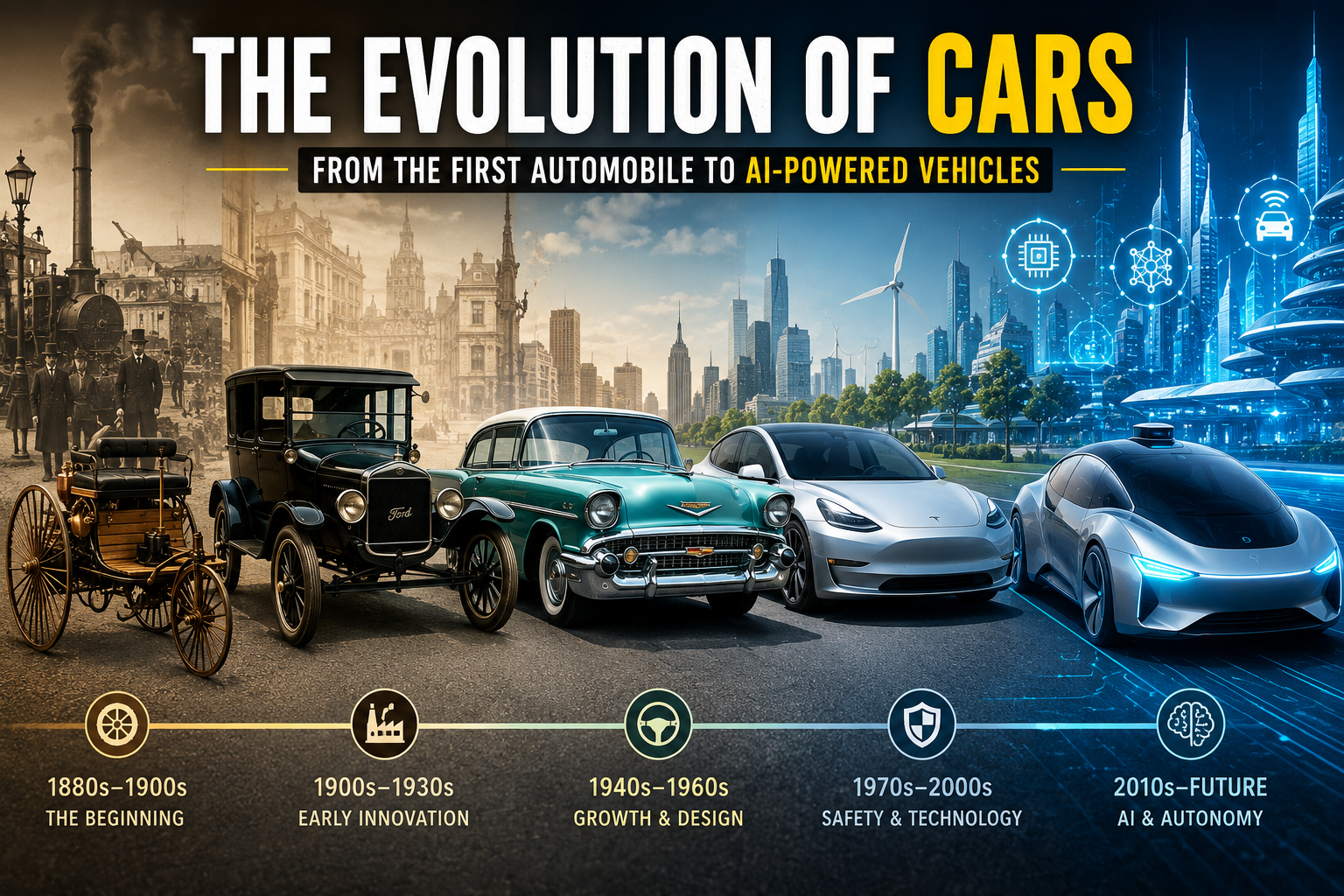
The Evolution of Cars: From the First Automobile to AI-Powered Vehicles
Introduction
The Evolution of Cars is one of the most remarkable stories of technological progress in modern history. In just over a century, automobiles have transformed from simple mechanical machines into intelligent vehicles equipped with computers, cameras, sensors, electric powertrains, and artificial intelligence.
Early automobiles were slow, expensive, and difficult to operate. They were considered experimental machines rather than practical forms of transportation. Today, cars can monitor road conditions, assist drivers during emergencies, calculate efficient routes, connect to digital services, and even perform some driving tasks automatically.
This transformation did not happen overnight. Generations of engineers, inventors, designers, and manufacturers introduced innovations that gradually changed the automobile industry. Mass production made cars more affordable, safety technologies reduced risks, electronic systems improved performance, and electric vehicles opened a new chapter in transportation.
Now, artificial intelligence is beginning to reshape the relationship between humans and vehicles. Modern cars can analyse information from multiple sensors and provide intelligent assistance in real time.
Understanding the Evolution of Cars helps us see how transportation has changed society, cities, industries, and everyday life. From the Benz Patent-Motorwagen to electric and AI-powered vehicles, the history of the automobile is a fascinating journey of invention and constant improvement.
Before the Modern Automobile
Long before cars appeared on roads, humans relied mainly on walking, animals, carts, and carriages for land transportation. Horses played an especially important role in travel, agriculture, and trade for centuries.
However, animal-powered transportation had several limitations. Long journeys took considerable time, carrying capacity was restricted, and growing cities needed more efficient transportation systems.
Inventors began experimenting with self-propelled vehicles. During the 18th and 19th centuries, several engineers developed steam-powered road vehicles. These machines demonstrated that mechanical power could move a vehicle without animals.
Steam technology had already transformed factories and railways, but using it in a small road vehicle was difficult. Steam engines could be heavy, required time to build pressure, and needed fuel and water.
Despite these problems, early experiments played an important role in the Evolution of Cars. They proved that self-powered road transportation was possible and encouraged inventors to search for smaller, more practical engines.
The development of the internal combustion engine eventually provided a major breakthrough.
The First Practical Automobile and Karl Benz
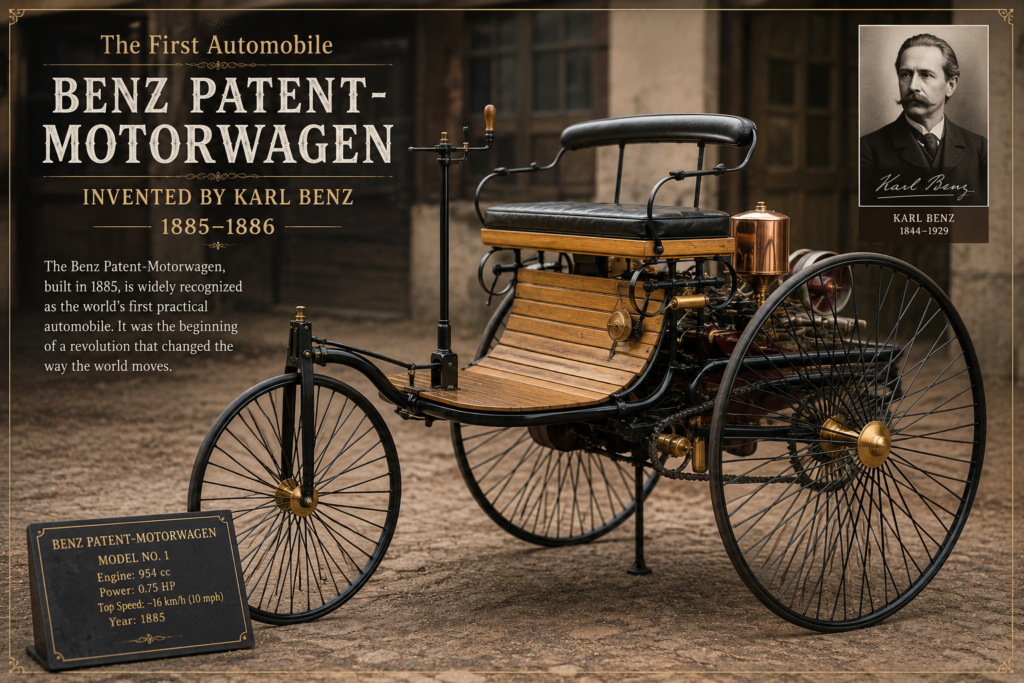
The history of the modern automobile changed dramatically in the 1880s. German engineer Karl Benz developed the Benz Patent-Motorwagen, widely recognized as the first practical automobile designed around an internal combustion engine.
Benz received a German patent for his vehicle in 1886, a year frequently used as an important starting point in automobile history.
The Patent-Motorwagen looked very different from modern cars. It had three wheels, a lightweight frame, and a single-cylinder engine. Its design was simple by today’s standards, but the idea behind it was revolutionary.
Instead of modifying a traditional horse carriage and simply attaching an engine, Benz created a vehicle specifically designed for motorized transportation.
One of the most famous events connected with the Patent-Motorwagen involved Bertha Benz. In 1888, she completed a pioneering long-distance journey in the vehicle. Her trip demonstrated that the automobile could be used for practical travel rather than remaining an engineering experiment.
The journey also revealed areas that required improvement. This showed an important principle that continues in the automobile industry today: real-world use helps engineers identify problems and improve technology.
The Benz Patent-Motorwagen became a defining milestone in the Evolution of Cars. The automobile age had begun.
Readers interested in the company’s historical account of the Patent-Motorwagen can explore the official https://www.mercedes-benz.com/en/ website.
Early Cars Were Expensive and Difficult to Own
The first automobiles were not designed for ordinary families. Early vehicles were expensive and often required considerable mechanical knowledge.
Road infrastructure was also poor in many regions. Roads originally built for pedestrians, horses, and carriages were not always suitable for motor vehicles.
Fuel availability created another challenge. Petrol stations were not yet common, and drivers could not simply stop at a modern fuel station during a journey.
Early cars also lacked many basic technologies that drivers now consider essential. There were no advanced braking systems, airbags, digital displays, navigation systems, or intelligent driving assistance features.
Vehicle reliability was another major concern. Mechanical failures could occur, and repairs often required specialised knowledge.
However, public interest in automobiles continued to grow. People quickly recognised the potential of personal motorized transportation.
Automobile manufacturers emerged in Europe and the United States. Competition encouraged engineers to develop more powerful engines, stronger vehicle structures, and improved control systems.
Cars were slowly changing from experimental inventions into commercial products.
Ford Model T and the Mass Production Revolution
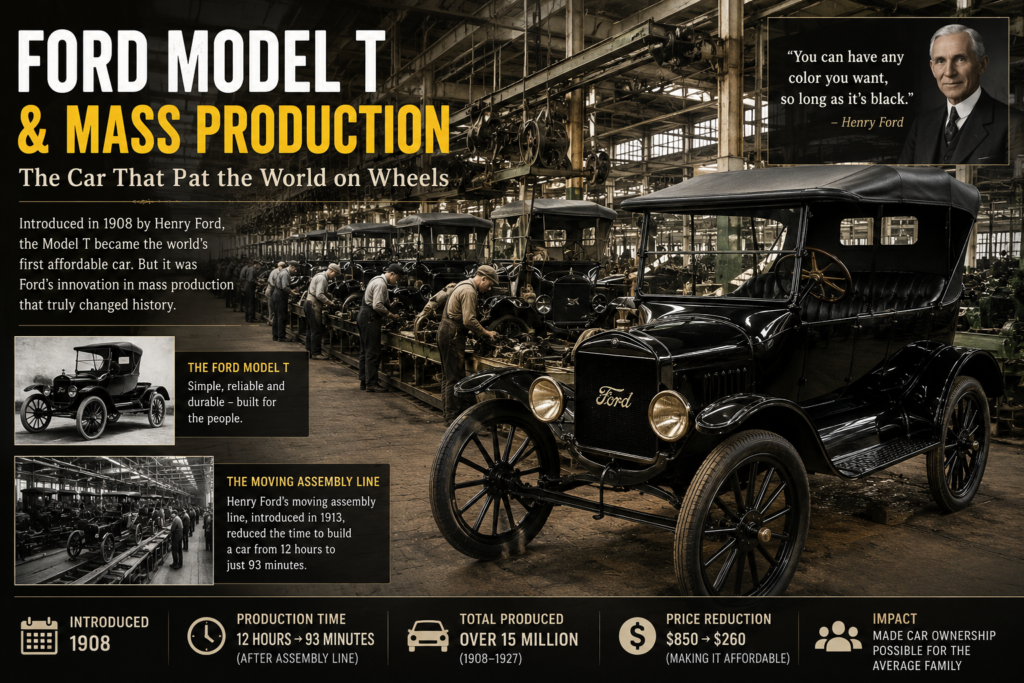
One of the greatest turning points in the Evolution of Cars came when automobiles became accessible to a much wider section of society.
The Ford Model T, introduced in 1908, played a major role in this transformation. It became famous for its relatively simple design, practicality, and large-scale production.
The development of moving assembly-line production at https://www.ford.com/?utm_source=chatgpt.com dramatically improved manufacturing efficiency. Instead of a small group of workers building an entire vehicle through a slower process, production tasks could be divided into organised stages.
Workers and machines performed specific tasks as vehicles moved through the manufacturing process.
This system reduced production time and helped lower costs. As manufacturing became more efficient, automobiles became affordable to more people.
The impact extended far beyond a single vehicle.
Other industries studied mass-production methods and adopted similar manufacturing principles. Factories became more organised, standardised components became increasingly important, and large-scale industrial production expanded.
The Model T also changed everyday life. People could travel farther for work, visit distant places, and transport goods more easily.
As car ownership increased, governments and businesses invested in roads, bridges, fuel stations, repair shops, and other automobile-related infrastructure.
The automobile was no longer simply a luxury machine for wealthy individuals. It was becoming an important part of modern society.
How Cars Changed Cities and Everyday Life
The rapid growth of automobile ownership transformed cities and communities.
Before cars became widespread, many people lived relatively close to workplaces, markets, and railway routes. Personal automobiles allowed individuals to travel greater distances more conveniently.
Suburban communities expanded as people gained the ability to commute between their homes and workplaces.
Road networks grew rapidly. Governments constructed highways and improved existing roads to support increasing traffic.
New industries also developed around the automobile. Fuel stations, repair garages, tyre manufacturers, insurance services, roadside businesses, and automobile dealerships became increasingly common.
Tourism changed as well. Families could plan road trips and explore destinations that were difficult to reach using traditional transportation.
However, growing automobile use also created new challenges. Traffic congestion, road accidents, air pollution, and dependence on fossil fuels became major concerns.
These problems would later encourage some of the most important safety and environmental innovations in automotive history.
Classic Cars and the Golden Age of Automobiles
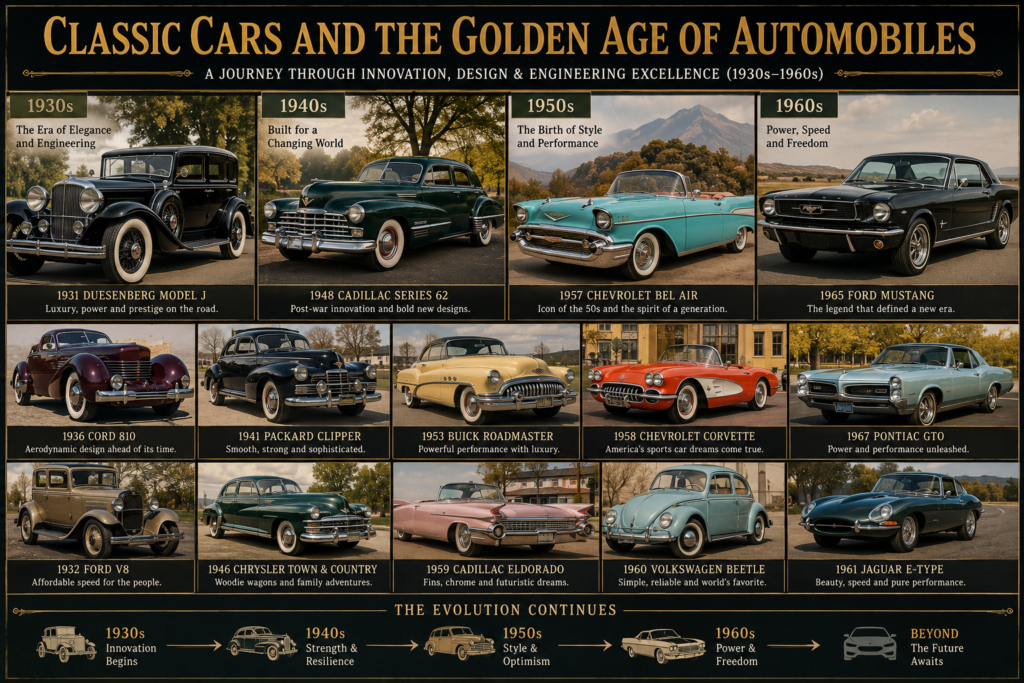
Between the 1930s and 1960s, automobile design experienced remarkable development. Cars became more than transportation machines; they increasingly represented style, technology, status, and personal identity.
Manufacturers experimented with body shapes, larger engines, improved interiors, and distinctive design elements.
During the 1930s, advances in aerodynamics began influencing vehicle design. Engineers recognised that the shape of a car could affect air resistance, performance, and efficiency.
The automobile industry was heavily affected by the Second World War. Many manufacturing facilities shifted their production towards military needs.
After the war, consumer demand for cars grew in several major markets. Economic expansion and improved manufacturing capabilities helped create a new era of automobile ownership.
The 1950s became especially famous for bold automotive designs. Chrome details, large body shapes, dramatic styling, and increasingly comfortable interiors appeared on many vehicles.
By the 1960s, performance cars and sports cars had become important parts of automobile culture. Manufacturers competed to create faster and more exciting vehicles.
Motorsport also influenced automotive engineering. Racing encouraged the development of better engines, braking systems, suspension technology, and aerodynamic designs.
Many innovations tested in demanding performance environments later influenced road vehicles.
This period remains an important chapter in the Evolution of Cars because automobile design became increasingly connected with culture and personal expression.
The Growth of Japanese Automobile Engineering
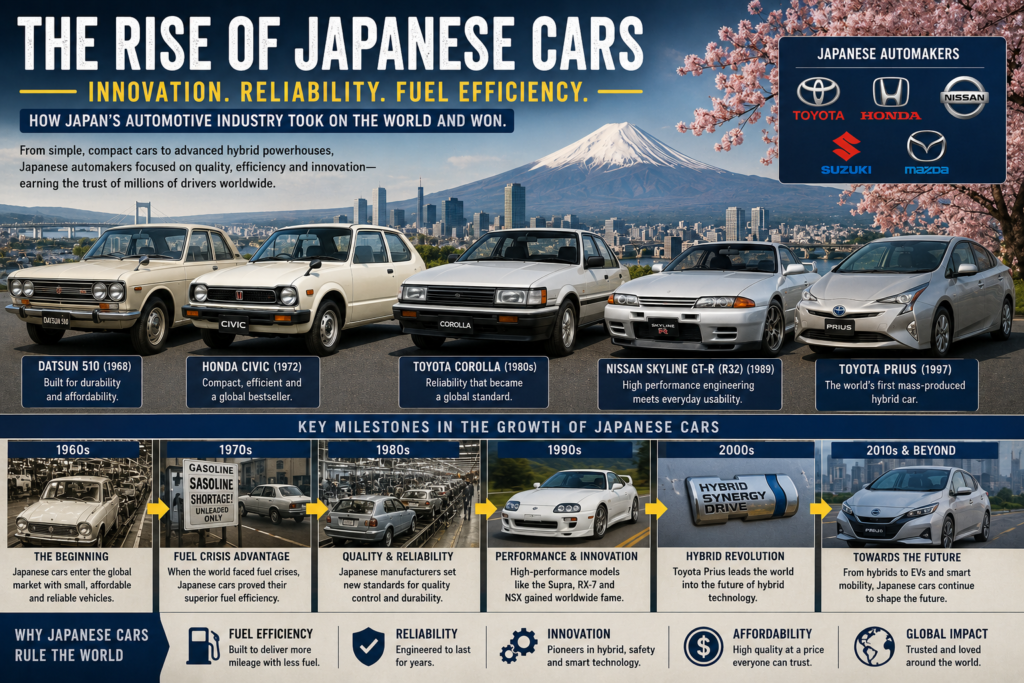
During the second half of the 20th century, Japanese automobile manufacturers became increasingly influential in the global car industry.
Japanese vehicles developed a strong reputation in many markets for reliability, practical engineering, and fuel efficiency.
Manufacturing efficiency was a major strength of the Japanese automotive industry. Companies focused heavily on quality control, reducing waste, and continuously improving production methods.
Fuel efficiency became particularly important during the oil crises of the 1970s. Rising fuel prices encouraged drivers to consider smaller and more economical vehicles.
This created major opportunities for Japanese manufacturers, whose compact and fuel-efficient cars attracted increasing international attention.
Japanese automotive engineering also contributed significantly to hybrid vehicle development. Combining an internal combustion engine with electric assistance demonstrated that cars could reduce fuel consumption while remaining practical for everyday use.
The rise of Japanese cars changed global competition. Automobile manufacturers worldwide were pushed to improve reliability, efficiency, manufacturing quality, and technology.
This competition accelerated the Evolution of Cars and encouraged constant innovation across the global automotive industry.
Cars Become Faster, More Comfortable, and More Advanced
As automobile technology improved, manufacturers focused on creating a better driving experience.
Power steering reduced the physical effort required to control vehicles. Automatic transmissions made driving easier for many people by reducing the need for manual gear changes.
Air conditioning improved comfort, especially in regions with hot climates. Better suspension systems created smoother journeys, while improved sound insulation reduced road and engine noise inside the cabin.
Car interiors also evolved dramatically.
Early automobiles had basic seating and simple controls. Modern vehicle interiors gradually introduced adjustable seats, entertainment systems, climate control, improved materials, and ergonomic dashboards.
Engine technology continued advancing as well. Fuel injection systems, electronic engine controls, and improved manufacturing techniques helped increase efficiency and performance.
However, one issue became increasingly important as cars became faster and more common: safety.
Road accidents demonstrated the need for technologies designed to protect drivers and passengers.
This concern would begin another major revolution in the history of automobiles—the evolution of car safety technology.
The Evolution of Car Safety Technology
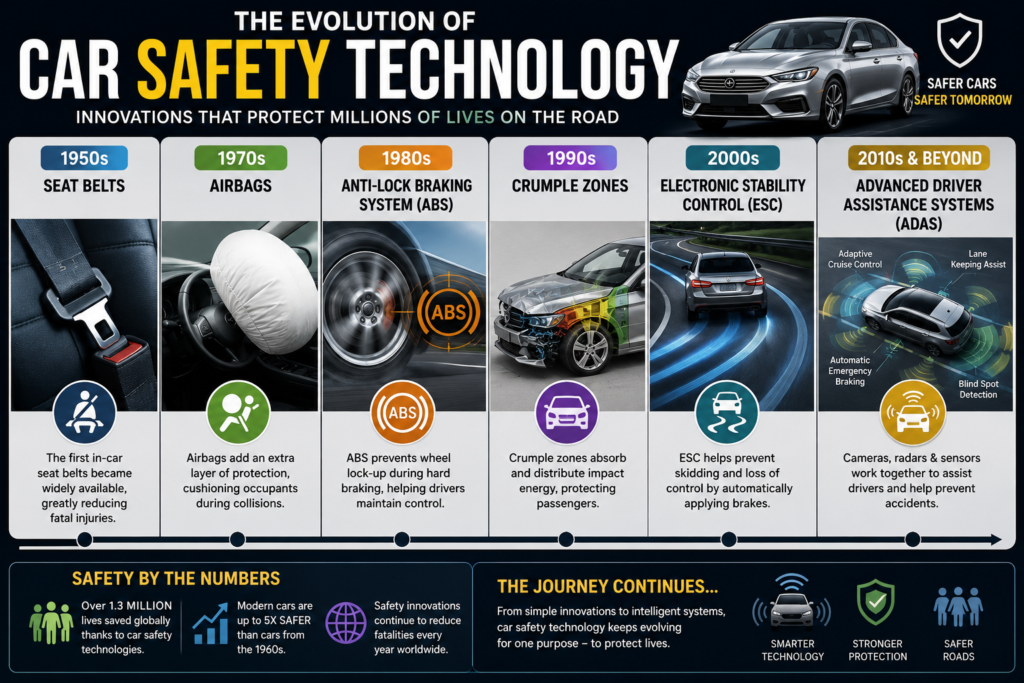
As automobiles became faster and more common, road safety emerged as one of the biggest challenges facing the automotive industry. Early cars offered very little protection during accidents. Vehicle bodies were not designed to absorb crash forces, and many basic safety technologies had not yet been invented.
Over time, engineers began studying how accidents affected vehicles and passengers. This research transformed automotive design and introduced technologies that have saved countless lives.
The development of modern safety systems represents one of the most important chapters in the Evolution of Cars.
Seat Belts: A Simple Innovation That Saved Lives
Seat belts became one of the most effective vehicle safety technologies ever developed. Early versions were basic lap belts, but the introduction of the three-point seat belt dramatically improved passenger protection.
A three-point seat belt secures the upper and lower body, helping distribute crash forces across stronger areas of the body. As governments introduced stronger safety regulations, seat belts became standard equipment in modern cars.
Today, cars also use seat belt reminders and pretensioner systems that improve protection during a collision.
The success of the seat belt demonstrated an important lesson: even relatively simple engineering solutions can have an enormous impact on road safety.
Crumple Zones and Safer Vehicle Structures
For many years, people believed that extremely rigid cars were automatically safer. However, engineers discovered that vehicles could better protect passengers by absorbing and managing crash energy.
This led to the development of crumple zones.
Crumple zones are sections of a vehicle designed to deform in a controlled manner during a collision. Instead of transferring the full impact directly to passengers, parts of the vehicle absorb some of the energy.
Meanwhile, the passenger compartment is designed to remain as strong as possible.
Modern vehicle structures use advanced materials and computer-designed crash structures to improve passenger protection. Engineers conduct physical crash tests and digital simulations to understand how vehicles respond to different types of accidents.
These developments completely changed the way cars were designed.
Airbags Add Another Layer of Protection
Airbags became another major safety innovation.
During a serious collision, sensors can detect rapid changes in vehicle movement and activate airbags within a very short period. The airbags provide additional cushioning for occupants and work together with seat belts.
Modern vehicles may contain multiple airbags placed around the cabin. Depending on the model, these can include front airbags, side airbags, and curtain airbags.
However, airbags are designed to support seat belt protection rather than replace it.
The combination of stronger vehicle structures, seat belts, and airbags significantly improved crash safety compared with early automobiles.
ABS and Electronic Safety Systems
Braking technology also evolved dramatically.
Traditional brakes could lock the wheels during emergency braking, potentially reducing steering control. The Anti-lock Braking System, commonly known as ABS, was developed to help prevent wheel lock under hard braking.
ABS rapidly adjusts braking pressure, helping the driver maintain better control of the vehicle.
Electronic Stability Control later added another layer of safety. This technology can detect when a vehicle begins moving differently from the driver’s intended direction and selectively apply braking to individual wheels.
Traction control systems also help reduce excessive wheel spin.
These technologies marked an important transition in the Evolution of Cars. Safety was no longer based only on mechanical components. Electronic systems were beginning to actively assist drivers.
The Digital Revolution in Cars
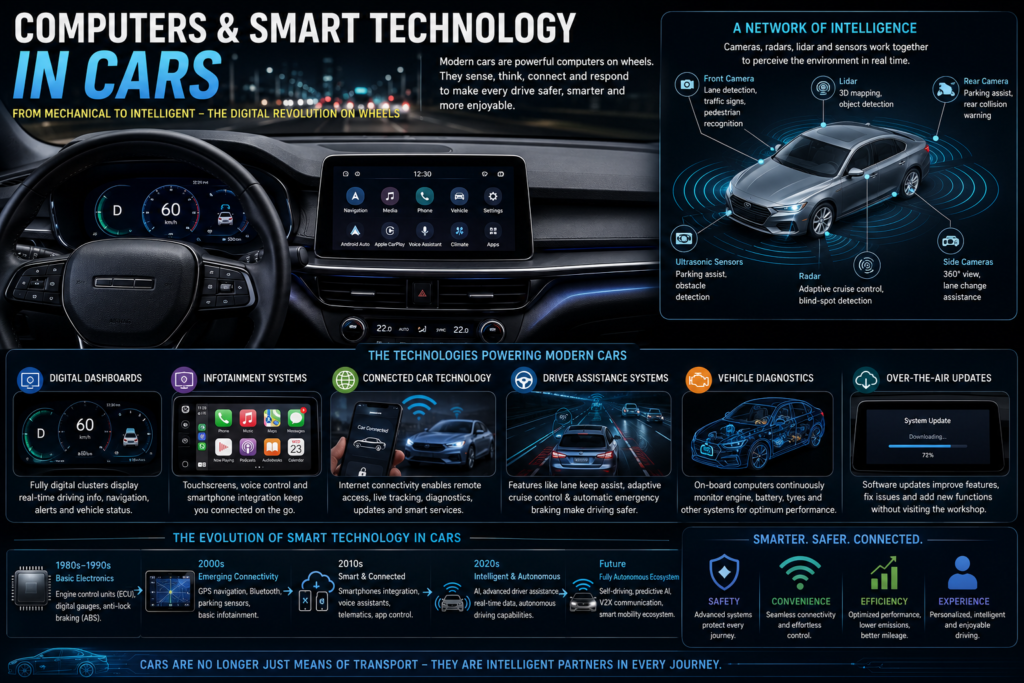
For much of automotive history, cars were primarily mechanical machines. Engines, transmissions, brakes, and steering systems relied heavily on mechanical components.
The arrival of electronic control systems changed everything.
Automakers began introducing computers known as electronic control units, or ECUs, to manage different vehicle functions. These computers could process information from sensors and make rapid adjustments.
Engine control became more precise. Computers could analyse factors such as engine temperature, airflow, and operating conditions to manage performance.
Electronic systems helped improve fuel efficiency, reduce emissions, and diagnose certain mechanical problems.
As technology advanced, the number of electronic systems inside vehicles increased dramatically.
Modern cars can use multiple computers to control the engine, transmission, safety systems, climate control, infotainment, and driver assistance technologies.
The car was gradually transforming from a mechanical machine into a complex digital system.
Computers and Smart Technology in Cars
Digital technology changed the driving experience inside the cabin as well.
Traditional analogue gauges were gradually joined or replaced by digital displays. Modern dashboards can show navigation instructions, vehicle information, safety alerts, and driving data.
Touchscreen infotainment systems have become common in many cars. Drivers can access navigation, music, phone connectivity, and vehicle settings through a central display.
Smartphone integration has further connected vehicles with the digital world. Drivers can access selected mobile functions using systems designed for vehicle use.
Cars have also become increasingly dependent on sensors.
Modern vehicles may use cameras, radar, ultrasonic sensors, and other technologies to observe the surrounding environment.
These systems can detect nearby vehicles, road markings, obstacles, and parking spaces.
The data collected by sensors supports a growing range of intelligent features.
Advanced Driver Assistance Systems
Advanced Driver Assistance Systems, commonly called ADAS, represent a major step toward intelligent vehicles.
ADAS technologies are designed to support drivers and reduce certain risks on the road.
One common feature is automatic emergency braking. Sensors monitor the road ahead and may warn the driver if a possible collision is detected. In certain situations, the system can automatically apply the brakes.
Lane departure warning can detect when a vehicle begins leaving its lane without an expected steering input or indicator signal.
Lane-keeping assistance may provide steering support to help keep the vehicle within its lane.
Adaptive cruise control is another important technology. Unlike traditional cruise control, which maintains a selected speed, adaptive systems can use sensors to monitor traffic ahead and adjust vehicle speed.
Blind-spot monitoring can alert drivers when another vehicle is detected in an area that may be difficult to see using mirrors.
Parking sensors and cameras have also made parking easier and safer.
The development of ADAS is a major milestone in the Evolution of Cars because vehicles are beginning to understand parts of their surroundings and assist drivers in real time.
However, driver assistance should not automatically be confused with fully autonomous driving. Many systems still require the driver to remain attentive and responsible for controlling the vehicle.
Connected Cars and the Internet
The growth of internet connectivity introduced another major change in automobile technology.
Connected cars can communicate with online services and, in some cases, mobile applications. This allows vehicles to access digital information and provide remote features.
Depending on the vehicle, drivers may be able to check certain car information using a smartphone application. Some systems can provide vehicle location, charging status for electric cars, or maintenance information.
Navigation systems can also use live information to identify traffic congestion and calculate alternative routes.
Software updates are becoming increasingly important. Some modern vehicles can receive certain updates remotely, reducing the need for every software improvement to be installed manually at a service centre.
Connectivity also creates opportunities for future communication between vehicles and infrastructure.
Vehicle-to-everything technology, often shortened to V2X, is being developed to allow vehicles to exchange information with other cars, roads, and traffic systems.
For example, future connected vehicles could potentially receive information about road hazards or changing traffic conditions.
However, increasing connectivity also introduces new challenges. Cybersecurity and data privacy have become important areas of automotive engineering.
As cars become more digital, manufacturers must protect vehicle systems against unauthorised access and software vulnerabilities.
Environmental Problems and the Search for Cleaner Cars
The automobile transformed human transportation, but widespread car use also created environmental challenges.
For decades, most cars depended on petrol or diesel engines. These vehicles burn fossil fuels and produce exhaust emissions.
As millions of automobiles appeared on roads worldwide, air pollution became a serious concern in many cities.
Governments introduced stricter emission standards, encouraging manufacturers to develop cleaner and more efficient engines.
Technologies such as catalytic converters helped reduce certain harmful pollutants from vehicle exhaust.
Engine efficiency also improved through better fuel injection, electronic control systems, turbocharging, and improved vehicle design.
Manufacturers explored alternative fuels and hybrid powertrains.
However, growing concerns about climate change and fossil fuel dependence increased interest in a more dramatic technological shift: electric vehicles.
The Electric Vehicle Revolution
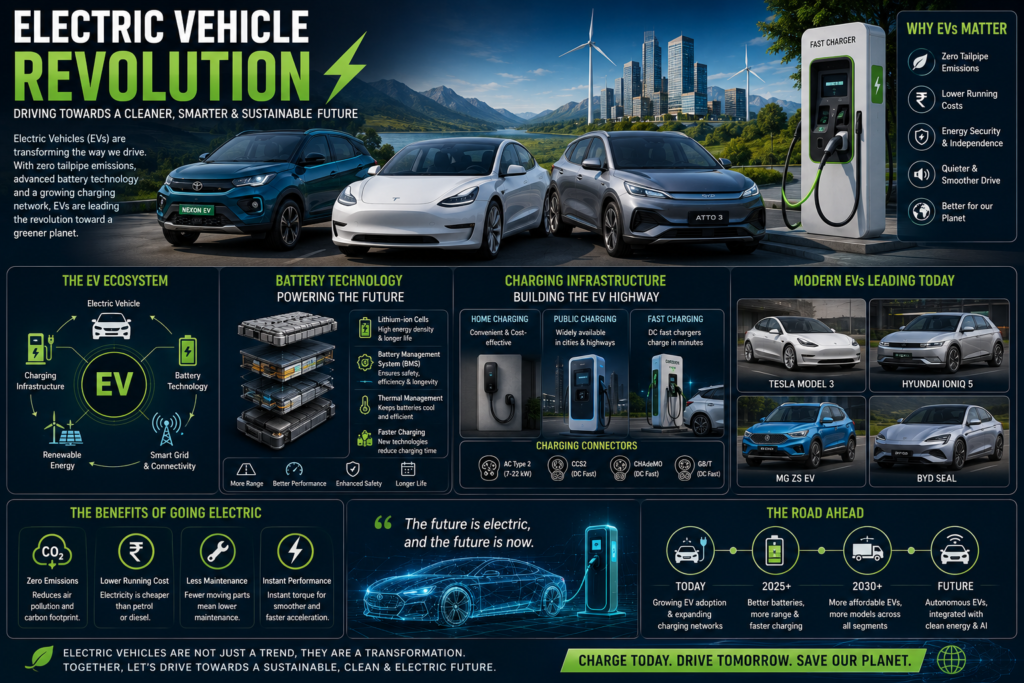
Electric cars are not a completely new invention. Electric vehicles existed during the early history of automobiles and competed with steam and petrol-powered vehicles.
However, limitations in battery technology restricted their practical use.
Internal combustion engine cars eventually became dominant because fuel offered convenient energy storage and growing fuel infrastructure made long-distance travel easier.
More than a century later, electric vehicles returned to the centre of automotive innovation.
The development of advanced lithium-ion batteries significantly improved electric vehicle performance. Modern batteries can store more energy than many earlier battery technologies, allowing EVs to travel greater distances.
Electric motors also offer several advantages.
Unlike internal combustion engines, electric motors can deliver power quickly and operate with fewer major moving components in the powertrain.
Electric vehicles produce no tailpipe emissions while driving. Their overall environmental impact still depends on factors including electricity generation, battery manufacturing, and the vehicle’s complete life cycle.
Nevertheless, EVs have become an important part of global efforts to reduce transport-related emissions.
Major manufacturers have expanded their electric vehicle programmes, while governments in many regions have supported charging infrastructure and cleaner transportation policies.
Companies such as Tesla helped increase public attention around modern electric cars, while established automakers have rapidly expanded their own EV strategies.
The electric vehicle revolution represents one of the largest transformations in the Evolution of Cars since the rise of mass production.
Battery Technology: The Heart of Electric Cars
The battery is one of the most important components of an electric vehicle.
An EV battery stores electrical energy that powers one or more electric motors. Battery capacity influences driving range, while charging technology affects how quickly the vehicle can regain energy.
Engineers are constantly working to improve battery energy density, charging speed, durability, safety, and cost.
Battery management systems monitor factors such as temperature and battery condition. Thermal management is particularly important because batteries perform best within suitable temperature ranges.
Fast-charging technology has also improved. High-power charging stations can add significant driving range during longer journeys, although charging speed varies depending on the vehicle, battery, charger, and conditions.
Researchers are also developing new battery technologies.
Solid-state batteries have attracted significant interest because they may offer advantages in energy density and safety. However, large-scale production and affordability remain major challenges.
Battery recycling is another important area. As EV adoption grows, recovering valuable materials from used batteries could reduce waste and support a more circular battery industry.
The Growth of EV Charging Infrastructure
Electric vehicles require a reliable charging network.
Many EV owners charge their vehicles at home, particularly overnight. Home charging can be convenient for drivers who have access to suitable parking and electrical infrastructure.
Public chargers are important for apartment residents, urban drivers, and long-distance travel.
Charging stations are increasingly appearing at highways, shopping centres, offices, and public parking areas.
Fast-charging networks are especially important for road trips because they can reduce the time required to continue a journey.
However, charging infrastructure remains uneven across different countries and regions.
Some areas have extensive charging networks, while others are still developing basic infrastructure.
The future growth of electric vehicles will depend partly on making charging reliable, accessible, and convenient.
Smart charging technology could also help manage electricity demand. Vehicles may charge when electricity demand is lower or when renewable energy availability is higher.
In the future, some electric cars may even support vehicle-to-grid systems that allow stored battery energy to interact with the electricity network.
Hybrid Cars: A Bridge Between Two Eras
Hybrid vehicles played an important role between traditional internal combustion cars and fully electric vehicles.
A hybrid vehicle combines an internal combustion engine with an electric motor and battery.
Different types of hybrid systems operate in different ways. Some use electric assistance mainly to improve efficiency, while plug-in hybrids can travel a certain distance using external electrical charging before relying more heavily on the engine.
Hybrid technology demonstrated that electrification could improve fuel efficiency without completely removing the internal combustion engine.
The Toyota Prius became one of the most widely recognised examples of hybrid vehicle technology.
Hybrids helped familiarise millions of drivers with electric motors, regenerative braking, and battery-assisted transportation.
They remain an important part of the broader Evolution of Cars, especially in markets where full EV charging infrastructure is still developing.
From Electric Cars to Intelligent Cars
The electric vehicle revolution changed how cars are powered. At the same time, digital technology was changing how cars understand the world.
Modern vehicles increasingly combine powerful computers with cameras, radar, and advanced software.
These technologies created the foundation for autonomous driving research.
Instead of simply reacting to a driver’s physical controls, future vehicles could analyse their surroundings and make certain driving decisions using computer systems.
This idea led engineers and technology companies to explore one of the most ambitious goals in automotive history: the self-driving car.
Self-Driving and Autonomous Cars
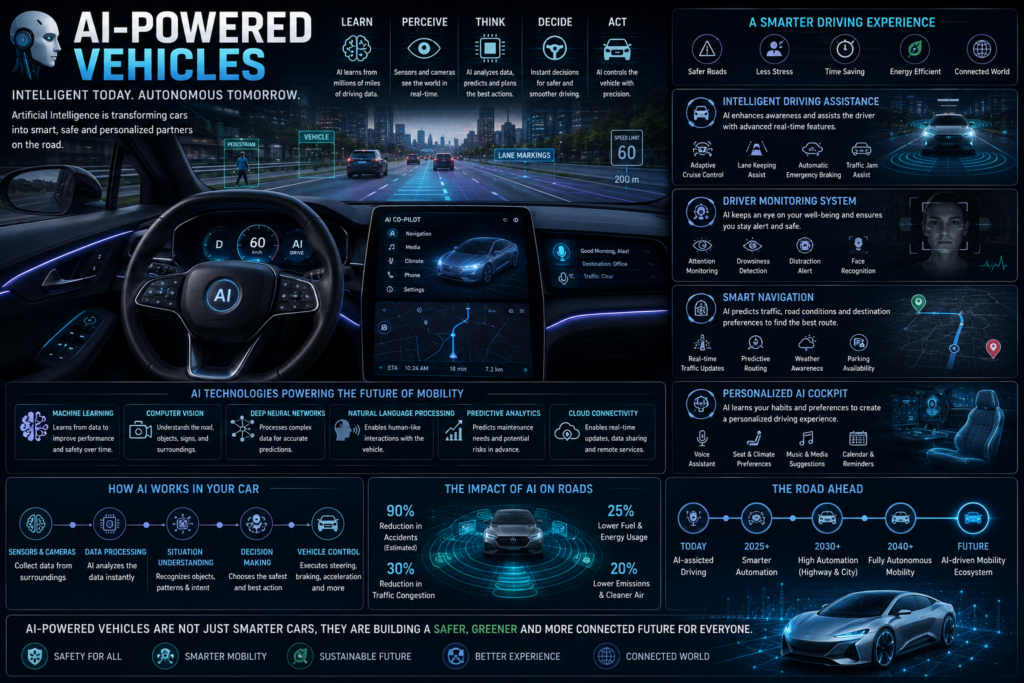
The idea of a car driving itself once belonged mainly to science fiction. Today, autonomous driving technology has become an important field of automotive research and development.
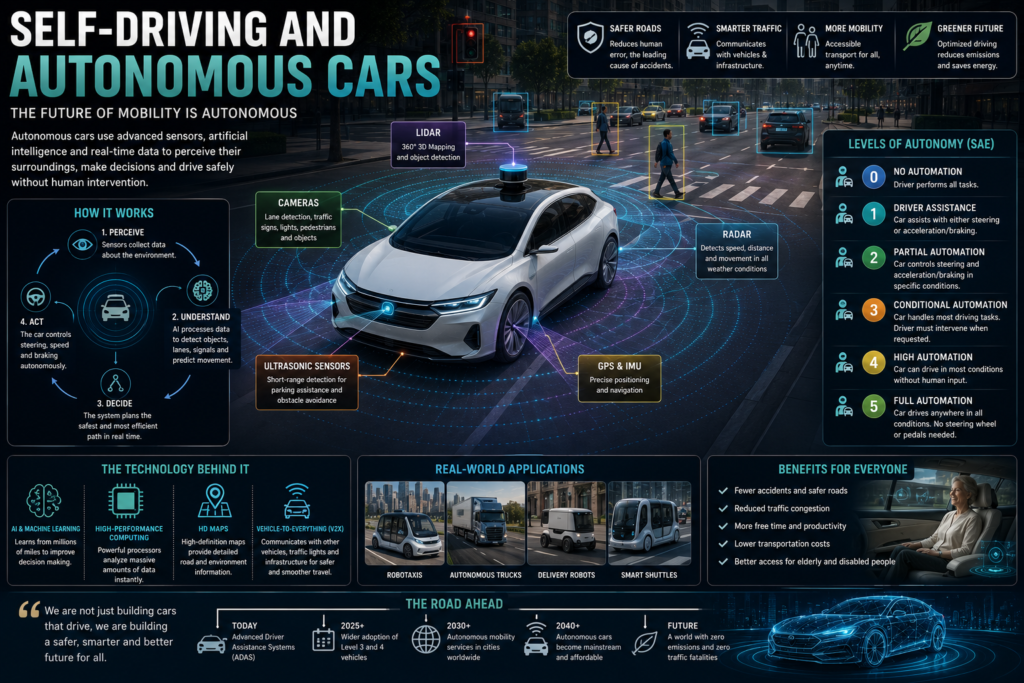
Self-driving vehicles use a combination of sensors, cameras, radar, powerful computers, and software to understand their surroundings. These systems analyse road conditions, detect nearby vehicles, recognise certain objects, and calculate possible driving actions.
The development of autonomous cars represents a major stage in the Evolution of Cars. For most of automobile history, the driver was responsible for every action. Steering, braking, acceleration, and navigation depended entirely on human control.
Modern driver assistance systems have started changing this relationship. Cars can already assist with selected driving tasks under specific conditions.
However, creating a vehicle capable of safely driving everywhere without human involvement is extremely difficult. Roads are unpredictable. Pedestrians, cyclists, animals, weather, construction zones, and unusual traffic situations create challenges that autonomous systems must understand.
For this reason, engineers continue to test and improve self-driving technology.
Levels of Driving Automation
Not every vehicle described as “automated” is fully self-driving. Driving automation is generally divided into different levels based on how much control the vehicle can perform.
Level 0 – No Driving Automation: The human driver controls the vehicle, although warning systems may provide alerts.
Level 1 – Driver Assistance: The vehicle can assist with one aspect of driving, such as steering or speed control.
Level 2 – Partial Driving Automation: The vehicle can assist with steering and acceleration or braking at the same time under certain conditions. The driver must remain responsible and attentive.
Level 3 – Conditional Driving Automation: The automated system can perform driving tasks under defined conditions, but a human may need to take control when requested.
Level 4 – High Driving Automation: The vehicle can drive without human control within specific operating areas or conditions.
Level 5 – Full Driving Automation: The vehicle would theoretically perform all driving tasks under all conditions without requiring a human driver.
Most consumer vehicles with advanced assistance technologies should not be treated as fully autonomous. Understanding these differences is important because drivers must know the limitations of the systems in their vehicles.
How Autonomous Cars Understand the Road
Human drivers use their eyes, ears, experience, and judgement to understand traffic. Autonomous vehicles attempt to build an understanding of the road using multiple technologies.
Cameras provide visual information about road markings, traffic lights, signs, vehicles, and other objects.
Radar can help measure the distance and relative movement of objects. It is widely used in features such as adaptive cruise control and collision warning systems.
LiDAR uses laser pulses to measure distances and create detailed representations of the surrounding environment. It has become an important technology in many autonomous vehicle research projects.
Ultrasonic sensors are commonly used for short-distance detection, particularly during parking.
A vehicle’s computer combines information from these systems. This process is often called sensor fusion.
The goal is to create a more accurate understanding of the environment than relying on a single sensor alone.
Once the system understands the surroundings, software must predict possible movements and decide how the vehicle should respond.
This requires enormous computing power and sophisticated algorithms.
Artificial Intelligence Enters the Automobile
Artificial intelligence is opening another chapter in the Evolution of Cars.
AI systems can analyse large amounts of information and identify patterns. In vehicles, artificial intelligence can support driver assistance, navigation, voice interaction, vehicle monitoring, and other intelligent functions.
For example, an AI-based system may analyse information from cameras and sensors to help identify objects around a vehicle.
Navigation systems can consider traffic conditions and recommend efficient routes. Intelligent software may also learn certain user preferences and personalise selected vehicle settings.
Artificial intelligence is increasingly being integrated into the digital cockpit. Drivers can interact with some vehicle functions using natural voice commands rather than navigating complex menus.
The goal is not simply to make cars more technologically impressive. AI has the potential to make vehicle systems more responsive, personalised, and easier to use.
AI-Powered Driver Monitoring
One important use of artificial intelligence is driver monitoring.
A driver monitoring system may use an interior camera and software to analyse signs of reduced attention. Depending on the system, it can provide warnings when it detects that a driver may not be watching the road appropriately.
Some systems can also monitor signs associated with tiredness or unusual driving behaviour.
This technology is particularly important as advanced driver assistance systems become more capable. Drivers may become overconfident and incorrectly assume that an assisted vehicle can drive completely independently.
Driver monitoring can help ensure that the person behind the wheel remains engaged when required.
In the future, intelligent vehicle systems may become even more capable of adapting assistance based on driving conditions and the driver’s level of attention.
Smart Navigation and Predictive Technology
Navigation has changed dramatically during the Evolution of Cars.
Early drivers depended on printed maps, road signs, and personal knowledge. Later, satellite navigation systems introduced digital route guidance.
Modern connected navigation can use traffic information to identify congestion and suggest alternative routes.
Artificial intelligence could make navigation increasingly predictive.
Instead of simply calculating the shortest route, intelligent systems may consider traffic, weather, charging requirements, and driving preferences.
For electric vehicles, smart route planning is particularly valuable. The system can identify charging stations and include charging stops during long journeys.
Future vehicles may combine navigation information with road sensors and connected infrastructure. A car could potentially receive warnings about hazards before the driver can see them.
The evolution from paper maps to intelligent navigation demonstrates how rapidly automobile technology has changed.
The Intelligent Car Cockpit
The interior of a car is becoming a digital environment.
Traditional dashboards contained mechanical gauges, switches, and basic controls. Modern cars increasingly use digital instrument displays, large touchscreens, head-up displays, and connected infotainment systems.
AI could make the cockpit more personalised.
A vehicle may recognise a driver’s profile and automatically adjust selected settings such as seat position, climate preferences, and frequently used functions.
Voice assistants may allow drivers to control navigation, climate systems, and entertainment without repeatedly touching a screen.
However, automobile designers face an important challenge. More technology does not always mean a safer or easier driving experience.
Complex menus and distracting screens can make simple tasks difficult. Future intelligent cockpits must balance advanced features with clear and safe controls.
The best automotive technology should support the driver rather than create unnecessary distraction.
The Evolution of Cars Timeline
The history of the automobile can be understood through several major technological eras:
1886 – The Early Automobile Era: The Benz Patent-Motorwagen became a defining milestone in the development of the practical motor car.
1900s–1920s – Mass Production: Assembly-line manufacturing and vehicles such as the Ford Model T helped expand car ownership.
1930s–1960s – Classic Automobile Era: Styling, performance, comfort, and automobile culture developed rapidly.
1950s–1990s – Safety Revolution: Seat belts, crumple zones, airbags, ABS, and stronger safety standards transformed vehicle protection.
1980s–2000s – Digital Cars: Electronic control units, sensors, fuel injection, and digital systems became increasingly important.
2000s–Present – Electrification: Hybrid and electric vehicles gained global attention as battery technology improved.
2010s–Present – Advanced Automation: Cameras, radar, ADAS, and autonomous driving research expanded.
The Emerging AI Era: Artificial intelligence is increasingly supporting intelligent assistance, driver monitoring, navigation, and personalised vehicle experiences.
This timeline shows that the Evolution of Cars has never stopped. Each generation of automobiles builds upon discoveries and technologies developed during earlier periods.
The Future of Cars
The automobile of the future may be very different from the vehicles people drive today.
Electric powertrains are expected to remain an important area of development. Engineers will continue working on battery range, charging speed, durability, and affordability.
Autonomous driving research will also continue. Fully driverless vehicles may first become more common in controlled environments or defined operating areas before becoming practical everywhere.
Vehicle connectivity could transform traffic management. Connected cars may exchange information with road infrastructure and other vehicles, helping transportation systems respond more efficiently to congestion and hazards.
Artificial intelligence will likely become more deeply integrated into vehicles. Intelligent assistants may understand more natural commands, while predictive systems could identify maintenance requirements before a major failure occurs.
Cars may also become increasingly software-defined. In these vehicles, software plays a central role in controlling functions and introducing improvements.
The future of automobiles will be shaped by a combination of electrification, automation, connectivity, and artificial intelligence.
Challenges Facing AI and Autonomous Vehicles
Despite rapid progress, AI-powered and autonomous vehicles face major challenges.
Safety is the most important concern. Autonomous systems must respond reliably to complex and unexpected road situations.
Weather can create difficulties for sensors. Heavy rain, fog, snow, and poor visibility may affect how systems understand their surroundings.
Road infrastructure also varies significantly between regions. A technology that performs well on clearly marked highways may face greater difficulty on crowded roads with inconsistent markings.
Cybersecurity is another major issue. As vehicles become connected computers on wheels, protecting software and communication systems becomes increasingly important.
Cost may also slow adoption. Advanced sensors, computing hardware, and research can be expensive.
Legal and ethical questions remain as well. Governments must determine how autonomous vehicles should be regulated and how responsibility should be handled when automated systems are involved in accidents.
These challenges show that the future of cars will require cooperation between automakers, technology companies, governments, researchers, and road safety experts.
How the Evolution of Cars Changed Society
The Evolution of Cars has changed far more than transportation.
Automobiles influenced the design of cities and encouraged the development of highways and suburban communities. They created enormous industries involving manufacturing, fuel, insurance, maintenance, logistics, and tourism.
Cars also changed personal freedom. People gained the ability to travel independently over greater distances.
Emergency services, delivery networks, businesses, and public infrastructure became increasingly dependent on road vehicles.
At the same time, automobile growth created serious problems, including congestion, road accidents, pollution, and environmental concerns.
The history of cars demonstrates that major technologies often create both opportunities and challenges.
The next generation of vehicles must therefore focus not only on speed and convenience but also on safety, efficiency, accessibility, and sustainability.
What Can We Learn From the Evolution of Cars?
The history of automobiles teaches us that innovation is usually a gradual process.
Karl Benz did not create an AI-powered electric vehicle in 1886. The Patent-Motorwagen provided an important foundation. Later inventors and engineers improved engines, manufacturing, safety, electronics, batteries, and software.
Mass production demonstrated the importance of efficient manufacturing.
The safety revolution showed that technology should protect human life.
Japanese automotive growth highlighted the value of reliability, efficiency, and continuous improvement.
Electric vehicles demonstrated how new technology can return after decades when supporting technology becomes more capable.
Artificial intelligence now shows how cars may continue evolving beyond traditional mechanical engineering.
Every major stage in the Evolution of Cars was built upon previous innovations.
Frequently Asked Questions
Who invented the first automobile?
Karl Benz is widely credited with developing the first practical automobile powered by an internal combustion engine. His Benz Patent-Motorwagen was patented in 1886.
When did cars become affordable for ordinary people?
Cars became more accessible during the early 20th century as mass-production techniques improved. The Ford Model T played a major role in expanding automobile ownership.
How did car safety technology evolve?
Vehicle safety improved through innovations such as seat belts, crumple zones, airbags, ABS, electronic stability control, and modern advanced driver assistance systems.
Are electric cars a new invention?
No. Electric vehicles existed during the early automobile era. However, modern battery technology has made EVs far more practical and capable.Evolution of Cars.
Are modern cars fully self-driving?
Many modern vehicles offer advanced driver assistance, but driver assistance is not automatically the same as full autonomy. The capabilities and limitations depend on the specific system.
How is AI used in cars?
Artificial intelligence can support object detection, driver monitoring, intelligent assistance, navigation, voice interaction, and personalised vehicle functions.Evolution of Cars is done.
What will cars look like in the future?
Future cars are likely to become more electric, connected, software-based, and intelligent. Autonomous technology may also expand as safety and technical challenges are addressed.Evolution of Cars
Conclusion
The Evolution of Cars is a remarkable journey from simple mechanical inventions to advanced vehicles powered by electricity, software, sensors, and artificial intelligence.
The Benz Patent-Motorwagen demonstrated that practical motorised road transportation was possible. Mass production helped bring automobiles to millions of people. Classic cars transformed vehicles into symbols of culture and design, while Japanese engineering increased global competition around reliability and efficiency.
Safety innovations such as seat belts, crumple zones, airbags, and electronic systems helped make modern vehicles far more protective than early automobiles.
Computers then transformed cars into digital machines. Sensors and advanced driver assistance systems gave vehicles the ability to observe parts of their surroundings and support drivers.
The electric vehicle revolution is changing how cars are powered, while autonomous driving research is exploring how much of the driving task machines may eventually perform.
Now, artificial intelligence is introducing intelligent cockpits, driver monitoring, smarter navigation, and increasingly sophisticated vehicle software.
The story is far from over.
The next stage in the Evolution of Cars may bring technologies that seem futuristic today. However, history shows that the automobile has always changed through constant experimentation and improvement.Evolution of Cars
From the first automobile to AI-powered vehicles, cars reflect humanity’s desire to move farther, travel more efficiently, and use technology to solve new challenges. The road ahead remains uncertain, but one thing is clear: the evolution of the automobile will continue.Evolution of Cars.
Explore more
The Evolution of Cars has also influenced the rise of modern automatic vehicles and future automotive technologies Evolution of Cars. To understand how driving is becoming easier and more convenient, read our guide on Automatic Cars in 2026 https://itshk.in/top-10-upcoming-cars-in-india-2026/ and explore more automobile content on https://itshk.in/