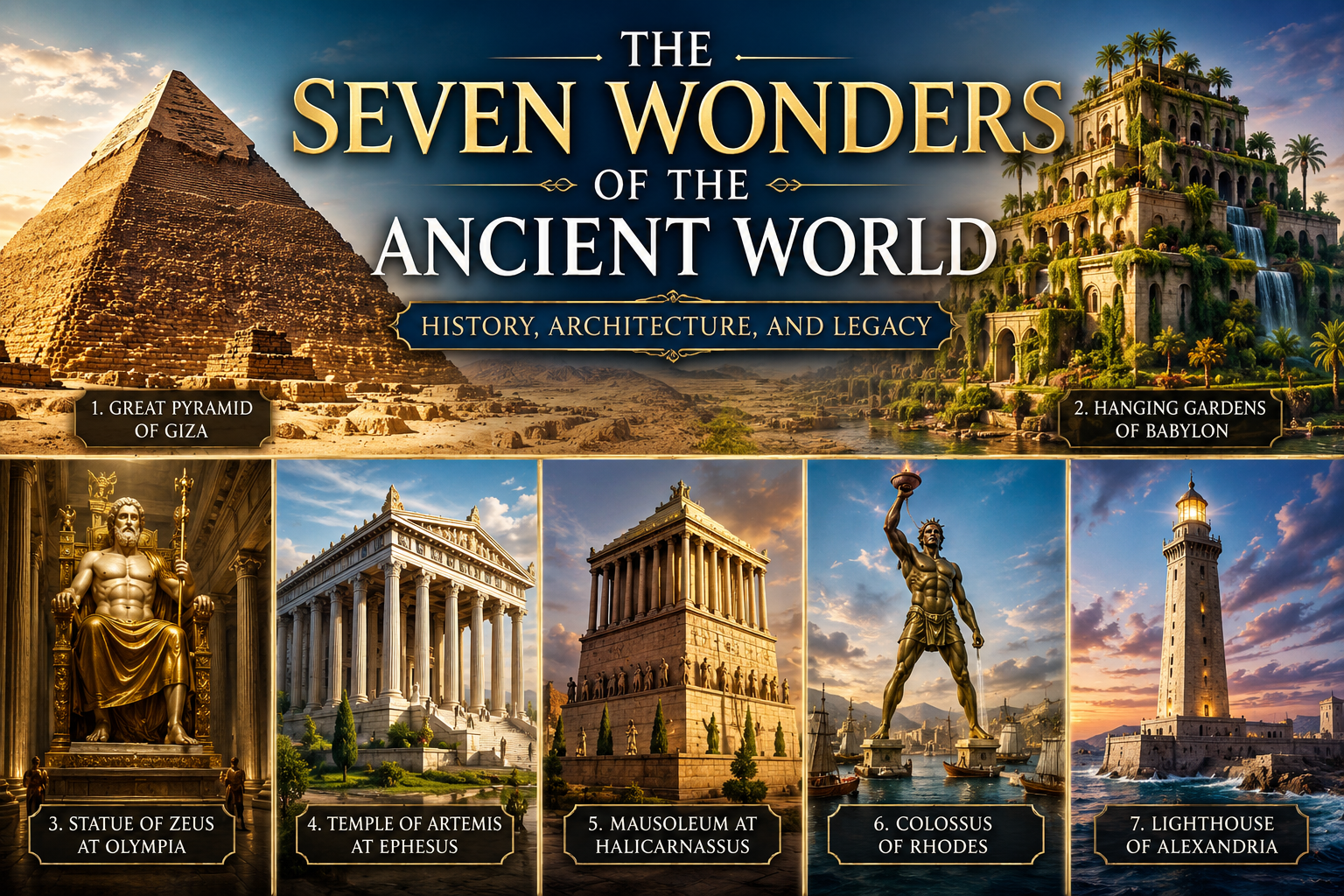
The Seven Wonders of the Ancient World: History, Architecture, and Legacy
Introduction
The Seven Wonders of the Ancient World represent some of the greatest architectural and engineering achievements in human history. Built thousands of years ago by ancient civilizations, these magnificent structures showcased extraordinary craftsmanship, advanced engineering techniques, and remarkable artistic vision. They were admired by travelers, historians, and scholars who considered them the most impressive monuments of the ancient world.
The original list of the Seven Wonders of the Ancient World was compiled by ancient Greek writers, who documented the most spectacular man-made structures known during their time. Although only one of these wonders—the Great Pyramid of Giza—still stands today, the remaining six continue to inspire historians, archaeologists, and travelers through historical records, legends, and archaeological discoveries.
Each wonder reflects the culture, beliefs, and technological achievements of the civilization that built it. From towering pyramids and magnificent temples to colossal statues and breathtaking lighthouses, these monuments demonstrate humanity’s desire to create structures that would stand the test of time.
In this article, we’ll explore the history, architecture, and legacy of the Seven Wonders of the Ancient World, discovering why they remain some of the greatest achievements in world history.
What Are the Seven Wonders of the Ancient World?
The Seven Wonders of the Ancient World are a collection of seven extraordinary monuments that were considered the greatest architectural masterpieces of the ancient era. These wonders were located around the Mediterranean and Middle East, where some of the world’s earliest civilizations flourished.
The seven wonders are:
Great Pyramid of Giza (Egypt)
Hanging Gardens of Babylon (Iraq)
Statue of Zeus at Olympia (Greece)
Temple of Artemis at Ephesus (Turkey)
Mausoleum at Halicarnassus (Turkey)
Colossus of Rhodes (Greece)
Lighthouse of Alexandria (Egypt)
Each monument was selected because of its size, beauty, engineering excellence, and cultural importance.
1. Great Pyramid of Giza
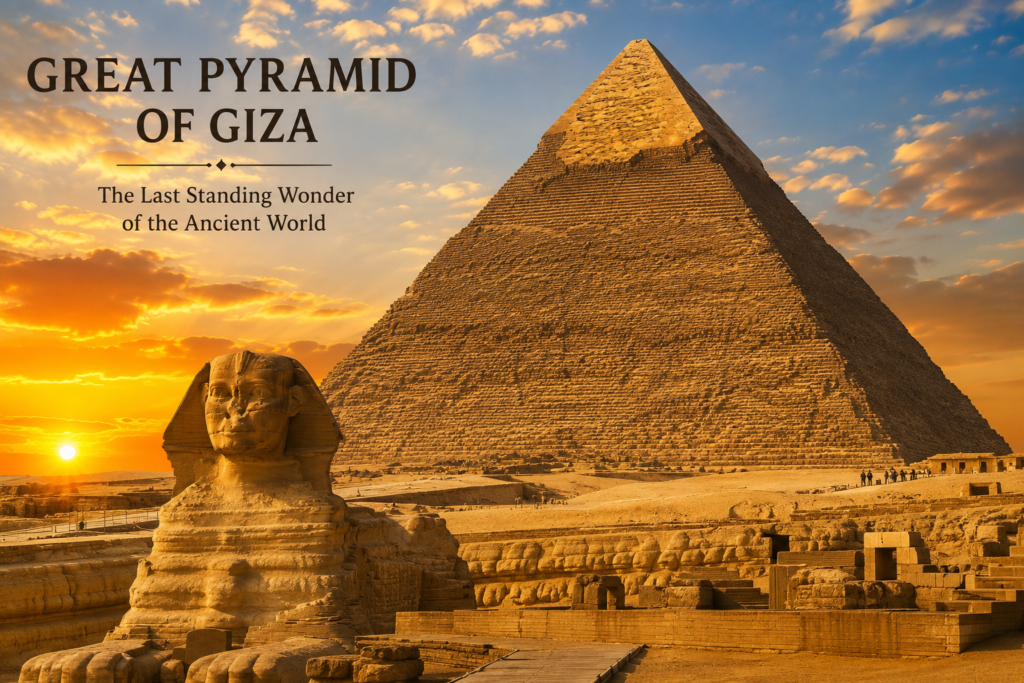
The Great Pyramid of Giza is the oldest and only surviving wonder among the Seven Wonders of the Ancient World. Built around 2560 BC during the reign of Pharaoh Khufu, the pyramid served as a royal tomb and remains one of the greatest engineering achievements ever accomplished.
Originally standing about 146 meters (481 feet) tall, it held the title of the world’s tallest man-made structure for nearly 4,000 years. Constructed using millions of limestone and granite blocks, the pyramid demonstrates the incredible mathematical and architectural knowledge of ancient Egypt.
Despite centuries of weathering, the Great Pyramid continues to attract millions of visitors every year and remains one of the world’s most recognizable historical monuments.
2. Hanging Gardens of Babylon
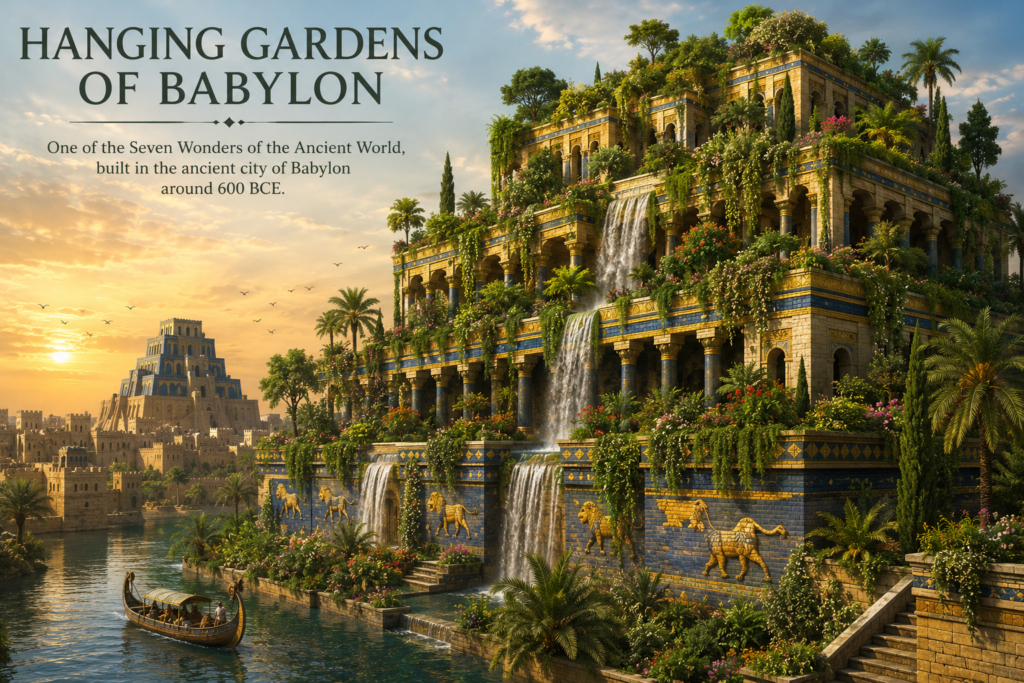
The Hanging Gardens of Babylon are perhaps the most mysterious of the Seven Wonders of the Ancient World. According to ancient accounts, the gardens were built by King Nebuchadnezzar II for his wife, Queen Amytis, who missed the lush green mountains of her homeland.
The gardens were said to feature beautiful terraces filled with trees, flowers, waterfalls, and exotic plants rising high above the city.
Interestingly, no definitive archaeological evidence has confirmed that the gardens actually existed, making them one of history’s greatest mysteries. Some historians believe the gardens may have been located elsewhere or described differently in ancient texts.
Regardless of the debate, the Hanging Gardens continue to capture the imagination of people around the world.
3. Statue of Zeus at Olympia
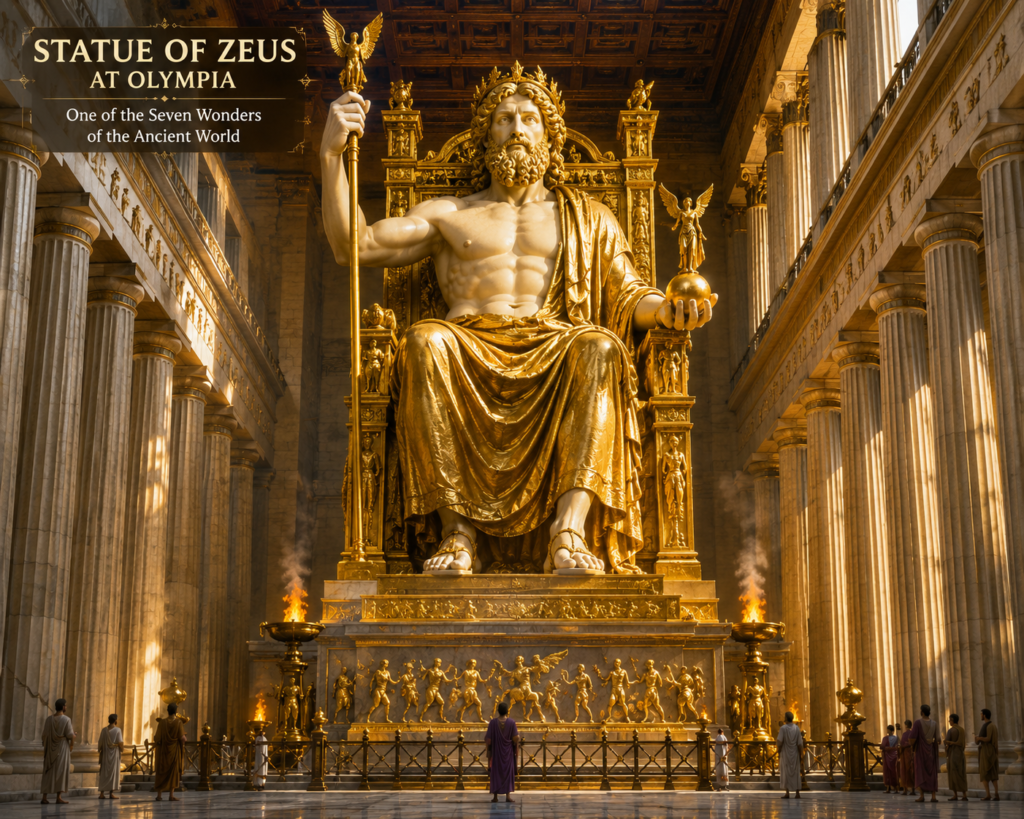
The Statue of Zeus at Olympia was one of the most magnificent sculptures of the ancient world. Created by the famous Greek sculptor Phidias around 435 BC, the statue honored Zeus, the king of the Greek gods.
Standing approximately 12 meters (40 feet) tall, the statue was made of ivory and gold over a wooden framework. Zeus was depicted seated on an elaborate throne decorated with precious stones and intricate carvings.
The statue symbolized the importance of Greek religion and culture and attracted pilgrims from across the ancient world. Unfortunately, it was eventually destroyed, likely during the early centuries of the Byzantine Empire.
4. Temple of Artemis at Ephesus
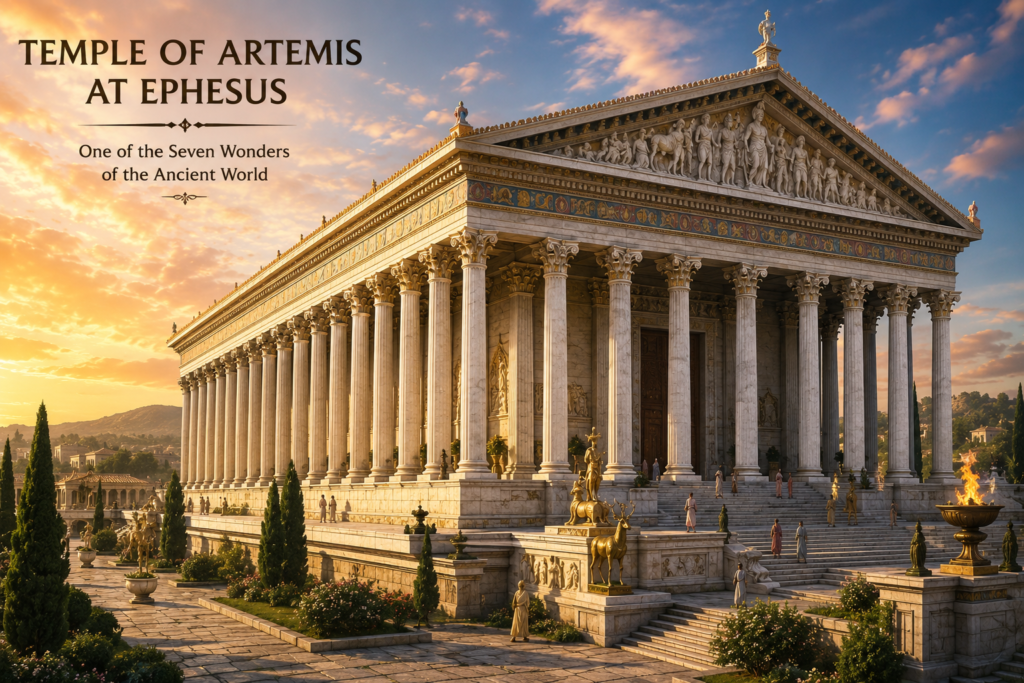
The Temple of Artemis at Ephesus was one of the largest and most beautiful temples ever built in the ancient world. Located in present-day Turkey, the temple was dedicated to Artemis, the Greek goddess of hunting, nature, and fertility.
Construction of the temple began around 550 BC under the rule of King Croesus of Lydia. Built entirely from marble, it featured over 120 massive columns, each standing approximately 18 meters (60 feet) high. The temple was decorated with magnificent sculptures and detailed carvings created by some of the finest artists of the time.
Throughout its history, the temple was destroyed and rebuilt several times. In 356 BC, it was deliberately burned down by a man seeking fame. Although it was reconstructed, the temple was eventually destroyed by invading forces and natural disasters. Today, only a few ruins remain, but it continues to be remembered as one of the greatest architectural masterpieces of the Seven Wonders of the Ancient World.
5. Mausoleum at Halicarnassus
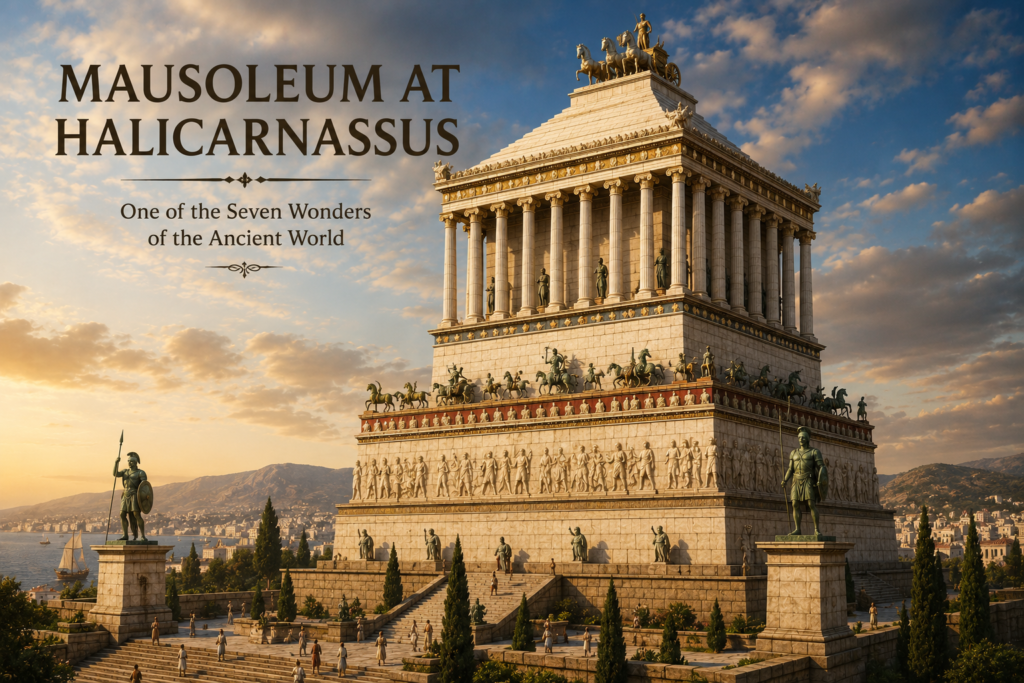
The Mausoleum at Halicarnassus was a grand tomb built for Mausolus, the ruler of Caria, and his wife Artemisia II. Located in present-day Bodrum, Turkey, the monument was completed around 350 BC.
Standing approximately 45 meters (148 feet) tall, the mausoleum combined elements of Greek, Egyptian, and Lycian architecture. It featured magnificent marble sculptures created by some of the most skilled artists of the ancient world.
The monument became so famous that the word “mausoleum” is now used worldwide to describe large and impressive tombs.
Unfortunately, the structure was severely damaged by a series of earthquakes during the Middle Ages. Many of its stones were later reused to build nearby fortifications, leaving only its foundations for archaeologists to study today.
6. Colossus of Rhodes
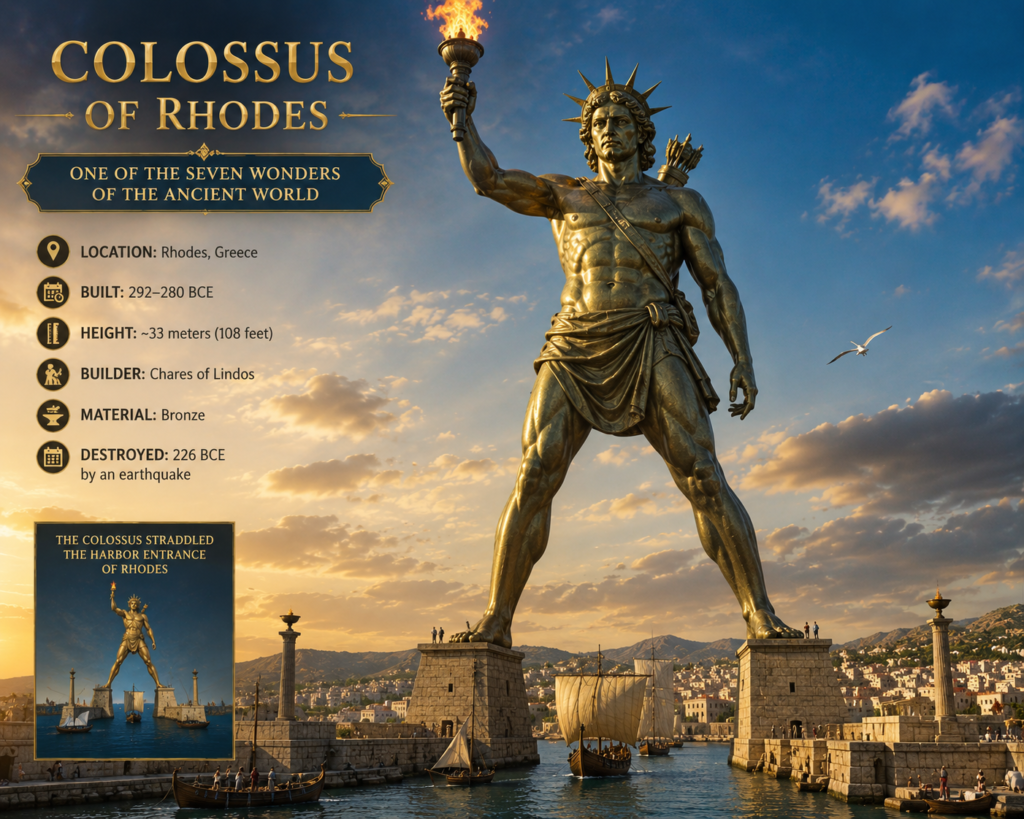
The Colossus of Rhodes was a gigantic bronze statue built on the Greek island of Rhodes around 280 BC. The statue honored Helios, the Greek sun god, and celebrated the island’s victory over invading forces.
Designed by the sculptor Chares of Lindos, the statue stood approximately 33 meters (108 feet) tall, making it one of the tallest statues of the ancient world.
Contrary to popular belief, historians generally agree that the Colossus did not stand with its legs spread across the harbor entrance. Instead, it likely stood beside the harbor, welcoming ships arriving at the island.
Sadly, the Colossus stood for only about 54 years before being destroyed by a powerful earthquake in 226 BC. Its remains stayed on the ground for centuries and continued attracting visitors until they were eventually removed.
7. Lighthouse of Alexandria
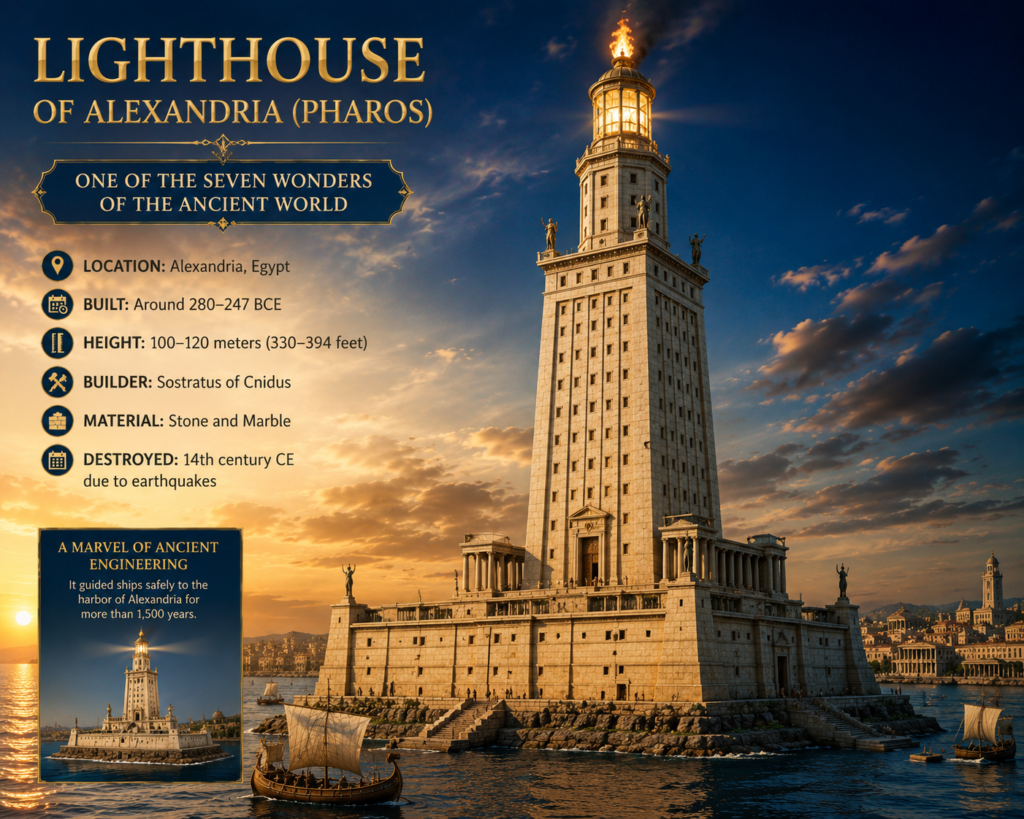
The Lighthouse of Alexandria, also known as the Pharos of Alexandria, was one of the greatest engineering achievements of ancient Egypt. Built during the reign of Ptolemy II around 280 BC, it stood on the island of Pharos near the city of Alexandria.
The lighthouse was constructed to guide ships safely into one of the busiest ports of the ancient Mediterranean. It is believed to have stood between 100 and 130 meters (330–430 feet) tall, making it one of the tallest structures of its time.
During the day, the lighthouse reflected sunlight using polished mirrors, while at night a large fire burned at the top to help sailors navigate safely.
Several powerful earthquakes eventually damaged the lighthouse beyond repair, and its ruins later disappeared beneath the sea. Today, underwater archaeological discoveries continue to provide valuable information about this remarkable wonder.
Why Are These Wonders So Important?
The Seven Wonders of the Ancient World are more than just impressive buildings. They represent the creativity, determination, and engineering brilliance of ancient civilizations.
Even though most of these monuments no longer exist, their influence can still be seen in modern architecture, engineering, archaeology, and cultural heritage. They remind us that people thousands of years ago were capable of creating structures that continue to inspire the world today.
Why Did Most of the Seven Wonders Disappear?
Although the Seven Wonders of the Ancient World were built to last, most of them were eventually destroyed by natural disasters, wars, fires, and human activities.
Major causes included:
Powerful earthquakes
Fires
Wars and invasions
Weathering over centuries
Reuse of building materials
Lack of preservation techniques
The Great Pyramid of Giza survived largely because of its massive stone construction and the dry Egyptian climate, while the other wonders were less fortunate.
The Legacy of the Seven Wonders
The legacy of the Seven Wonders of the Ancient World continues to inspire architects, historians, engineers, and travelers across the globe.
These monuments demonstrated that ancient civilizations possessed extraordinary knowledge of mathematics, engineering, architecture, and art. Their influence can still be seen in modern buildings, museums, and historical research.
Today, although only one of the original wonders survives, all seven continue to symbolize humanity’s creativity and ambition. Their stories encourage people to preserve historical monuments for future generations.
Frequently Asked Questions
Which is the only surviving wonder?
The Great Pyramid of Giza is the only surviving monument among the Seven Wonders of the Ancient World.
Why are there only seven wonders?
Ancient Greek scholars considered the number seven to represent perfection and completeness, so they selected seven remarkable monuments.
Where were the Seven Wonders located?
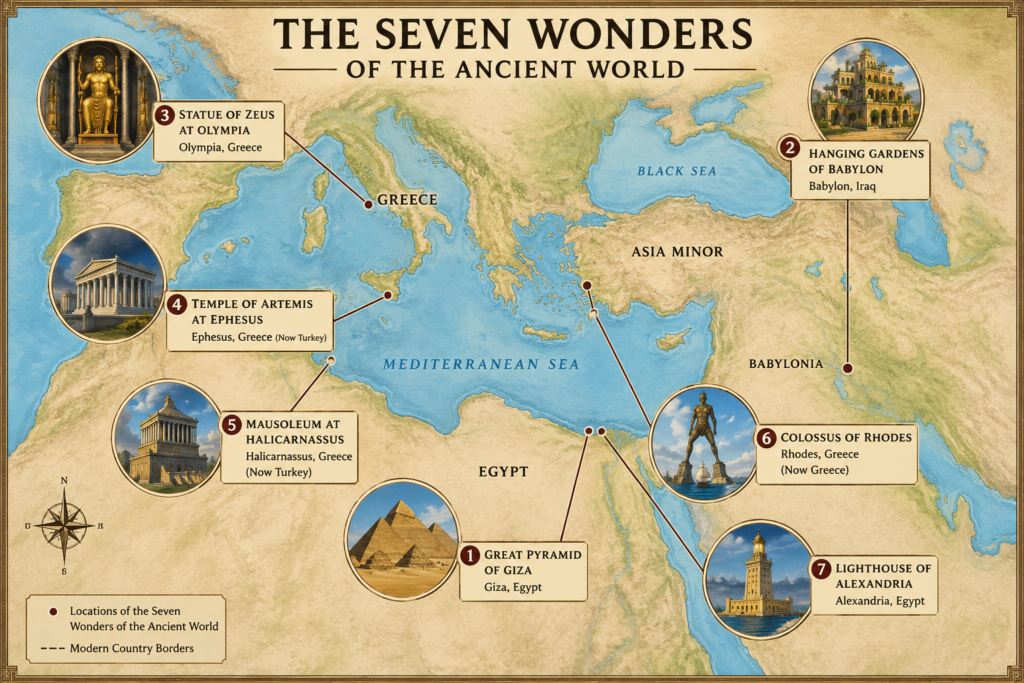
They were located across modern-day Egypt, Iraq, Turkey, and Greece.
Can people visit the Seven Wonders today?
Only the Great Pyramid of Giza still stands and can be visited. The others survive through archaeological remains, historical records, or legends.
Conclusion
The Seven Wonders of the Ancient World remain among the greatest achievements in human history. From the towering Great Pyramid of Giza to the legendary Hanging Gardens of Babylon and the magnificent Lighthouse of Alexandria, each wonder reflects the remarkable skills and imagination of ancient civilizations.
Although six of these wonders have disappeared over time, their history continues to inspire millions of people worldwide. They remind us of humanity’s ability to create extraordinary monuments that leave a lasting legacy across generations.
Whether you are passionate about history, archaeology, or architecture, exploring the story of the Seven Wonders of the Ancient World offers a fascinating journey into the achievements of our ancestors.
Explore More
You may also enjoy:
Legends of India: Heroes, Myths, Mysteries, and the Stories That Shaped a Civilization https://itshk.in/legends-of-india/
Haunted Places in India https://itshk.in/haunted-places-in-india/
History of Video Games: From Arcade to Virtual Reality https://itshk.in/history-of-video-games/
The Seven Wonders of the Ancient World continue to inspire people around the world because of their historical and cultural importance. Readers interested in learning more about the preservation of historic monuments and globally recognized heritage sites can explore the official UNESCO World Heritage Centre, which provides valuable information about cultural heritage and conservation efforts.
http://UNESCO World Heritage Centre
To learn more about the Seven Wonders of the Ancient World, their history, architecture, and the civilizations that built them, readers can also visit Encyclopaedia Britannica. It offers detailed articles written by experts on ancient history, archaeology, and world civilizations.http://Encyclopaedia Britannica
1 thought on “7 Incredible Wonders: The Seven Wonders of the Ancient World Explained”