Introduction
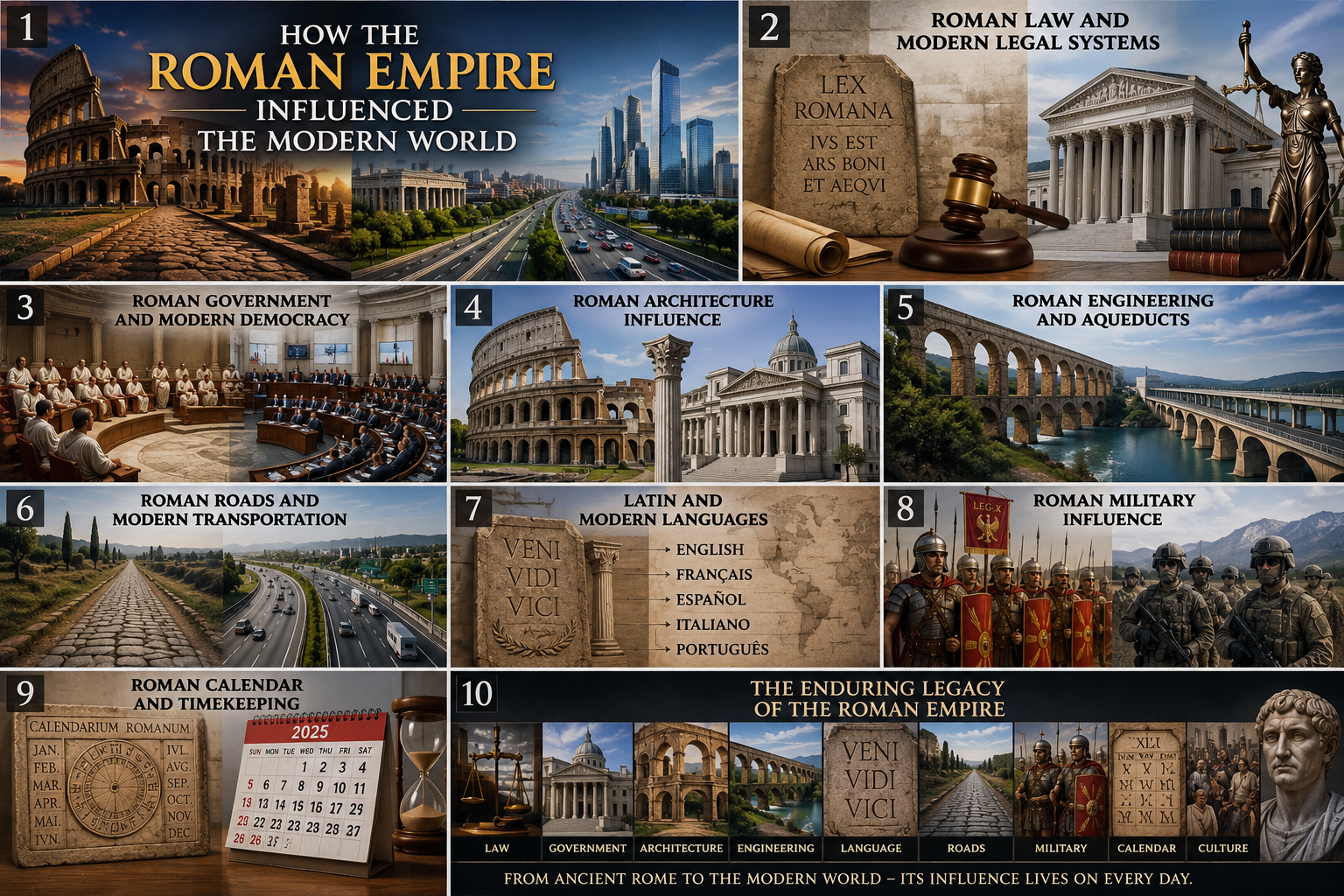
The Roman Empire is widely regarded as one of the greatest civilizations in human history. At its height, it stretched across Europe, North Africa, and parts of Asia, ruling millions of people and shaping the political, cultural, and technological development of the ancient world. Although the Western Roman Empire fell in AD 476, its influence did not disappear. Instead, many of its ideas, innovations, and institutions became the foundation of modern civilization.
Today, the Roman Empire influenced the modern world in countless ways. From legal systems and democratic governments to roads, architecture, engineering, military organization, and even the languages we speak, the legacy of Rome can still be seen almost everywhere. Many of the conveniences and institutions that people consider normal today have roots that trace back more than two thousand years.
The Romans were not only skilled conquerors but also brilliant engineers, administrators, architects, and lawmakers. They understood the importance of infrastructure, education, trade, and public administration, creating systems that inspired future civilizations for centuries.
In this article, we explore how the Roman Empire influenced the modern world and why its remarkable legacy continues to shape our daily lives.
The Rise of the Roman Empire
The story of Rome began as a small settlement on the Italian Peninsula around the 8th century BCE. According to Roman tradition, the city was founded in 753 BCE by the twin brothers Romulus and Remus. Although this story is legendary, archaeological evidence confirms that Rome gradually grew from a small community into a powerful city-state.
Initially ruled by kings, Rome later became a republic where elected officials and the Roman Senate shared political authority. This political system encouraged organization, military expansion, and efficient administration. Over several centuries, Rome expanded across the Mediterranean through diplomacy, alliances, and military conquest.
By the reign of Emperor Trajan in the second century AD, the Roman Empire had reached its greatest territorial extent. It controlled Britain, much of Europe, North Africa, and parts of the Middle East. Such a vast empire required excellent administration, communication, and infrastructure, many of which continue to influence modern society.
Roman Law: The Foundation of Modern Justice
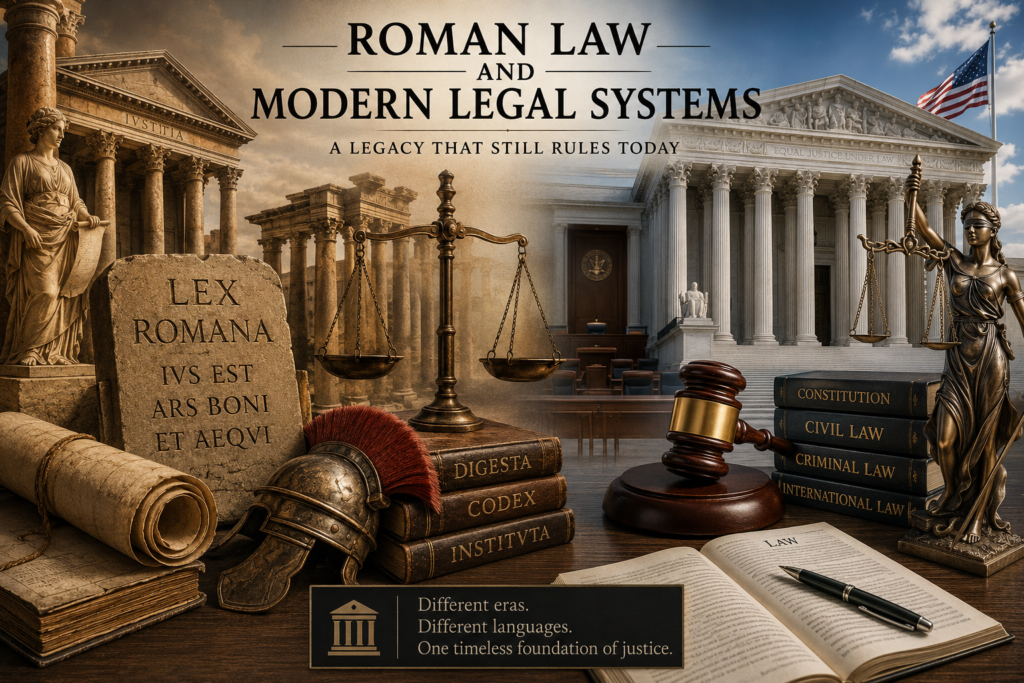
One of the greatest ways the Roman Empire influenced the modern world is through its legal system.
Before Rome developed a structured legal code, laws in many societies were often inconsistent and depended heavily on local customs or the decisions of rulers. The Romans introduced written laws that provided greater consistency and fairness.
The famous Twelve Tables, created around 450 BCE, became one of the earliest written legal codes in Roman history. These laws covered property rights, contracts, family matters, and civil disputes, ensuring that citizens knew their legal rights and responsibilities.
As the empire expanded, Roman jurists refined legal principles based on logic, fairness, and evidence. Ideas such as the presumption of innocence, legal representation, contracts, and property ownership gradually became central to Roman law.
Many countries today—including those in Europe, Latin America, and parts of Asia—still use legal systems influenced by Roman legal principles. Even where legal systems developed differently, many Roman concepts remain recognizable in modern courts.
The Roman commitment to written laws and equal legal procedures helped establish the idea that justice should be based on rules rather than the personal decisions of rulers.
Roman Government and Political Systems
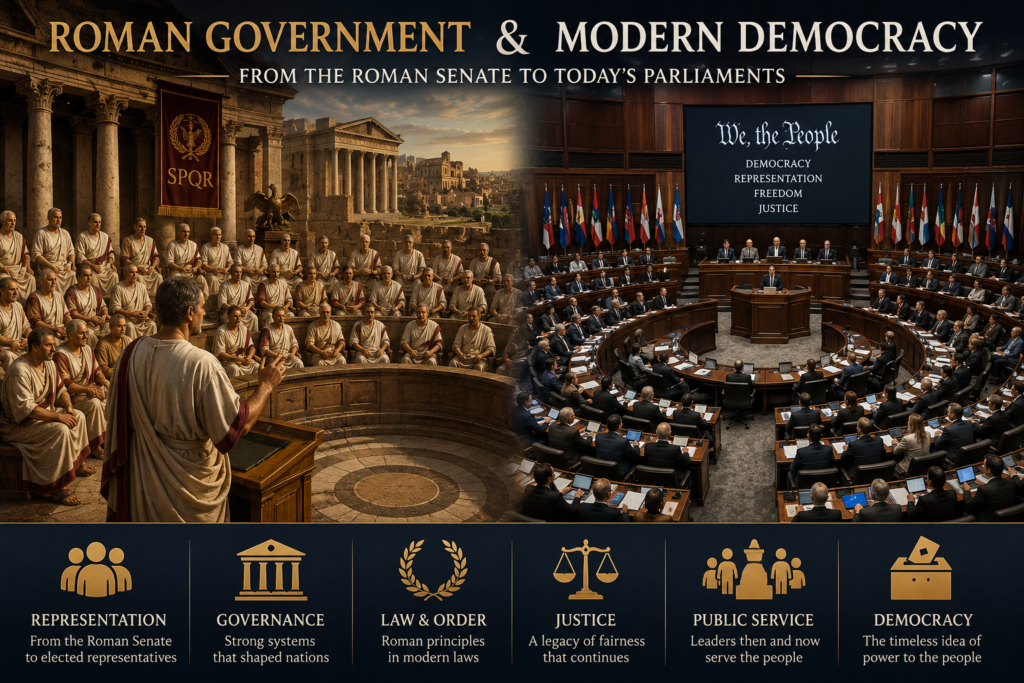
Another important way the Roman Empire influenced the modern world is through government.
Although modern democracies differ significantly from ancient Rome, several political ideas originated during the Roman Republic.
The Roman Senate served as an advisory and legislative body composed of experienced political leaders. Magistrates were elected to administer different areas of government, while officials were expected to perform specific public responsibilities.
The Romans also developed systems of checks and balances that limited the concentration of political power. While these systems were imperfect and did not include all citizens equally, they inspired later political thinkers during the Renaissance and Enlightenment.
Modern democratic governments continue to use ideas such as elected representatives, legislative assemblies, constitutions, public administration, and civic responsibility.
The concept that governments should operate according to laws rather than personal authority remains one of Rome’s most enduring political contributions.
Roman Architecture Still Shapes Modern Cities
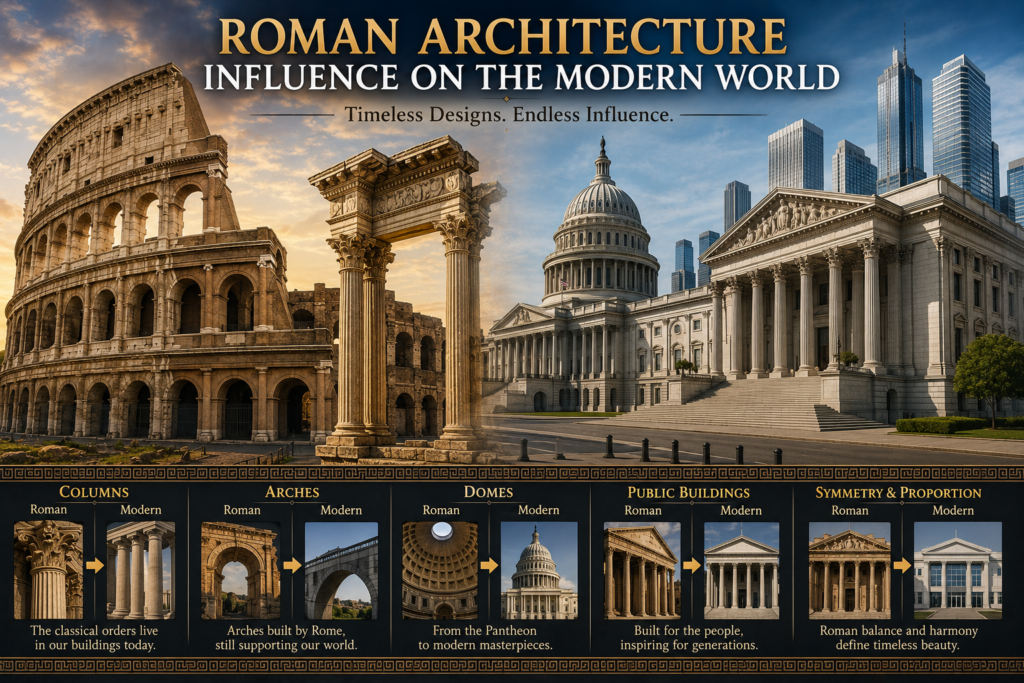
Roman architecture remains one of the most recognizable legacies of the ancient world.
The Romans combined beauty with practicality, constructing buildings that were both impressive and functional. Many of their architectural innovations continue to influence public buildings around the world.
The Colosseum, Pantheon, Roman forums, amphitheaters, and public baths demonstrated advanced engineering techniques and architectural creativity.
Roman architects perfected the use of arches, domes, vaults, and concrete construction. These innovations allowed them to build larger and stronger structures than many earlier civilizations.
Today, government buildings, museums, universities, courthouses, and monuments frequently incorporate Roman-inspired columns, domes, and symmetrical designs.
The influence of Roman architecture can be seen in famous landmarks such as the United States Capitol, the British Museum, and numerous government buildings across Europe and Asia.
The Romans proved that architecture could serve both practical needs and cultural identity, a philosophy that continues to inspire architects today.
Roman Engineering Changed Infrastructure Forever
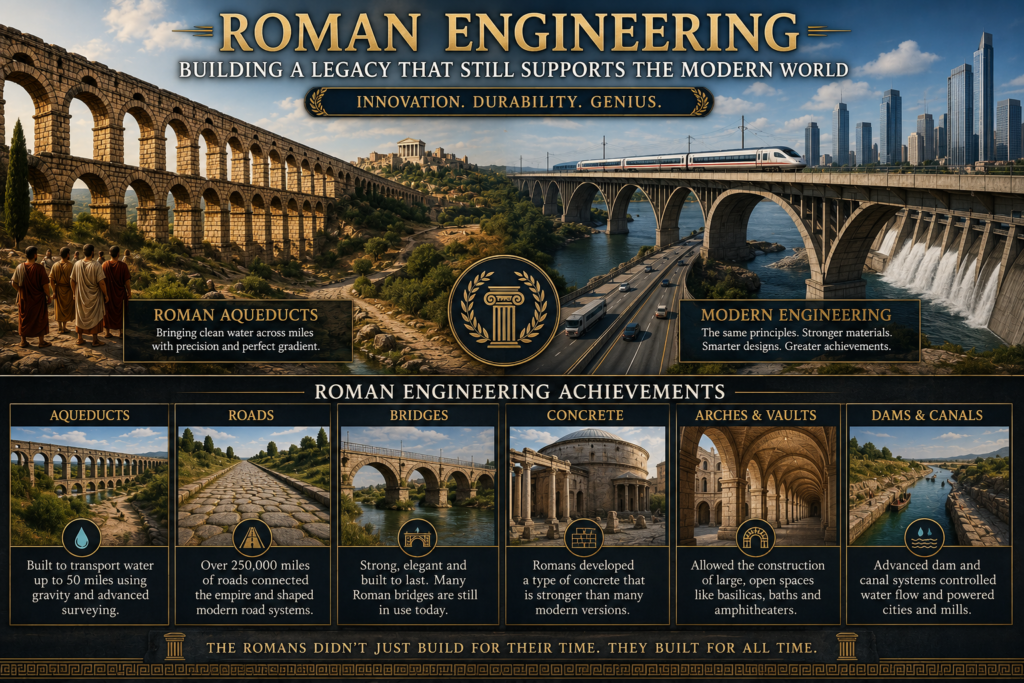
Roman engineers were among the greatest builders of the ancient world.
They constructed thousands of kilometers of roads, massive aqueducts, bridges, harbors, and drainage systems that supported one of history’s largest empires.
Roman aqueducts transported clean water over long distances using carefully designed gradients, supplying cities with drinking water, public baths, and fountains.
Many Roman bridges remained usable for centuries because of their exceptional engineering quality.
The Romans also developed advanced construction methods using concrete, allowing them to build durable structures capable of surviving earthquakes and harsh weather conditions.
Modern civil engineering continues to study Roman construction techniques because many ancient structures remain standing after nearly two thousand years.
Roman Roads Revolutionized Transportation
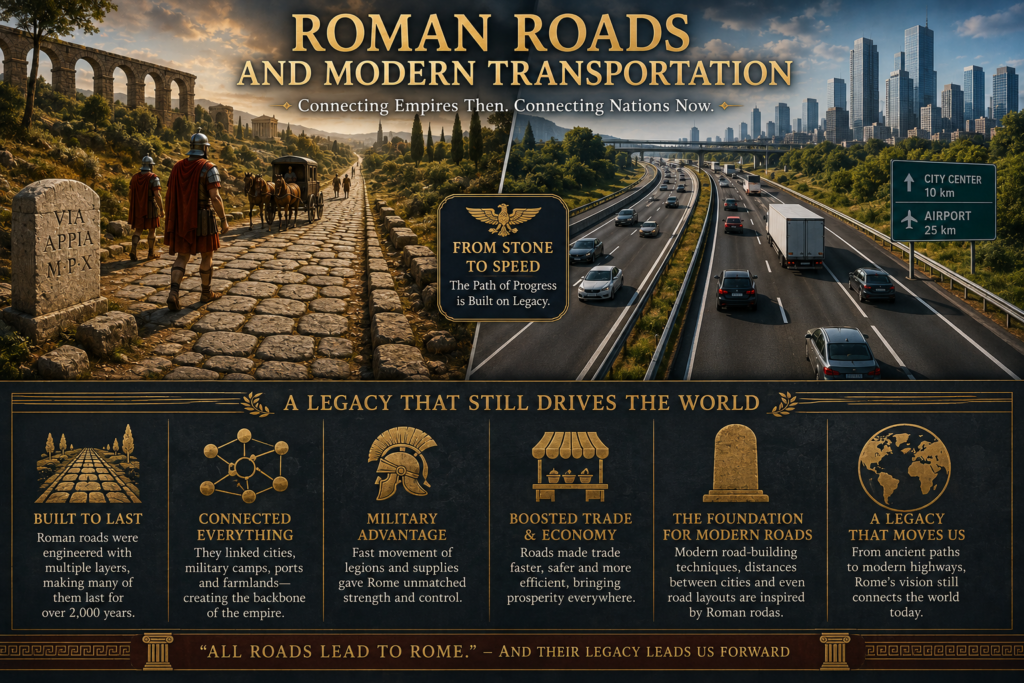
One of the greatest reasons the Roman Empire Influenced the Modern World was its extraordinary road network. The Romans believed that a powerful empire needed fast communication, efficient trade, and quick military movement. To achieve this, they built one of the largest and most advanced road systems in ancient history.
Roman engineers constructed over 400,000 kilometers of roads, with more than 80,000 kilometers being paved with stone. These roads connected cities, military camps, ports, and marketplaces across Europe, North Africa, and the Middle East.
Unlike many ancient roads, Roman roads were built in several layers using stone, gravel, and sand. Their excellent drainage systems made them durable enough to survive for centuries. In fact, some Roman roads are still visible and even used today.
Modern highways follow many of the same engineering principles developed by Roman builders. Straight routes, milestones, bridges, and proper drainage all reflect Roman innovation. This is another remarkable example of how the Roman Empire Influenced the Modern World through engineering and transportation.
The famous saying, “All Roads Lead to Rome,” reflects not only Rome’s political power but also its incredible transportation network that united an enormous empire.
Latin Shaped Many Modern Languages
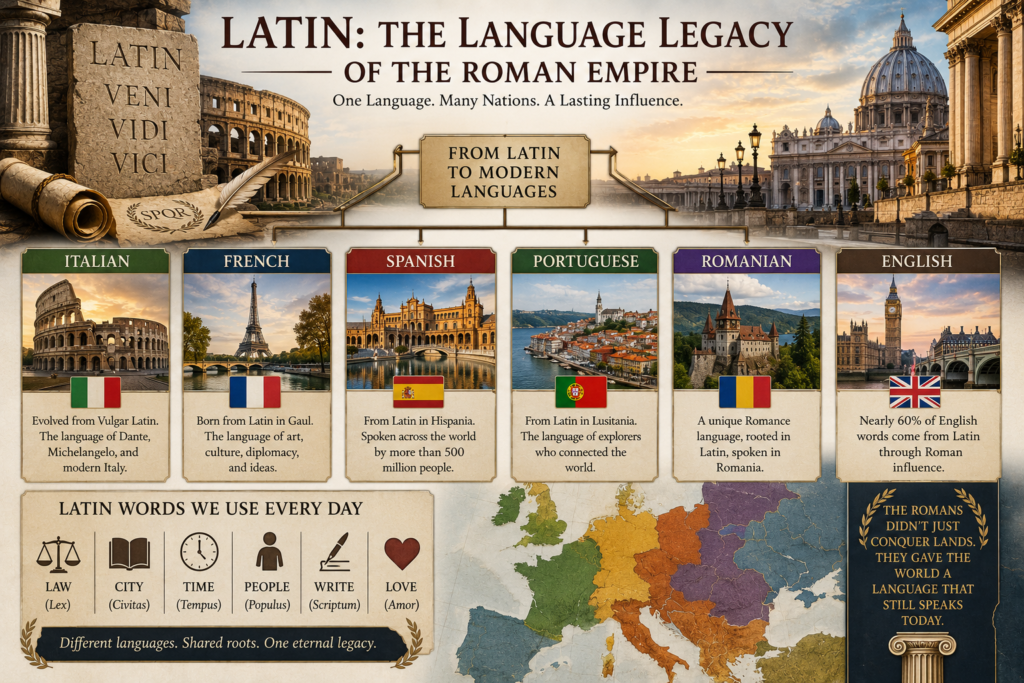
Another important way the Roman Empire Influenced the Modern World is through language.
Latin served as the official language of the Roman Empire for many centuries. Government records, military commands, education, literature, science, and law were all conducted in Latin.
Although Latin is no longer widely spoken as a native language, its influence remains enormous.
Modern Romance languages such as:
Italian
Spanish
French
Portuguese
Romanian
all evolved directly from Latin.
Even English contains thousands of Latin-derived words because of Roman influence and later historical developments.
Words like justice, library, doctor, education, science, culture, university, republic, and constitution all have Latin roots.
Scientific names for plants and animals, legal terminology, medical vocabulary, and many academic subjects continue to use Latin today.
Every time we use these words, we are experiencing another example of how the Roman Empire Influenced the Modern World.
Roman Military Organization Changed Warfare
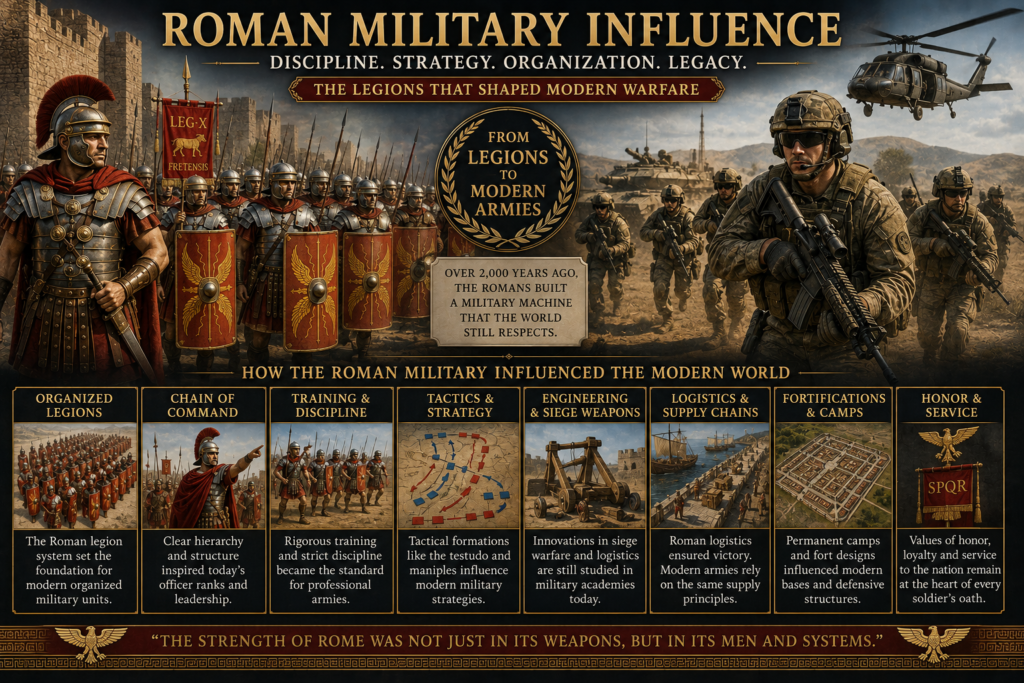
The Roman army became one of history’s most disciplined and successful military forces.
Rather than relying only on bravery, Roman commanders emphasized organization, planning, logistics, engineering, and training.
Roman soldiers trained regularly and followed strict discipline. Each legion operated under a clearly defined chain of command.
The Romans also built permanent military camps, roads, bridges, and defensive walls that allowed armies to move efficiently across the empire.
Modern armies still use many organizational principles that resemble Roman military systems.
Ideas such as:
standardized training
organized ranks
military engineering
logistics
supply chains
permanent bases
all reflect practices perfected by Roman commanders.
Military academies continue to study Roman campaigns because many leadership principles remain valuable today.
This demonstrates yet another way the Roman Empire Influenced the Modern World beyond politics and architecture.
The Roman Calendar Still Guides Our Lives
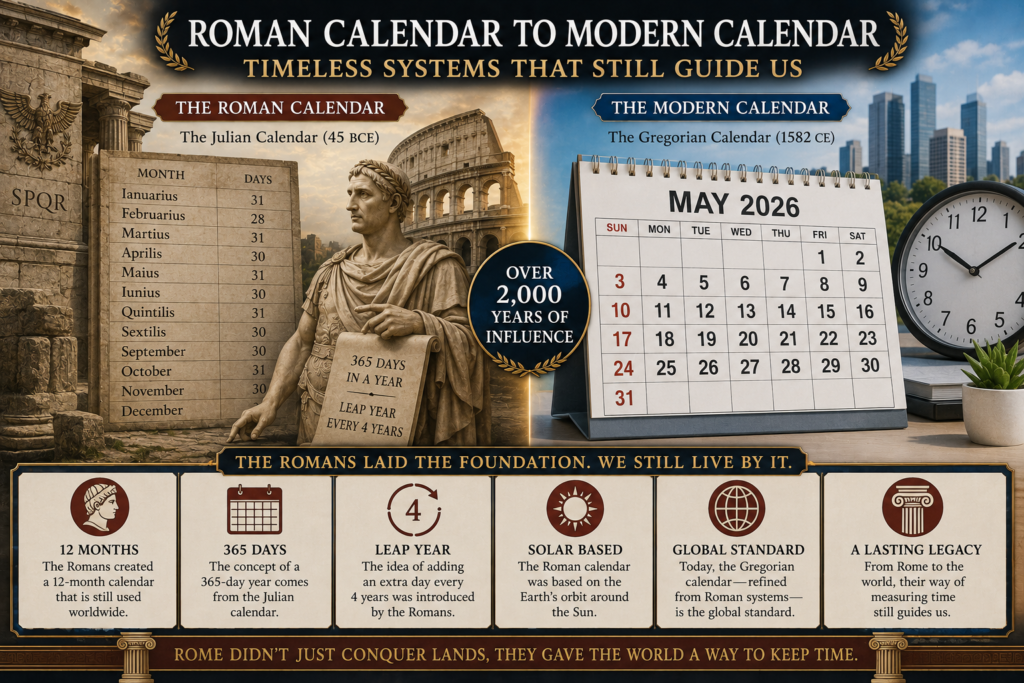
Most people never realize that the calendar they use every day has Roman origins.
The Romans developed the Julian Calendar, introduced by Julius Caesar in 45 BCE.
It organized the year into 365 days with a leap year every four years.
Although the Gregorian Calendar later refined the system, it was built directly upon Roman foundations.
The names of many months also come from Roman history.
January — Janus
March — Mars
June — Juno
July — Julius Caesar
August — Augustus Caesar
Without Roman reforms, modern international timekeeping would look very different.
This everyday example clearly shows how the Roman Empire Influenced the Modern World in ways most people rarely notice.
Roman Culture Still Inspires Society
The Romans greatly valued education, literature, philosophy, sports, theatre, and public entertainment.
Large amphitheaters hosted dramatic performances and sporting events that attracted thousands of spectators.
Public baths became important social centers where people discussed politics, business, and daily life.
Roman writers such as Virgil, Cicero, Livy, Seneca, and Ovid produced works that continue to be studied in schools and universities around the world.
Roman myths also influenced later literature, art, music, and cinema.
Even today, many movies, television series, novels, and video games draw inspiration from Roman history and mythology.
The cultural achievements of Rome demonstrate another powerful reason why the Roman Empire Influenced the Modern World so deeply.
Roman Influence on Christianity
Religion also became an important part of Rome’s lasting legacy.
During the early Roman Empire, Christianity began as a small religious movement.
Although early Christians faced periods of persecution, the situation changed dramatically during the reign of Emperor Constantine.
In AD 313, the Edict of Milan granted religious tolerance to Christians.
Later, Christianity became the dominant religion of the empire.
As Christianity spread throughout Europe, Roman administration, roads, and communication networks helped missionaries travel across vast regions.
Many famous churches and religious traditions developed within territories once ruled by Rome.
Today, Christianity remains one of the world’s largest religions, making this another important way the Roman Empire Influenced the Modern World.
Why the Roman Empire Fell
Despite its remarkable achievements, the Roman Empire eventually declined.
Historians believe several factors contributed to its fall.
These included:
Political instability
Economic difficulties
Military pressure from invading groups
Internal conflicts
Corruption
Administrative challenges
In AD 476, the Western Roman Empire officially came to an end.
However, the Eastern Roman Empire, also known as the Byzantine Empire, continued for nearly another thousand years.
Although Roman political power disappeared in Western Europe, Roman knowledge, laws, architecture, engineering, and culture continued influencing future civilizations.
The fall of Rome marked the end of an empire—not the end of its legacy.
Lessons We Can Learn from Rome
The history of Rome teaches valuable lessons.
Strong governments require good administration.
Infrastructure supports economic growth.
Written laws create stability.
Education encourages innovation.
Engineering improves society.
However, Rome also reminds us that even the greatest civilizations can face challenges if political instability, economic problems, and internal divisions become too severe.
Understanding these lessons helps explain why the Roman Empire Influenced the Modern World not only through its achievements but also through its successes and failures.
Frequently Asked Questions
Why is the Roman Empire important today?
The Roman Empire Influenced the Modern World through law, government, engineering, architecture, language, roads, and culture that continue to shape modern civilization.
What language did the Romans speak?
Latin was the official language of the Roman Empire and became the foundation of many modern European languages.
What is Rome’s greatest contribution?
Many historians consider Roman law, engineering, roads, and government among Rome’s greatest achievements.
Are Roman roads still used today?
Yes. Some Roman roads remain visible and a few sections are still used because of their outstanding construction quality.
How did Roman architecture influence modern buildings?
Roman arches, domes, columns, and concrete construction continue to inspire government buildings, museums, churches, and monuments around the world.
Conclusion
More than fifteen centuries after the fall of the Western Roman Empire, its influence remains visible almost everywhere. The Roman Empire Influenced the Modern World through legal systems, representative government, engineering, architecture, transportation, language, military organization, calendars, religion, and culture.
Whether we drive on modern highways, enter a courthouse, visit a parliament building, study Latin-based vocabulary, or admire buildings with Roman columns and domes, we are experiencing the remarkable legacy of ancient Rome.
Few civilizations have left such a lasting impact on humanity. The achievements of Roman engineers, lawmakers, architects, and leaders continue to inspire governments, scientists, historians, and citizens across the globe.
The story of Rome reminds us that great civilizations may rise and fall, but their ideas can continue shaping the world for thousands of years. That is why historians still consider the Roman Empire one of the most influential civilizations in human history, and why the Roman Empire Influenced the Modern World in ways that remain relevant even today.
To explore the history, expansion, government, and lasting achievements of ancient Rome in greater detail, readers can visit https://www.britannica.com/place/Roman-Empire?utm_source=chatgpt.com. This historical overview provides additional context for understanding how Roman institutions and innovations shaped later civilizations.
Explore more
Read more of my articles https://itshk.in/rise-and-fall-of-ancient-civilizations/
1 thought on “10 Ways the Roman Empire Influenced the Modern World”