The History of Video Games: From Arcade to Virtual Reality
Introduction
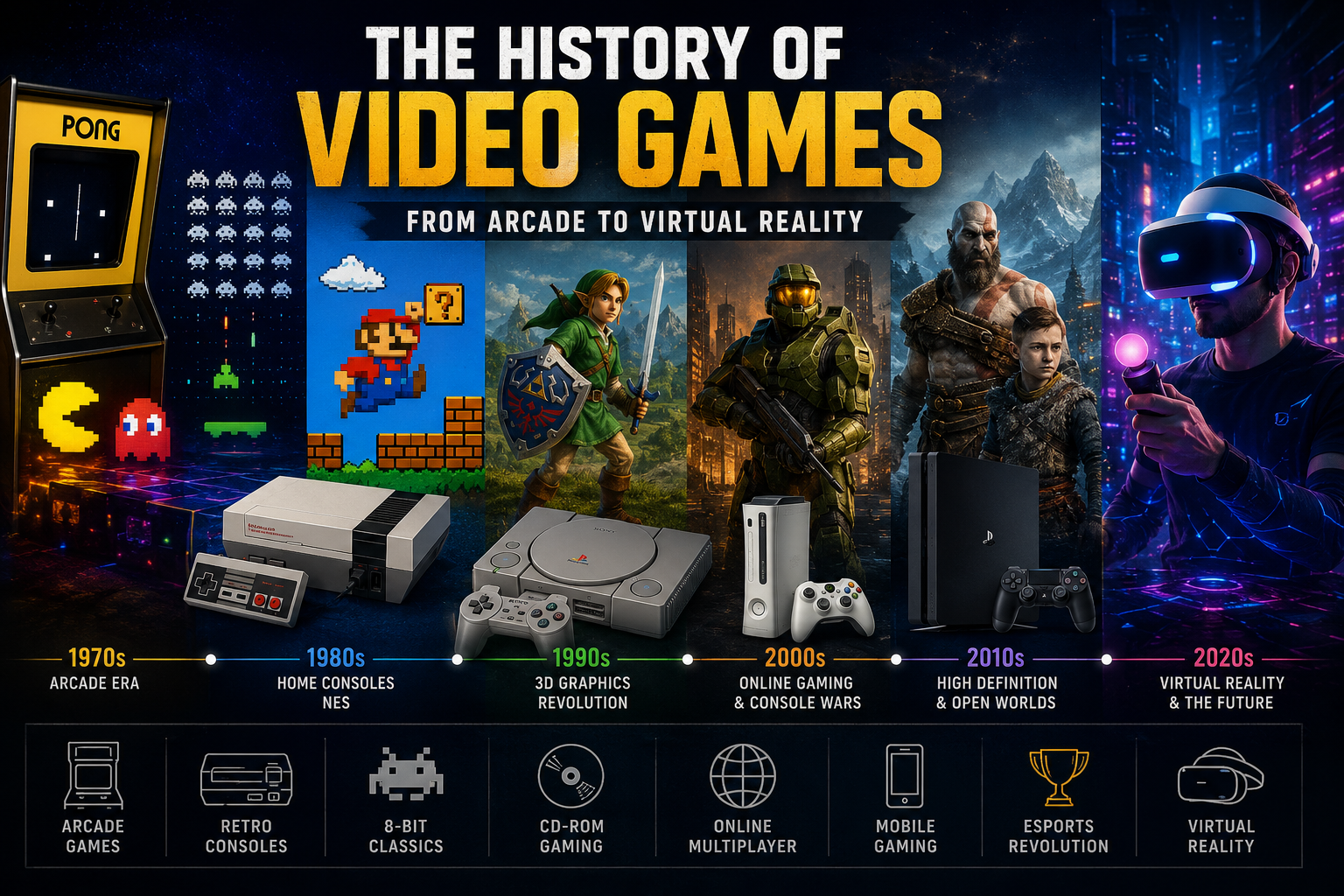
The History of Video Games is one of the most fascinating stories in modern technology and entertainment. What began as simple electronic experiments in laboratories has grown into a global industry worth hundreds of billions of dollars, connecting billions of players across the world. Today, video games are more than just a form of entertainment—they are a cultural phenomenon that influences education, sports, storytelling, music, and even scientific research.
Over the past several decades, gaming has evolved from simple pixel-based arcade machines into breathtaking virtual worlds powered by artificial intelligence, cloud computing, and virtual reality. Every generation of gamers has witnessed remarkable innovations that have transformed how people play, compete, and interact.
The journey began in the 1950s and 1960s when researchers created simple computer games to demonstrate technological capabilities. Although these early experiments were far from the sophisticated games we enjoy today, they laid the foundation for one of the fastest-growing industries in history.
The 1970s introduced arcade gaming, bringing video games into shopping malls, restaurants, and entertainment centers. During the following decades, home consoles, personal computers, online multiplayer gaming, mobile devices, and esports completely changed the gaming landscape.
Today, the gaming industry serves players of all ages through countless genres, including action, adventure, role-playing, racing, simulation, strategy, sports, and educational games. Modern technologies such as virtual reality (VR), augmented reality (AR), cloud gaming, and artificial intelligence continue to push gaming into exciting new directions.
In this complete guide to the History of Video Games, we explore how gaming evolved from simple arcade machines to immersive virtual reality experiences, highlighting the inventions, companies, consoles, and legendary games that shaped the industry.
What Are Video Games?
Before exploring the History of Video Games, it is important to understand what a video game actually is.
A video game is an interactive digital experience where players control characters, vehicles, or objects using electronic devices such as consoles, computers, smartphones, tablets, or virtual reality headsets.
Unlike movies or television, video games allow players to actively participate in the story or challenge. Every decision made by the player can influence gameplay, making gaming one of the most interactive forms of entertainment.
Modern video games include stunning graphics, realistic physics, cinematic storytelling, multiplayer experiences, artificial intelligence, and online communities that connect players across the globe.
Today, games are enjoyed not only for fun but also for education, professional esports competitions, military training, healthcare simulations, and scientific research.
The Birth of Video Games
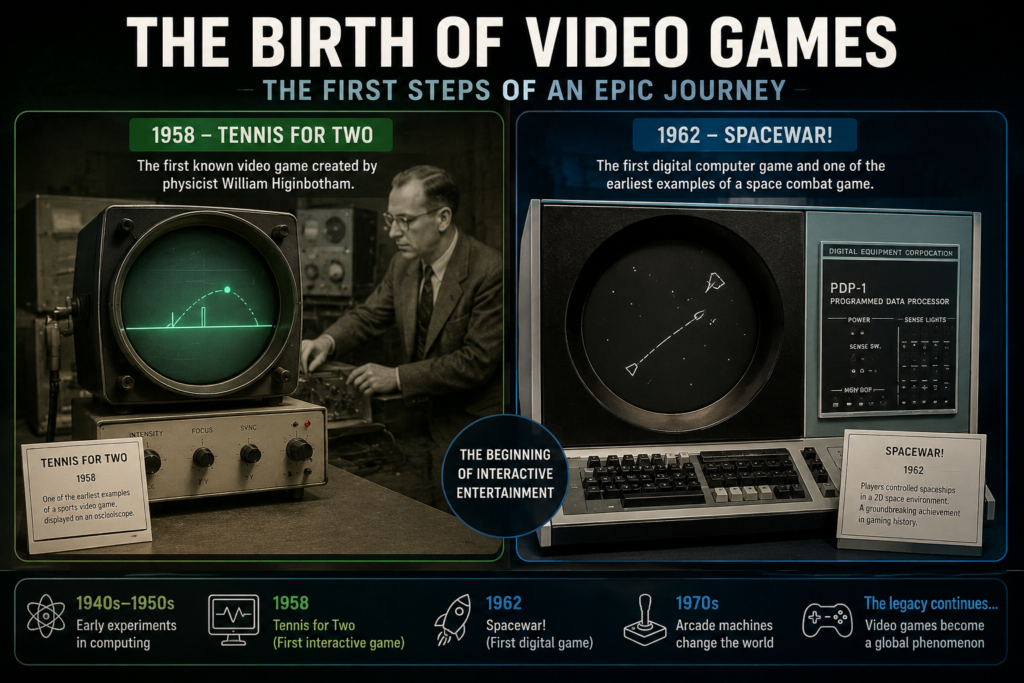
The History of Video Games began long before home consoles and powerful gaming PCs existed.
During the late 1950s, scientists started experimenting with computers capable of displaying simple interactive graphics.
One of the earliest examples was Tennis for Two, created in 1958 by physicist William Higinbotham. The game simulated a tennis match on an oscilloscope screen and allowed two players to compete using simple controllers.
Although it was created as a scientific demonstration rather than a commercial product, Tennis for Two proved that computers could provide interactive entertainment.
A few years later, in 1962, a group of students at the Massachusetts Institute of Technology (MIT) developed Spacewar!, widely regarded as one of the first influential computer video games.
Spacewar! featured two spacecraft battling in space while being affected by the gravity of a nearby star. The game introduced many concepts still found in modern games, including competitive multiplayer gameplay, physics-based movement, and strategic decision-making.
Although these early games reached only universities and research laboratories, they inspired future developers to create commercial video games for the public.
The Golden Age of Arcade Games
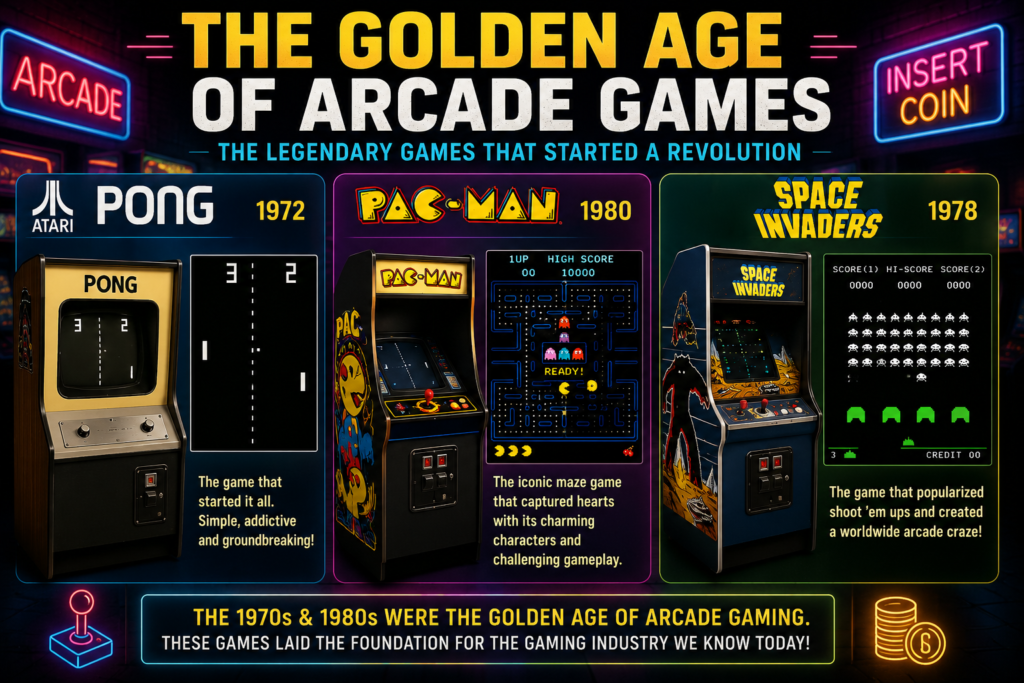
One of the most exciting periods in the History of Video Games began during the 1970s and early 1980s with the rise of arcade gaming.
Arcade machines quickly became popular attractions in shopping malls, restaurants, amusement parks, and dedicated gaming arcades.
The release of Pong by Atari in 1972 marked one of the first major commercial successes in gaming history. Inspired by table tennis, Pong featured simple gameplay but attracted enormous public interest.
Following Pong’s success, many companies entered the gaming market, leading to rapid innovation.
Some of the most iconic arcade games included:
Pac-Man
Space Invaders
Donkey Kong
Galaga
Asteroids
Frogger
These games introduced memorable characters, competitive high-score systems, and addictive gameplay that captivated millions of players worldwide.
The arcade era also helped establish video games as a profitable entertainment industry.
The Rise of Home Consoles
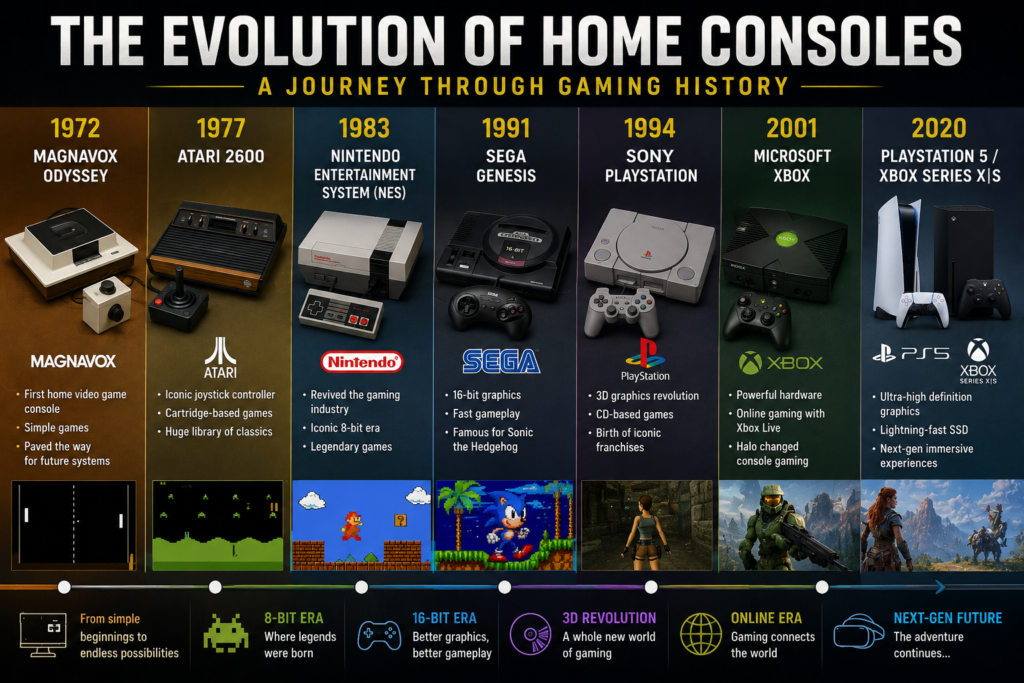
While arcade games continued growing in popularity, many families wanted to enjoy video games at home.
This demand led to one of the biggest milestones in the History of Video Games—the development of home gaming consoles.
One of the earliest successful home consoles was the Magnavox Odyssey, released in 1972.
Although its graphics were extremely simple compared to modern systems, the Odyssey demonstrated that gaming could become a regular part of family entertainment.
Later, Atari released the Atari 2600, which revolutionized home gaming through interchangeable game cartridges.
Instead of purchasing a completely new console for every game, players could simply buy different cartridges, dramatically expanding the console’s library.
This innovation transformed the gaming industry and established the business model still used by modern consoles.
The Video Game Crash of 1983
Despite rapid growth, the gaming industry experienced one of its greatest challenges.
In 1983, North America faced a major video game market crash caused by an oversupply of low-quality games and increasing competition from home computers.
Many companies rushed to release poorly designed games, causing consumer confidence to decline sharply.
One of the most famous examples was the disappointing video game adaptation of E.T. the Extra-Terrestrial, which became one of the industry’s biggest commercial failures.
Sales collapsed, numerous companies went bankrupt, and many experts believed the video game industry would never recover.
Fortunately, this difficult period encouraged developers to focus more on quality, innovation, and player experience, laying the foundation for the industry’s future success.
Why Video Games Became So Popular
The rapid growth of the gaming industry is one of the most remarkable chapters in the History of Video Games. Unlike traditional forms of entertainment, video games allow players to actively participate in stories, solve challenges, compete with friends, and explore imaginative worlds. This level of interaction makes gaming a unique experience that appeals to people of all ages.
As technology improved, developers introduced better graphics, realistic sound effects, engaging storylines, and innovative gameplay mechanics. The arrival of the internet further transformed gaming by allowing players from different countries to compete and cooperate in real time. Online multiplayer games helped build global gaming communities and introduced entirely new ways of social interaction.
Video games have also expanded far beyond entertainment. Today, they are used in education to teach problem-solving and creativity, in healthcare for rehabilitation and therapy, and in professional esports competitions where skilled players compete for international titles and prize money. Streaming platforms and content creators have also made gaming one of the most popular forms of online entertainment.
The continued innovation of the gaming industry ensures that the History of Video Games is still being written. From simple arcade machines to virtual reality experiences, video games continue to inspire creativity, technological advancement, and global communities of passionate players.
Nintendo Saves the Video Game Industry
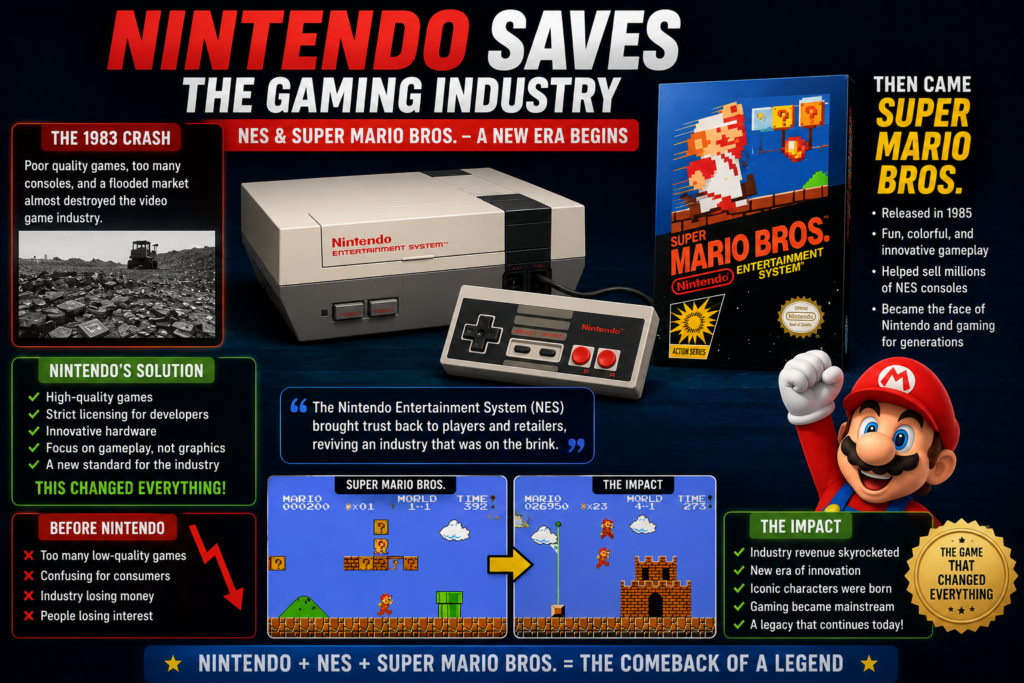
After the devastating video game crash of 1983, many people believed the gaming industry had reached its end. However, one Japanese company completely changed its future—Nintendo.
In 1985, Nintendo introduced the Nintendo Entertainment System (NES) in North America. Unlike many earlier consoles, the NES focused on strict quality control, ensuring that only carefully tested games were released. This restored consumer confidence and helped revive the gaming industry.
Nintendo also introduced innovative accessories, improved controllers, and unforgettable game characters that became icons of popular culture. The company demonstrated that high-quality gameplay and memorable storytelling were essential for long-term success.
The release of the NES marked one of the most important turning points in the History of Video Games, proving that the industry could recover stronger than ever.
Super Mario Bros. Changed Gaming Forever
One of the greatest milestones in the History of Video Games came with the release of Super Mario Bros. in 1985.
Created by legendary game designer Shigeru Miyamoto, the game introduced players to Mario, an adventurous plumber who set out to rescue Princess Peach from Bowser.
Unlike many earlier games, Super Mario Bros. featured smooth side-scrolling gameplay, hidden secrets, creative level design, memorable music, and precise controls.
The game’s enormous success transformed Mario into one of the world’s most recognizable fictional characters. Today, Mario remains the mascot of Nintendo and has appeared in hundreds of games across multiple genres.
Super Mario Bros. also established many gameplay principles that continue influencing game developers today.
The Console Wars – Nintendo vs Sega
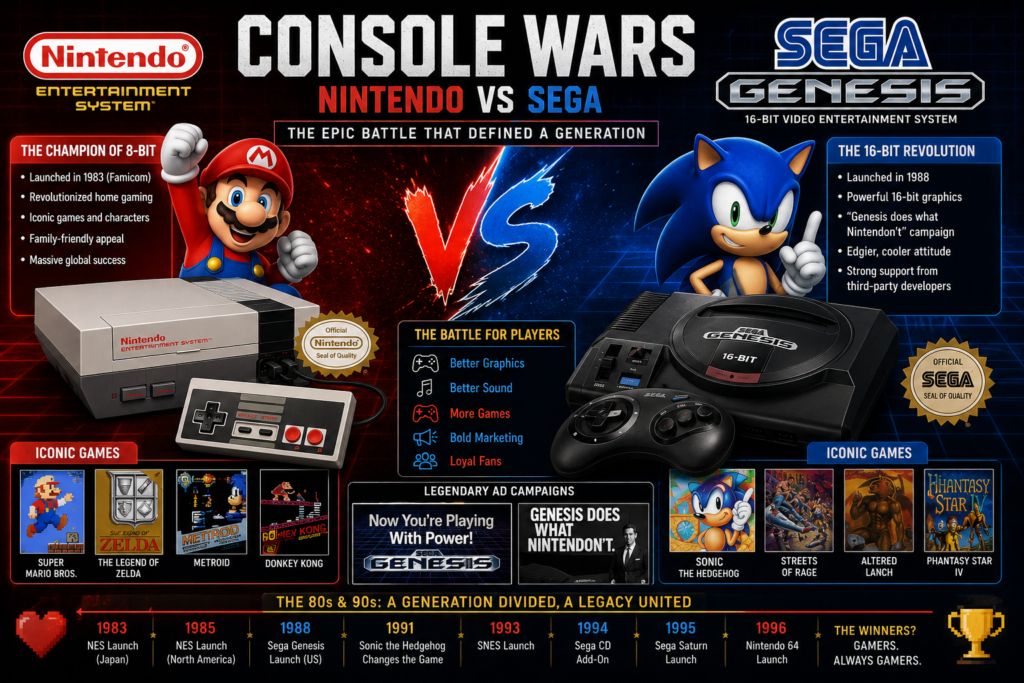
During the late 1980s and early 1990s, one of the most exciting rivalries in the History of Video Games emerged.
Nintendo dominated the gaming market with the NES, but another Japanese company, Sega, challenged its leadership.
Sega launched the Sega Genesis (known as the Mega Drive in many countries), promoting faster gameplay and more powerful hardware.
To compete with Mario, Sega introduced Sonic the Hedgehog, a fast-moving blue hedgehog who quickly became one of gaming’s most famous characters.
The competition between Nintendo and Sega became known as the Console Wars.
Both companies competed through:
Better graphics
Faster processors
Exclusive games
Aggressive advertising
Innovative accessories
This rivalry encouraged rapid technological innovation and greatly expanded the global gaming market.
Although Nintendo remained highly successful, Sega eventually stopped producing home consoles and shifted its focus toward software development.
The Rise of 3D Gaming
One of the biggest technological advances in the History of Video Games occurred during the mid-1990s when developers began creating fully three-dimensional game worlds.
Earlier games primarily used two-dimensional graphics.
The introduction of powerful hardware allowed characters and environments to move freely within 3D space.
This revolution completely changed game design.
Players could now explore realistic cities, forests, castles, and entire open worlds from multiple camera angles.
Games such as Super Mario 64, The Legend of Zelda: Ocarina of Time, and Tomb Raider demonstrated the enormous possibilities of 3D gaming.
The shift from 2D to 3D remains one of the most important technological milestones in gaming history.
Sony Changes the Industry with PlayStation

Another major chapter in the History of Video Games began in 1994 when Sony entered the gaming market with the original PlayStation.
Unlike cartridge-based systems, the PlayStation used compact discs (CDs), allowing developers to create larger games with improved graphics, music, and cinematic storytelling.
The console quickly became a global success.
Popular PlayStation franchises included:
Final Fantasy VII
Metal Gear Solid
Resident Evil
Gran Turismo
Crash Bandicoot
Sony’s success attracted millions of new players and encouraged greater investment in game development.
The PlayStation established Sony as one of the world’s leading gaming companies.
Microsoft Enters the Gaming World
The History of Video Games entered another exciting era in 2001 when Microsoft launched the first Xbox.
The Xbox introduced powerful hardware and an online gaming service called Xbox Live, allowing players to compete with friends across the internet.
One of the console’s most successful games was Halo: Combat Evolved, which helped popularize online multiplayer first-person shooters.
Xbox Live introduced features that are now common across modern gaming platforms, including:
Online matchmaking
Voice chat
Digital game downloads
Achievement systems
Multiplayer communities
Microsoft quickly became one of the biggest competitors in the console market alongside Sony and Nintendo.
The Evolution of PC Gaming
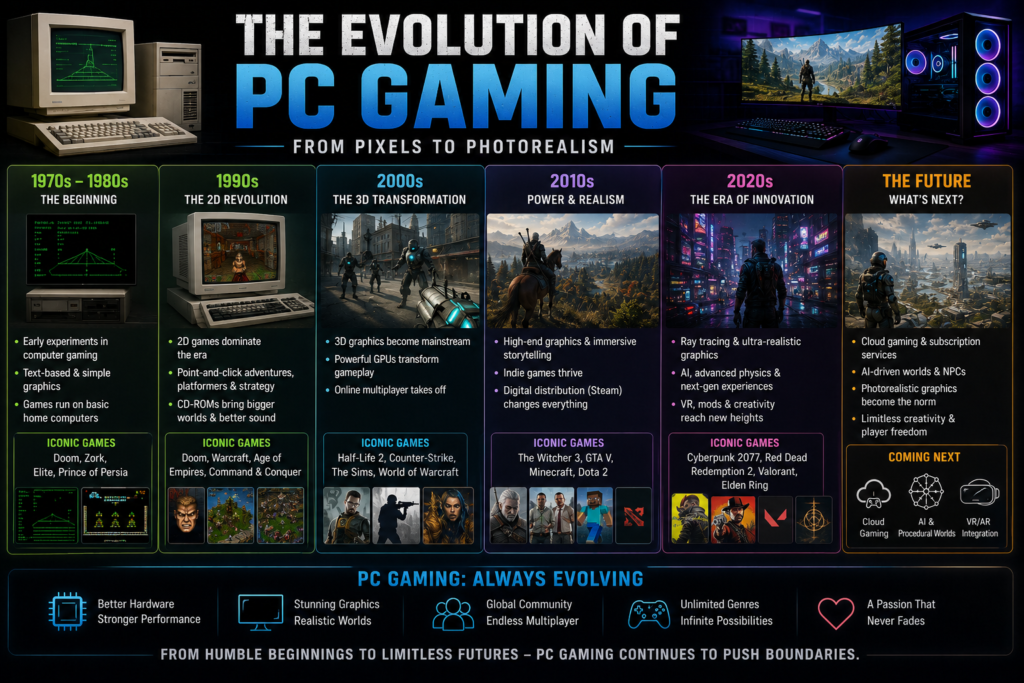
While consoles became increasingly popular, personal computers also played a major role in the History of Video Games.
PC gaming offered several advantages:
Better graphics
Customizable hardware
Keyboard and mouse controls
User-created modifications (mods)
Massive online multiplayer games
Popular PC games such as Doom, Half-Life, Counter-Strike, World of Warcraft, and Minecraft helped shape modern gaming culture.
Digital platforms like Steam made purchasing, downloading, and updating games easier than ever before.
Today, PC gaming continues to be one of the largest and most innovative segments of the gaming industry.
Video Games That Changed History
Several games transformed the History of Video Games forever.
Some of the most influential titles include:
Pong
Pac-Man
Tetris
Super Mario Bros.
The Legend of Zelda
Doom
Pokémon Red and Blue
Minecraft
Grand Theft Auto V
Fortnite
Each of these games introduced new ideas, influenced future developers, or reached millions of players worldwide.
Their impact extends beyond entertainment, shaping technology, popular culture, and even education.
The Rise of Online Multiplayer Gaming
One of the biggest milestones in the History of Video Games was the introduction of online multiplayer gaming. Before the internet became widely available, most games could only be played alone or with friends sitting in the same room. As internet technology improved during the late 1990s and early 2000s, gaming entered a completely new era.
Players could now connect with people from different countries in real time, making video games more social than ever before. Online multiplayer introduced teamwork, competitive rankings, voice chat, and global gaming communities.
Games such as Counter-Strike, World of Warcraft, Runescape, Halo 2, and Call of Duty became hugely popular because they allowed millions of players to compete and cooperate online.
Modern games continue this trend with massive online experiences where players build friendships, join clans, and participate in worldwide tournaments. Online multiplayer has transformed gaming into a global social platform and remains one of the most influential developments in the History of Video Games.
The Mobile Gaming Revolution
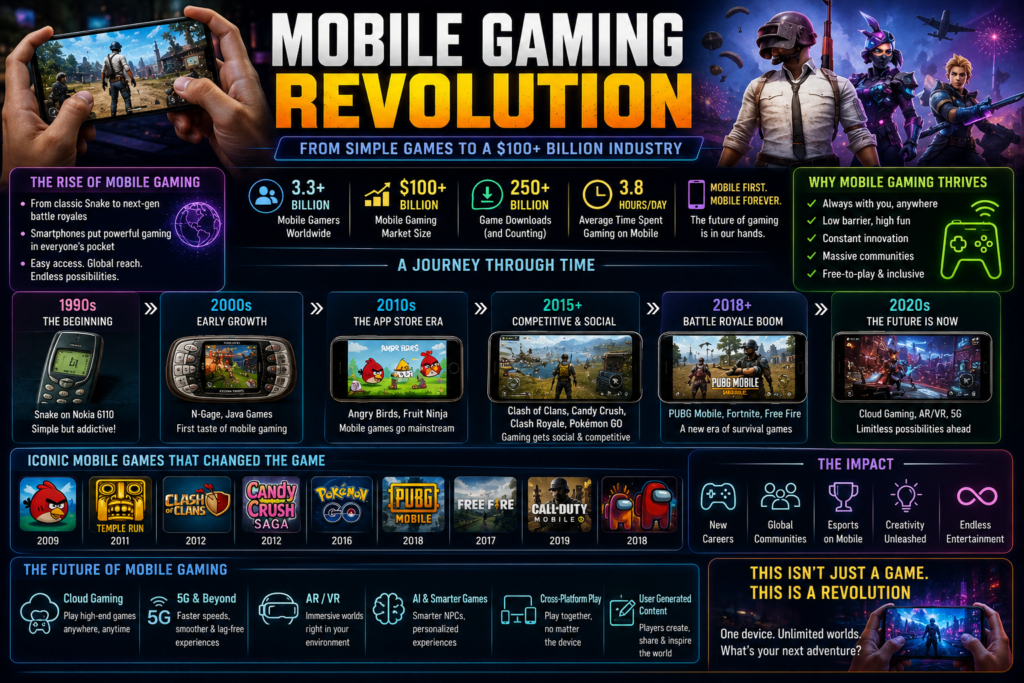
The launch of smartphones changed the History of Video Games forever. Earlier mobile phones supported only simple games such as Snake, but modern smartphones introduced powerful processors, touchscreens, and app stores that allowed developers to create high-quality games for millions of users.
The release of Apple’s App Store in 2008 and Google’s Play Store soon after opened the door for mobile game developers around the world. Casual games like Angry Birds, Temple Run, Subway Surfers, and Candy Crush Saga attracted players of all ages.
Later, competitive mobile games such as PUBG Mobile, Free Fire, Call of Duty: Mobile, and Mobile Legends demonstrated that smartphones could deliver experiences similar to traditional gaming consoles.
Today, mobile gaming has become one of the largest sectors of the gaming industry, with billions of players enjoying games anytime and anywhere.
The Growth of Esports
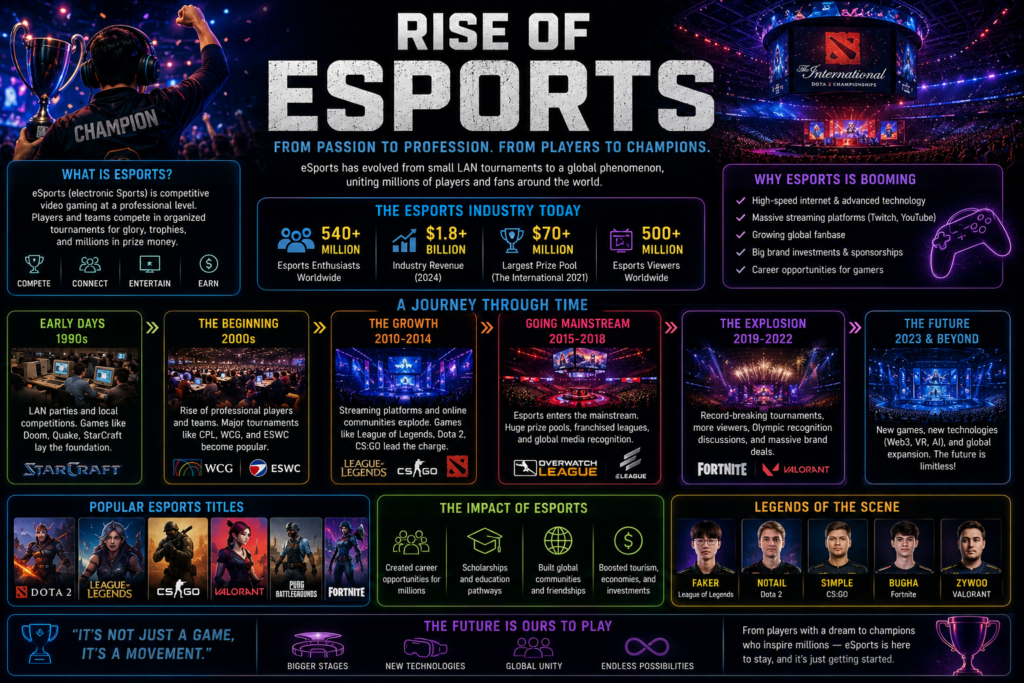
Another major chapter in the History of Video Games is the rise of esports.
Esports refers to organized competitive gaming where professional players and teams compete in tournaments for prize money, championships, and global recognition.
What began as small competitions has evolved into a billion-dollar industry watched by millions of fans online and in stadiums.
Popular esports titles include:
League of Legends
Dota 2
Counter-Strike
Valorant
PUBG
Free Fire
Rocket League
Professional players now train like traditional athletes, working on strategy, teamwork, reaction time, and communication.
International tournaments often feature prize pools worth millions of dollars, while livestreaming platforms allow fans to watch matches from anywhere in the world.
Esports has created new career opportunities for players, coaches, commentators, analysts, and content creators.
The Rise of Virtual Reality Gaming.
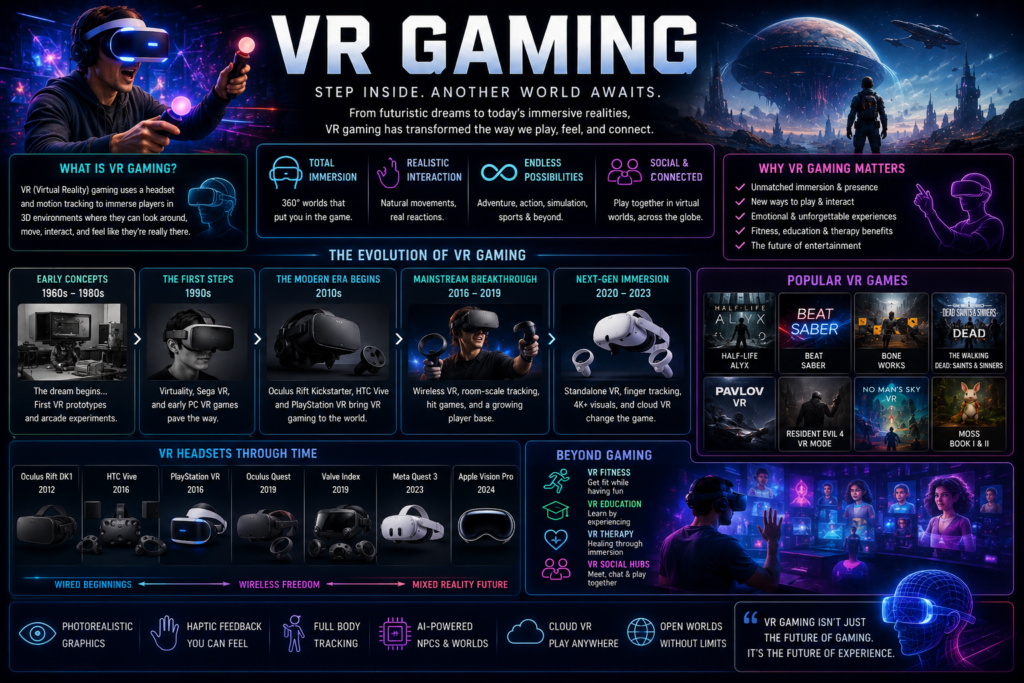
Virtual Reality (VR) represents one of the most exciting innovations in the History of Video Games.
Unlike traditional gaming, VR places players directly inside the virtual world through specialized headsets and motion controllers.
Instead of simply watching a screen, players can look around naturally, interact with objects, and experience immersive environments.
Modern VR systems include:
Meta Quest
PlayStation VR
HTC Vive
Valve Index
VR gaming offers experiences ranging from adventure and puzzle games to racing simulators, fitness applications, and educational programs.
As hardware becomes more affordable and powerful, many experts believe VR will play an increasingly important role in the future of gaming.
Cloud Gaming Changes Everything
Cloud gaming is one of the newest chapters in the History of Video Games.
Traditionally, games needed to be downloaded and installed on powerful hardware.
Cloud gaming changes this by running games on remote servers while streaming the gameplay directly to a player’s device.
This technology allows users to play demanding games on smartphones, tablets, laptops, and even smart TVs without requiring expensive gaming hardware.
Popular cloud gaming services include:
Xbox Cloud Gaming
NVIDIA GeForce NOW
Amazon Luna
Although cloud gaming depends on fast internet connections, improvements in broadband and 5G technology continue making the service more practical.
Many experts believe cloud gaming will become increasingly important during the coming years.
Artificial Intelligence in Video Games
Artificial Intelligence (AI) has transformed the History of Video Games by making virtual worlds more realistic and engaging.
Early games featured simple computer-controlled opponents that followed predictable patterns.
Modern AI allows non-player characters (NPCs) to react intelligently to player actions, communicate naturally, adapt strategies, and create more believable environments.
AI is also used for:
Enemy behavior
Dynamic difficulty adjustment
Procedural world generation
Storytelling
Character animation
Voice interaction
As AI technology continues improving, future games may offer personalized adventures where every player’s experience becomes unique.
Indie Games and Creative Innovation
Independent game developers, commonly called indie developers, have become an important part of the History of Video Games.
Unlike major studios with huge budgets, indie developers often work in small teams while focusing on creativity and original gameplay ideas.
Many indie games have achieved worldwide success despite modest development budgets.
Popular indie titles include:
Minecraft (originally developed independently)
Stardew Valley
Hollow Knight
Celeste
Undertale
Among Us
These games demonstrate that innovative ideas and engaging gameplay can be just as important as expensive graphics.
Indie developers continue introducing fresh concepts that inspire the entire gaming industry.
Gaming as a Cultural Phenomenon
Today, the History of Video Games extends far beyond entertainment.
Gaming influences:
Movies
Television
Music
Fashion
Education
Scientific research
Social media
Digital art
Gaming conventions, livestreams, speedrunning events, cosplay competitions, and online communities bring together millions of fans every year.
Platforms such as YouTube and Twitch have also allowed gamers to become content creators, educators, and entertainers with global audiences.
Video games now play an important role in modern culture and continue shaping how people communicate, learn, and create.
The Future of Video Games
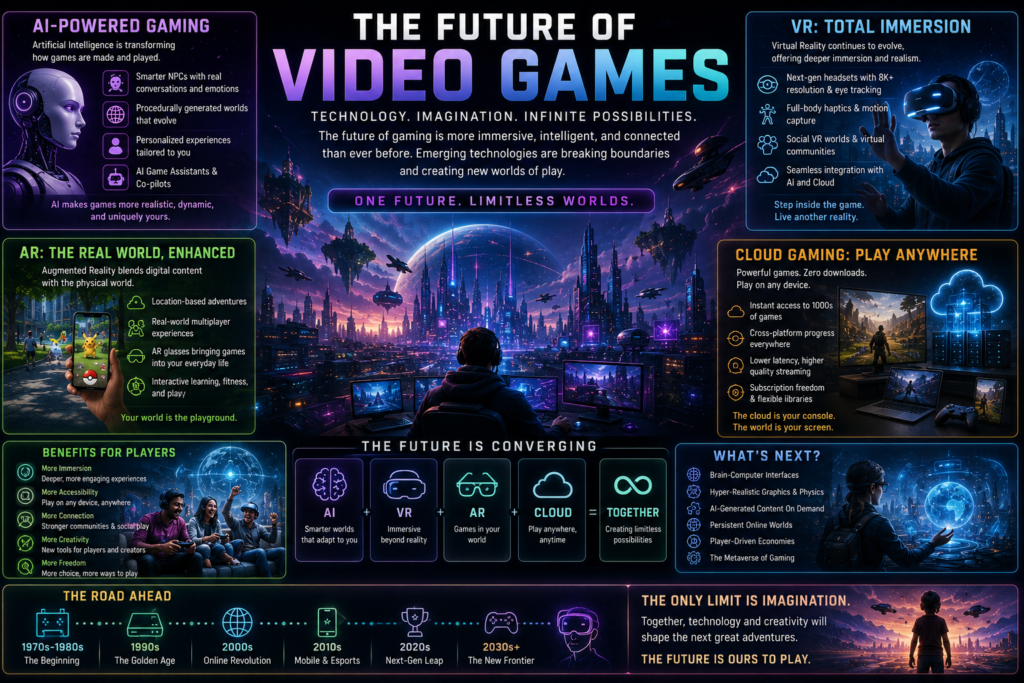
The History of Video Games continues to evolve at an incredible pace. Technologies that once seemed like science fiction are becoming reality, opening exciting possibilities for players and developers alike.
Artificial intelligence is making non-player characters (NPCs) smarter and game worlds more dynamic. Cloud gaming allows players to enjoy high-quality games without expensive hardware, while virtual and augmented reality create immersive experiences that blur the line between the digital and physical worlds.
Developers are also exploring haptic feedback, eye tracking, motion capture, and realistic physics engines to make games feel more lifelike than ever before. Future games may adapt to individual player choices, creating unique adventures every time someone plays.
As internet speeds continue improving through fiber-optic networks and 5G technology, online multiplayer games will become even smoother and more accessible around the world.
The future promises exciting innovations that will continue shaping the History of Video Games for generations to come.
Video Games in Education
Video games are no longer used only for entertainment.
Educational games help students learn mathematics, science, geography, languages, history, and problem-solving skills through interactive experiences.
Teachers increasingly use educational games to improve classroom engagement because students often learn more effectively when they actively participate rather than simply reading textbooks.
Simulation games also allow learners to practice real-world skills in safe virtual environments.
Examples include:
Flight simulators for pilot training
Engineering simulations
Language learning games
Medical training simulations
Coding games for beginners
These applications demonstrate how gaming has become an important educational tool.
Video Games in Healthcare
Another fascinating chapter in the History of Video Games is their growing role in healthcare.
Hospitals and rehabilitation centers use specially designed games to help patients recover from injuries, improve motor skills, and increase physical activity.
Virtual reality games assist with:
Physical rehabilitation
Balance training
Pain management
Anxiety reduction
Stress relief
Some games also encourage regular exercise through motion-based gameplay.
Researchers continue studying how video games can improve mental health, memory, and cognitive abilities while supporting medical treatments.
The Impact of Video Games on Society
The History of Video Games has had a profound influence on modern society.
Gaming has become one of the world’s largest entertainment industries, generating more revenue than many other forms of entertainment combined.
Video games have influenced:
Movies
Television
Music
Fashion
Sports
Education
Technology
Artificial Intelligence
Gaming communities bring together people from different countries, cultures, and languages.
Many friendships, careers, and businesses have been built through gaming.
At the same time, experts encourage maintaining a healthy balance between gaming, education, work, exercise, and family life to ensure gaming remains a positive part of everyday life.
Amazing Facts About Video Games
The History of Video Games is filled with fascinating achievements and surprising milestones.
The first commercial arcade hit was Pong, released in 1972.
Super Mario is one of the world’s most recognizable video game characters.
Minecraft is one of the best-selling video games of all time.
The gaming industry generates hundreds of billions of dollars each year.
Esports tournaments attract millions of online viewers worldwide.
Modern games can require hundreds of developers working together.
Some video game soundtracks are performed by full orchestras.
Virtual reality allows players to experience games in fully immersive environments.
Cloud gaming makes high-quality games accessible without expensive hardware.
Artificial intelligence creates smarter and more realistic game worlds.
Mobile gaming has introduced billions of people to video games.
Gaming technology has influenced robotics, artificial intelligence, and scientific simulations.
Educational games help students develop creativity and problem-solving skills.
Professional esports players compete for prize pools worth millions of dollars.
The History of Video Games continues to evolve every year with new technologies and creative ideas.
Frequently Asked Questions
What was the first video game?
One of the earliest interactive video games was Tennis for Two, created in 1958. Another influential early game was Spacewar!, developed in 1962.
Which company helped revive the gaming industry?
Nintendo played a major role in reviving the gaming industry after the 1983 crash through the success of the Nintendo Entertainment System (NES).
What is the most popular gaming platform today?
Today, people play games on consoles, personal computers, smartphones, tablets, and cloud gaming platforms. Popularity varies by region and game type.
What is esports?
Esports refers to organized competitive video gaming where professional players and teams compete in tournaments watched by audiences worldwide.
What is virtual reality gaming?
Virtual reality (VR) gaming uses special headsets and controllers to place players inside immersive three-dimensional virtual environments.
How has gaming changed over time?
Gaming has evolved from simple arcade machines into highly realistic experiences featuring online multiplayer, artificial intelligence, cloud gaming, and virtual reality.
Conclusion
The History of Video Games is a remarkable story of creativity, innovation, and technological progress. From the early experiments of the 1950s to today’s immersive virtual reality experiences, gaming has transformed into one of the world’s most influential forms of entertainment.
Every era has introduced groundbreaking ideas—from arcade classics and home consoles to online multiplayer, mobile gaming, esports, and cloud gaming. Companies such as Nintendo, Sega, Sony, Microsoft, and countless independent developers have played vital roles in shaping the industry.
Today, video games inspire creativity, connect millions of people worldwide, support education and healthcare, and continue pushing the boundaries of technology. As artificial intelligence, virtual reality, and cloud computing become more advanced, the future of gaming promises even more exciting possibilities.
The History of Video Games is far from over. With every new innovation, developers and players continue writing the next chapter of one of humanity’s greatest technological success stories.
Explore More
If you enjoyed learning about the History of Video Games, you may also like these articles:
Black Holes Explained: The Ultimate Guide to the Universe’s Greatest Mystery https://itshk.in/black-holes-explained/
The Deep Ocean: Earth’s Last Unexplored World https://itshk.in/the-deep-ocean-earths-last-unexplored-world/
Top 10 Upcoming Space Missions That Could Change the Future https://itshk.in/top-10-upcoming-space-missions-in-india/
The History of Video Games is closely connected to the evolution of technology, entertainment, and popular culture. Readers interested in learning more about classic arcade games, legendary consoles, and the preservation of gaming history can explore the official resources provided by The Strong National Museum of Play, which features one of the world’s most comprehensive collections of video game history and interactive exhibits. http://The Strong National Museum of Play
The video game industry continues to grow through innovation, education, esports, and technological advancement. Readers who want to learn more about the gaming industry, its impact on society, and the latest developments in interactive entertainment can visit the official website of the Entertainment Software Association (ESA).http://Entertainment Software Association (ESA)