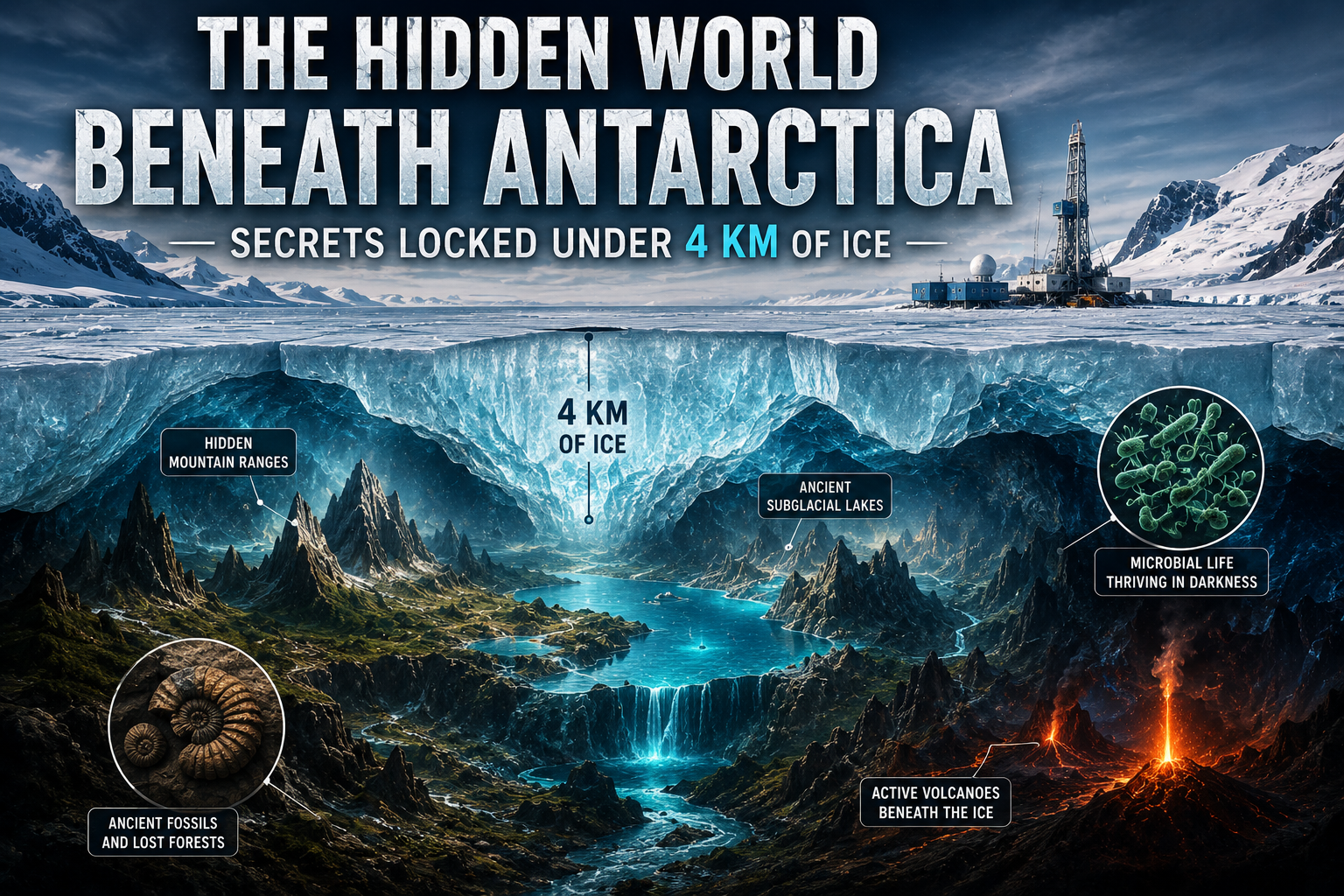
The Hidden World Beneath Antarctica: Secrets Locked Under 4 km of Ice
Introduction
Antarctica is often imagined as a vast, frozen wilderness of endless snow, powerful glaciers, and extreme cold. Covering nearly 14 million square kilometers, it is the coldest, driest, and windiest continent on Earth. While its icy surface appears lifeless, scientists have discovered that one of the planet’s greatest mysteries lies hidden far below the frozen landscape.
Beneath Antarctica’s ice sheet—reaching depths of up to 4 kilometers—exists an extraordinary hidden world. This underground realm contains ancient mountain ranges, massive freshwater lakes, active volcanoes, fossilized forests, mysterious microorganisms, and geological secrets that have remained untouched for millions of years. Every new scientific expedition reveals another piece of this incredible puzzle, changing our understanding of Earth’s history and even providing clues about the possibility of life on other planets.
The Hidden World Beneath Antarctica is not just a fascinating scientific mystery—it is a living archive of our planet’s past. By studying what lies beneath the ice, researchers can uncover evidence of ancient climates, extinct ecosystems, continental movements, and the evolution of life itself. These discoveries also help scientists predict future climate changes and understand how Antarctica influences global sea levels and weather patterns.
In recent decades, breakthroughs in satellite imaging, ice-penetrating radar, seismic mapping, and deep drilling technology have allowed researchers to peer through the continent’s massive ice sheet without removing it. These advanced tools have revealed a landscape unlike anything previously imagined—a hidden continent buried beneath one of Earth’s thickest layers of ice.
In this pillar guide, you’ll explore the incredible secrets locked beneath Antarctica’s 4 km thick ice, including hidden mountain ranges, ancient subglacial lakes, microbial life, fossilized forests, active volcanoes, groundbreaking scientific missions, and what these discoveries could mean for the future of our planet.
Why Antarctica Is Unlike Any Other Continent
Antarctica is unlike any place on Earth. Located at the southernmost point of the planet, it is almost entirely covered by ice, with approximately 98% of its surface buried beneath a permanent ice sheet. Some regions have remained frozen for more than 30 million years, preserving a unique geological record found nowhere else.
Several remarkable facts make Antarctica one of the most extraordinary places on the planet:
It contains about 70% of Earth’s freshwater locked inside its glaciers and ice sheets.
The ice sheet reaches up to 4 kilometers thick in some regions.
Winter temperatures can fall below −80°C, making it the coldest place on Earth.
Strong winds regularly exceed 300 km/h in certain areas.
It has no permanent human population, only rotating teams of scientists working at research stations.
Despite its harsh environment, Antarctica plays a critical role in regulating Earth’s climate. The continent reflects a significant amount of sunlight back into space, helping maintain global temperatures. Ocean currents surrounding Antarctica also influence weather systems across the entire planet.
For many years, scientists believed that Antarctica’s frozen surface hid nothing but solid rock. However, modern technology has revealed an astonishing underground world filled with rivers, lakes, mountains, volcanoes, and signs that Antarctica was once a green, forest-covered continent.
These discoveries have transformed Antarctica from a seemingly lifeless land into one of the most important scientific frontiers on Earth.
How Antarctica Became Covered by 4 km of Ice
Millions of years ago, Antarctica looked dramatically different from the frozen continent we know today. During the age of the supercontinent Gondwana, Antarctica was connected to Africa, South America, India, Australia, and Madagascar. The continent enjoyed a much warmer climate, with rivers, dense forests, and diverse plant and animal life.
Fossil evidence discovered beneath Antarctica confirms that ancient forests once flourished across the continent. Fossilized leaves, tree trunks, pollen, and even dinosaur remains show that Antarctica supported thriving ecosystems millions of years before it became frozen.
The transformation began around 34 million years ago when Earth’s climate cooled significantly. As Antarctica gradually drifted toward the South Pole due to plate tectonics, it became increasingly isolated by the formation of the Southern Ocean and the Antarctic Circumpolar Current. This powerful ocean current prevented warm tropical waters from reaching the continent.
Without warm ocean currents, temperatures dropped dramatically. Snow that fell during winter no longer melted completely during summer. Over millions of years, layer upon layer of snowfall compressed into dense glacial ice.
This slow but continuous accumulation eventually created the enormous Antarctic Ice Sheet we see today. In some regions, the ice became nearly 4 kilometers thick, burying mountains, valleys, rivers, forests, lakes, and volcanoes beneath an almost unimaginable weight.
Although Antarctica appears frozen and inactive from above, the hidden landscape beneath the ice remains surprisingly dynamic. Geological activity continues deep below the surface, while subglacial lakes, underground rivers, and volcanic heat interact beneath the massive ice sheet.
The Antarctic Ice Sheet: Earth’s Frozen Giant
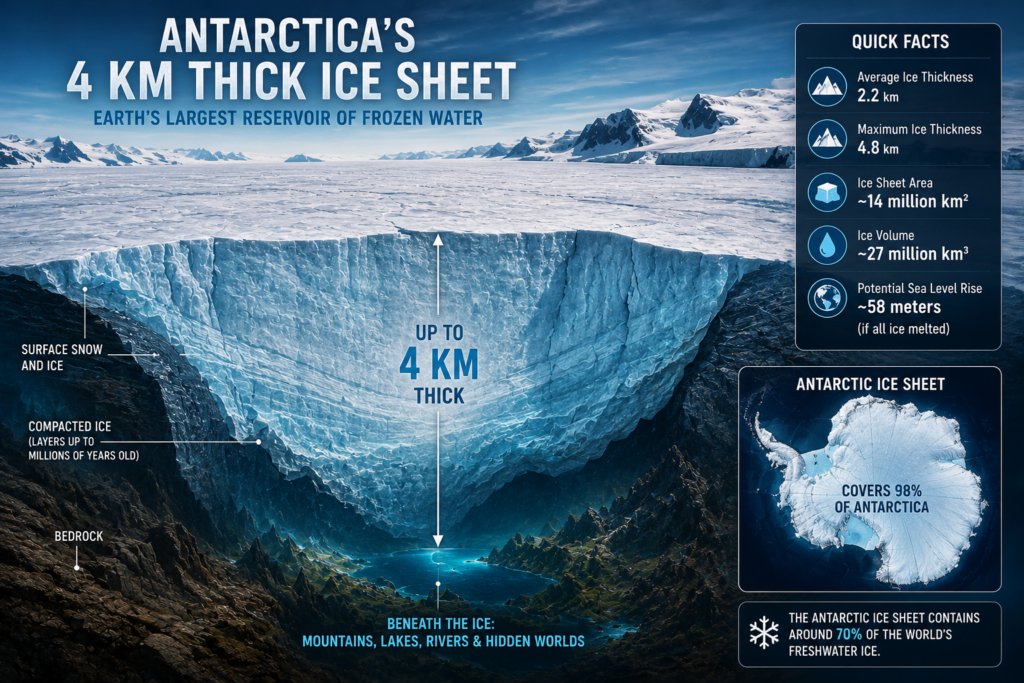
The Antarctic Ice Sheet is the largest single mass of ice on Earth and one of the most important natural systems influencing the planet’s climate. Covering almost the entire continent, it stores an enormous amount of freshwater that would dramatically reshape coastlines if it were ever to melt completely.
The ice sheet is divided into two major sections:
East Antarctic Ice Sheet
The East Antarctic Ice Sheet is the larger and older of the two. It contains most of Antarctica’s ice and rests on ancient continental rock. In many places, this ice has remained stable for millions of years, making it an invaluable archive of Earth’s climate history.
West Antarctic Ice Sheet
The West Antarctic Ice Sheet is smaller but more vulnerable to climate change. Much of it rests on bedrock below sea level, making it especially sensitive to warming ocean water. Scientists closely monitor this region because melting here could significantly contribute to global sea-level rise.
The Antarctic Ice Sheet acts like a gigantic frozen blanket covering an entire hidden continent. Beneath it lie towering mountain ranges, deep valleys, vast freshwater lakes, volcanic systems, ancient river networks, and evidence of ecosystems that existed long before Antarctica froze.
Scientists study ice cores extracted from deep within the ice sheet to understand Earth’s past climate. These ice cores trap tiny bubbles of ancient air, allowing researchers to reconstruct atmospheric conditions from hundreds of thousands of years ago. Each layer of ice represents another chapter in Earth’s history, helping scientists understand how climate has changed over time.
As technology continues to improve, researchers are discovering that the Hidden World Beneath Antarctica is far more complex than anyone imagined. Every expedition uncovers new landscapes, hidden waterways, and clues about our planet’s distant past, setting the stage for even more remarkable discoveries beneath the ice.
The Hidden World Beneath Antarctica: The Mysterious Gamburtsev Mountain Range
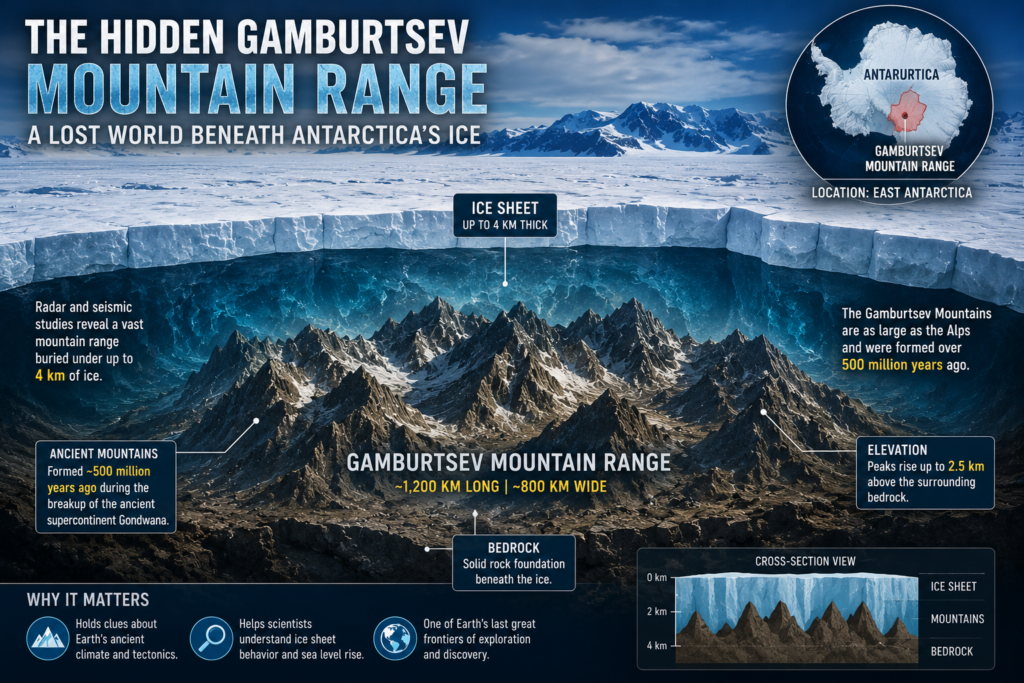
One of the greatest discoveries in the Hidden World Beneath Antarctica is the Gamburtsev Mountain Range, a gigantic chain of mountains completely buried beneath the Antarctic Ice Sheet. Unlike famous mountain ranges such as the Himalayas or the Andes, these mountains have never been seen directly by human eyes because they are hidden beneath nearly 4 kilometers of solid ice.
The Gamburtsev Mountains were first detected in 1958 during a Soviet scientific expedition using seismic instruments. The discovery shocked geologists because Antarctica was believed to be relatively flat beneath its ice sheet. Instead, scientists found an enormous mountain range stretching for more than 1,200 kilometers, with peaks reaching nearly 3,000 meters above the underlying bedrock.
What makes these mountains even more fascinating is that they appear surprisingly rugged. Normally, mountain ranges gradually erode over millions of years due to rain, rivers, glaciers, and wind. However, Antarctica’s thick ice has acted like a protective blanket, preserving many of the mountain peaks for millions of years. Scientists believe these mountains may be over 500 million years old, making them among Earth’s oldest mountain systems.
Researchers continue to debate how such a massive mountain range formed in the middle of an otherwise stable continent. One leading theory suggests that ancient continental collisions during the formation of the supercontinent Gondwana created the mountains. Another proposes that deep geological forces beneath Earth’s crust uplifted the region long before Antarctica became frozen.
Modern aircraft equipped with ice-penetrating radar, satellite imaging, gravity sensors, and seismic technology have allowed scientists to produce detailed maps of the Gamburtsev Mountains without removing the ice above them. These surveys reveal sharp ridges, deep valleys, and towering peaks comparable to many visible mountain ranges around the world.
Scientists also believe the Gamburtsev Mountains played an important role in the formation of Antarctica’s enormous ice sheet. As Earth’s climate cooled millions of years ago, the high mountain peaks likely captured snowfall, allowing glaciers to grow and eventually spread across the continent. Over time, these glaciers merged into the massive Antarctic Ice Sheet that now covers almost the entire continent.
The Gamburtsev Mountains remain one of the greatest geological mysteries within the Hidden World Beneath Antarctica, and future exploration may reveal even more about their origin and their influence on Earth’s climate history.
Lake Vostok and the Incredible Network of Subglacial Lakes
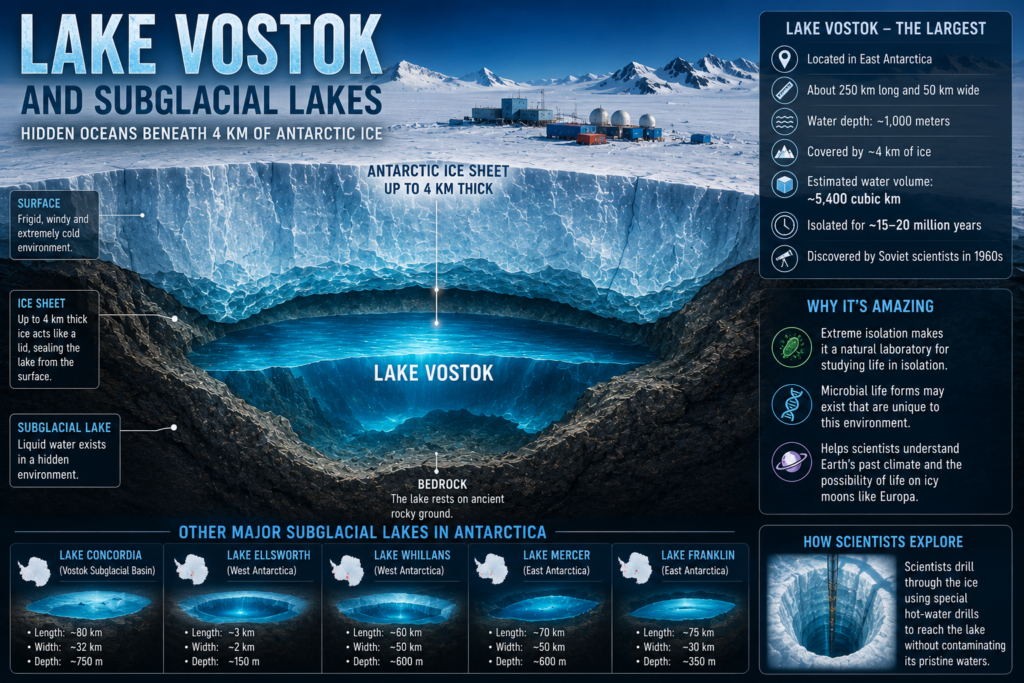
Perhaps the most astonishing feature of the Hidden World Beneath Antarctica is the existence of hundreds of hidden lakes trapped beneath the ice sheet. These are known as subglacial lakes because they lie underneath glaciers and ice rather than on the surface.
Scientists have identified more than 400 subglacial lakes beneath Antarctica. These lakes remain liquid despite the freezing temperatures because immense pressure from the thick ice lowers the freezing point of water, while heat from Earth’s interior gently warms the bedrock below.
Among all these lakes, Lake Vostok is by far the most famous.
Located beneath approximately 4 kilometers of ice, Lake Vostok is the largest known subglacial lake in Antarctica. It measures nearly 250 kilometers long and 50 kilometers wide, making it one of the largest freshwater lakes on Earth despite being completely hidden.
Scientists estimate that Lake Vostok has remained isolated from the outside world for at least 15 million years, and possibly much longer. During this time, no sunlight has reached its waters, creating one of the most extreme environments on Earth.
Because the lake has been sealed beneath the ice for millions of years, researchers believe it may contain ancient microorganisms that evolved independently from life on the surface. Discovering such organisms would greatly improve our understanding of how life adapts to extreme environments.
Studying Lake Vostok is extremely challenging. Scientists must avoid contaminating the lake with modern bacteria during drilling operations. For this reason, researchers use specially designed sterile drilling techniques and advanced robotic equipment capable of collecting water samples while minimizing environmental impact.
Lake Vostok is not alone. Other important subglacial lakes include Lake Whillans, Lake Ellsworth, and numerous smaller hidden lakes connected through underground rivers. Satellite observations suggest that water slowly flows between many of these lakes beneath the ice, creating an enormous hidden freshwater network.
These underground waterways constantly reshape the landscape beneath Antarctica. Water lubricates the base of glaciers, allowing some ice streams to move faster toward the ocean. Understanding this hidden water system helps scientists improve predictions of future glacier movement and sea-level rise.
The discovery of these hidden lakes has transformed scientific understanding of Antarctica. Instead of being a completely frozen continent, researchers now know that the Hidden World Beneath Antarctica contains active water systems supporting unique ecosystems beneath one of Earth’s harshest environments.
Microbial Life Beneath the Ice: Life Without Sunlight
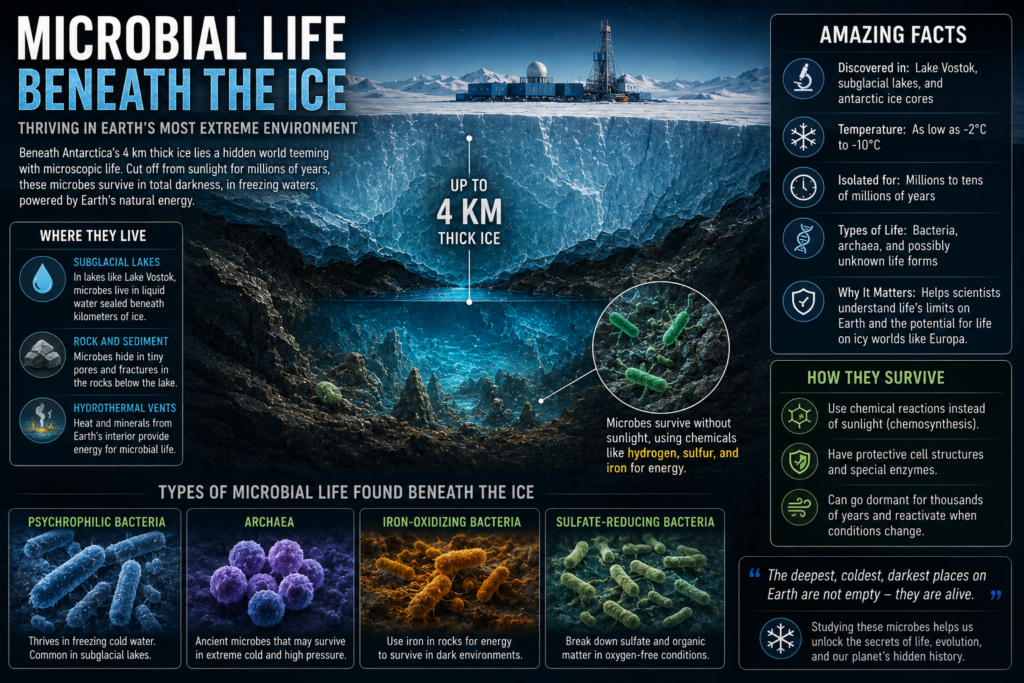
One of the most exciting discoveries within the Hidden World Beneath Antarctica is the existence of microscopic life living in complete darkness beneath kilometers of ice.
For many years, scientists assumed that no living organisms could survive in such an environment. Temperatures remain below freezing, sunlight never reaches the water, oxygen is extremely limited, and nutrients are scarce. Yet scientific expeditions have revealed thriving microbial communities beneath Antarctica’s ice sheet.
These organisms include bacteria, archaea, and other microscopic life forms specially adapted to survive under extreme conditions. Instead of depending on sunlight through photosynthesis, many microbes obtain energy by breaking down minerals such as iron, sulfur, and methane in a process known as chemosynthesis.
This remarkable survival strategy allows life to flourish without plants or sunlight.
One of the most important discoveries occurred beneath Lake Whillans, where scientists drilled through nearly 800 meters of ice and collected water samples containing thousands of microbial species. Similar discoveries have been made in sediments beneath glaciers and in other subglacial lakes.
Many of these microorganisms grow extremely slowly. Some may divide only once every several months or even years due to the limited energy available in their environment. Despite these harsh conditions, they continue to survive and reproduce, demonstrating the incredible adaptability of life.
Studying these microbes is important for several reasons. First, they help scientists understand how ecosystems function in one of Earth’s most extreme environments. Second, they provide valuable information about how life may have survived during ancient global ice ages when much of Earth was frozen.
Perhaps even more exciting is their connection to space exploration.
Scientists believe that icy moons such as Europa, which orbits Jupiter, and Enceladus, one of Saturn’s moons, may contain hidden oceans beneath thick layers of ice. These environments could resemble Antarctica’s subglacial lakes.
If microorganisms can survive beneath Antarctica’s ice without sunlight, similar forms of life might also exist beneath the frozen surfaces of these distant worlds.
For this reason, Antarctica serves as one of the best natural laboratories for astrobiology. Technologies developed to study the Hidden World Beneath Antarctica are also helping space agencies design future missions to search for extraterrestrial life.
Although researchers have already made remarkable discoveries, scientists believe they have explored only a tiny fraction of Antarctica’s hidden ecosystems. Every new expedition uncovers additional evidence that the frozen continent remains one of Earth’s greatest scientific frontiers.
Ancient Forests and Fossils Under Antarctica: Evidence of a Green Lost World
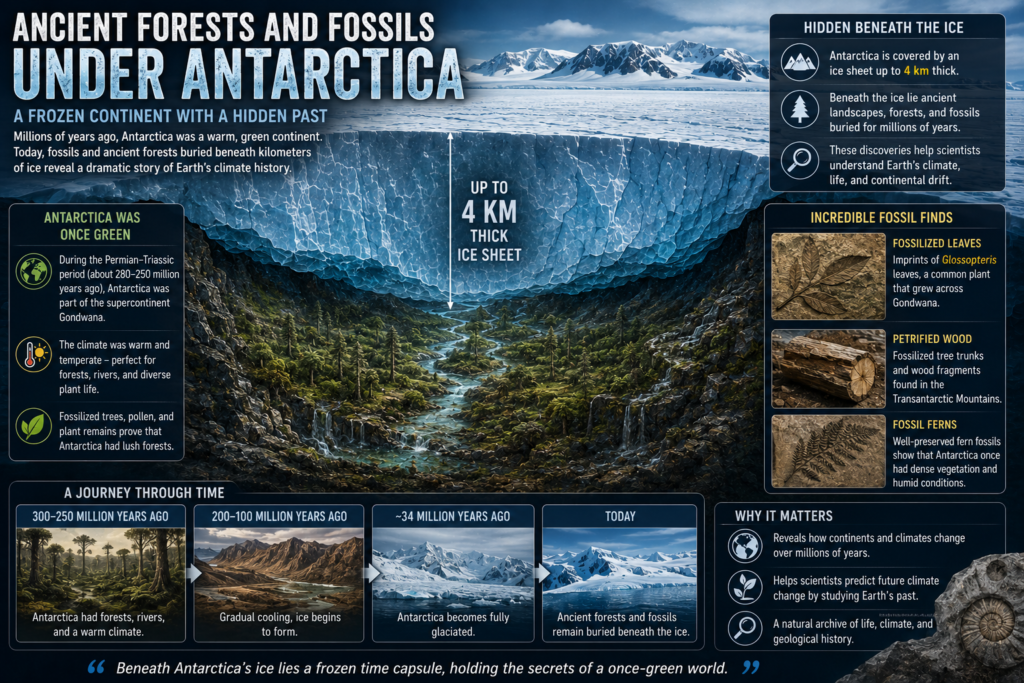
The Hidden World Beneath Antarctica is not only home to buried mountains and hidden lakes but also preserves remarkable evidence that Antarctica was once covered with lush forests, flowing rivers, and diverse wildlife. Millions of years before it became a frozen desert, the continent enjoyed a much warmer climate and supported thriving ecosystems.
Today, scientists have discovered fossilized tree trunks, ancient pollen, leaves, roots, spores, and even dinosaur fossils beneath Antarctica’s ice and rocky outcrops. These discoveries completely changed our understanding of the continent’s past and proved that Antarctica has experienced dramatic climate transformations throughout Earth’s history.
Around 200–100 million years ago, Antarctica formed part of the supercontinent Gondwana alongside Africa, South America, India, Australia, and Madagascar. During this period, the continent was located farther north and experienced a mild climate with abundant rainfall. Thick forests of conifers, ferns, mosses, and other prehistoric plants covered much of the landscape.
Although Antarctica experienced long periods of darkness during winter because of its polar location, many plant species adapted by growing rapidly during the long summer daylight. The forests supported numerous insects, reptiles, and eventually dinosaurs that thrived in these unusual conditions.
One of the most important discoveries was the fossil remains of Glossopteris, an extinct seed fern found across Antarctica, India, South America, Africa, and Australia. These identical fossils provided strong evidence that these continents were once connected before drifting apart through plate tectonics.
Scientists have also uncovered fossilized wood that still preserves microscopic growth rings. These rings help researchers reconstruct ancient rainfall, seasonal temperatures, and environmental conditions from hundreds of millions of years ago.
Even more surprising are dinosaur discoveries. Fossils of species such as Cryolophosaurus, often nicknamed the “Frozen Crested Dinosaur,” reveal that large predators once roamed Antarctica. Plant-eating dinosaurs, early mammals, amphibians, and flying reptiles also lived on the continent before global cooling transformed it into an icy wilderness.
Deep beneath the ice, researchers suspect even more ancient forests remain buried beneath sediments that have never been explored. Advanced radar surveys suggest ancient river valleys, floodplains, and forested landscapes may still exist beneath the Antarctic Ice Sheet.
These discoveries make the Hidden World Beneath Antarctica one of the most valuable archives of Earth’s ancient climate. By studying fossilized ecosystems, scientists can better understand how changing carbon dioxide levels influenced global temperatures and how ecosystems responded to dramatic environmental shifts over millions of years.
Volcanoes Hidden Beneath Antarctica
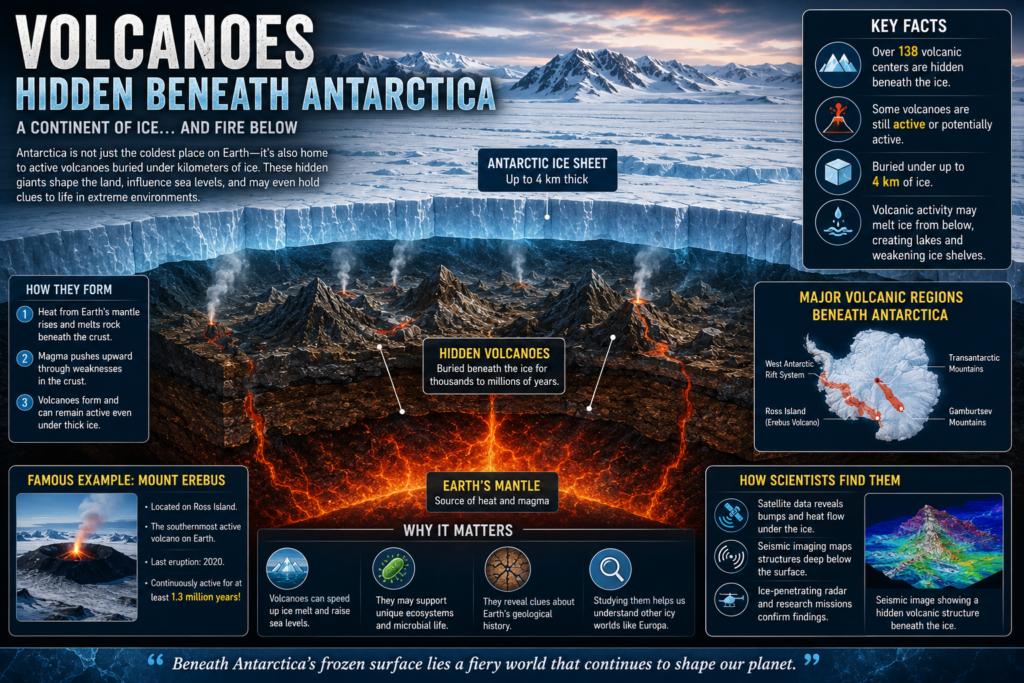
One of the most surprising parts of the Hidden World Beneath Antarctica is that the frozen continent is far from geologically inactive. Beneath its thick ice sheet lies one of the largest collections of volcanoes on Earth.
Scientists have identified more than 130 volcanoes across Antarctica, many of them hidden beneath kilometers of ice. Some are extinct, while others may still be active beneath the surface.
The best-known volcano is Mount Erebus, located on Ross Island. Rising nearly 3,794 meters, it is the southernmost active volcano on Earth and has remained active for decades. Mount Erebus is famous for its persistent lava lake, which is extremely rare worldwide.
However, many hidden volcanoes remain completely buried beneath the Antarctic Ice Sheet. Scientists discovered these volcanic systems using satellite observations, airborne radar surveys, gravity mapping, and seismic monitoring.
Volcanic heat plays an important role beneath Antarctica. Heat rising from underground can melt the base of glaciers, producing liquid water that feeds subglacial lakes and rivers. This meltwater also reduces friction between glaciers and bedrock, allowing ice streams to move more rapidly toward the ocean.
Researchers are particularly interested in West Antarctica, where volcanic activity appears more widespread. Although volcanoes are not the main cause of Antarctic ice loss, geothermal heat can influence glacier stability in certain regions.
Studying Antarctica’s volcanoes also helps scientists understand Earth’s tectonic history. Some volcanic systems formed millions of years ago when Gondwana began breaking apart, while others may be associated with deeper mantle processes still active today.
Future drilling projects may reveal whether unknown volcanic systems remain hidden beneath the ice. Every discovery adds another layer to the Hidden World Beneath Antarctica, showing that the continent is far more dynamic than its frozen surface suggests.
Scientists Drilling Through Antarctic Ice: Unlocking Earth’s Greatest Frozen Archive
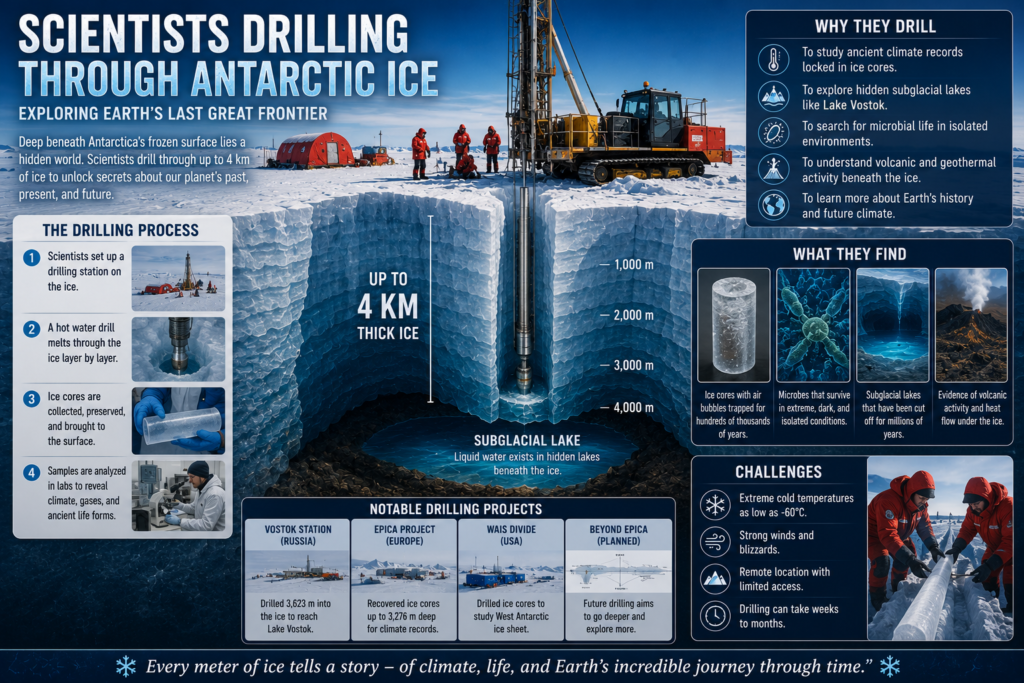
Exploring the Hidden World Beneath Antarctica is one of the greatest engineering and scientific challenges ever attempted. In many places, researchers must drill through nearly 4 kilometers of solid ice before reaching the hidden landscape below.
Because Antarctica is one of the harshest environments on Earth, drilling operations require years of planning and international cooperation. Temperatures often fall below −50°C, storms can delay missions for weeks, and equipment must operate flawlessly in extreme conditions.
Scientists use specialized hot-water drills, mechanical drilling systems, and sterile sampling equipment to avoid contaminating ancient environments beneath the ice. Even a small amount of modern bacteria introduced into subglacial lakes could permanently alter ecosystems that have remained isolated for millions of years.
One major focus of Antarctic drilling is the collection of ice cores. These long cylinders of ice preserve tiny bubbles of ancient air trapped when snow originally fell. By analyzing these bubbles, researchers can reconstruct past concentrations of carbon dioxide, methane, and other greenhouse gases stretching back hundreds of thousands of years.
Ice cores also contain volcanic ash, dust from distant deserts, microscopic marine organisms, and chemical signatures that reveal ancient climate events. Together, these records help scientists understand how Earth’s climate has changed naturally over time.
Another important goal is reaching subglacial lakes such as Lake Vostok and Lake Ellsworth. These hidden lakes may contain unique microorganisms and valuable information about ancient environmental conditions.
Modern exploration increasingly relies on advanced technology beyond drilling alone. Satellites equipped with radar penetrate the ice to map hidden mountains and valleys. Aircraft carrying gravity sensors reveal underground geological structures, while autonomous underwater robots are being developed to explore hidden lakes without contamination.
Artificial intelligence is also becoming an important tool. Machine-learning systems analyze enormous datasets collected from satellites, radar surveys, and seismic instruments, helping scientists identify previously unknown features beneath the ice.
Every expedition expands our understanding of the Hidden World Beneath Antarctica. Despite decades of exploration, researchers believe they have mapped only a fraction of the hidden continent. Vast regions remain unexplored, meaning future discoveries could include entirely new mountain ranges, lakes, ecosystems, and geological formations.
The technologies perfected in Antarctica are also influencing space exploration. Instruments designed for drilling through Antarctic ice may one day be used to penetrate the icy crust of Jupiter’s moon Europa or Saturn’s moon Enceladus in the search for extraterrestrial life.
For this reason, Antarctica is not only revealing Earth’s ancient history but also helping humanity prepare for future exploration beyond our planet.
Antarctica and Climate Change: Why the Hidden World Beneath Antarctica Matters More Than Ever
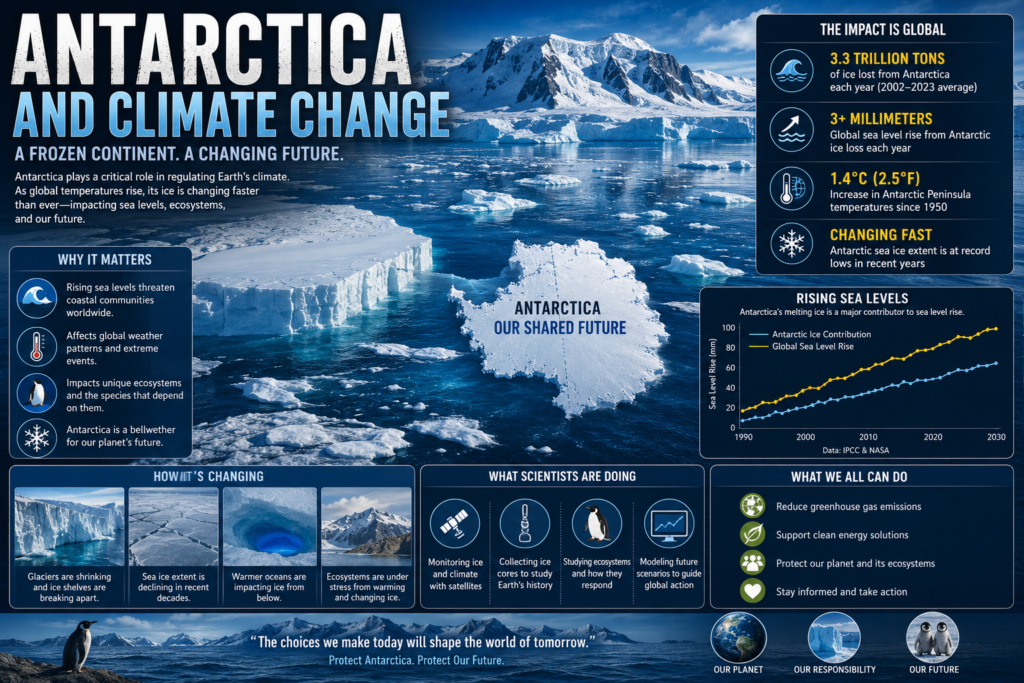
The Hidden World Beneath Antarctica is no longer just a scientific curiosity—it has become one of the most important areas of climate research on Earth. As global temperatures continue to rise, scientists are closely monitoring Antarctica because changes beneath its ice sheet could significantly influence sea levels, ocean currents, ecosystems, and weather patterns across the planet.
Although Antarctica still appears stable from space, subtle changes are occurring beneath the surface. Warmer ocean water is reaching the edges of major glaciers, causing them to melt from below. At the same time, underground rivers and subglacial lakes continue to move beneath the ice, while geothermal heat from hidden volcanoes affects certain regions.
Researchers use satellites to measure tiny changes in the height and movement of Antarctica’s ice sheet. Even small variations can indicate that glaciers are speeding up, slowing down, or losing ice into the ocean.
One of the greatest concerns is the West Antarctic Ice Sheet. Unlike much of East Antarctica, large parts of West Antarctica rest on bedrock below sea level. This makes the region particularly vulnerable because warm seawater can flow beneath floating ice shelves, weakening them from below. When ice shelves collapse, glaciers behind them often move faster toward the sea.
Scientists stress that Antarctica is not expected to lose all its ice anytime soon. However, understanding these processes is essential because Antarctica stores about 70% of Earth’s freshwater. If significant portions of this ice melted over many centuries, global coastlines would change dramatically.
The Hidden World Beneath Antarctica also plays an important role in climate prediction. Ice cores extracted from deep within the Antarctic Ice Sheet preserve tiny bubbles of ancient air that reveal how Earth’s atmosphere changed over hundreds of thousands of years. By comparing ancient climate records with modern observations, scientists can improve computer models that predict future climate trends.
Antarctica also influences global ocean circulation. Cold, dense water formed around the continent sinks deep into the oceans and helps drive major ocean currents that transport heat and nutrients around the world. Any major disruption to this system could affect marine ecosystems and weather patterns far beyond Antarctica itself.
Because of these reasons, Antarctica has become one of the world’s most closely studied regions. Every new discovery beneath its ice helps researchers better understand not only the continent itself but also the future of Earth’s climate.
The Future of the Hidden World Beneath Antarctica
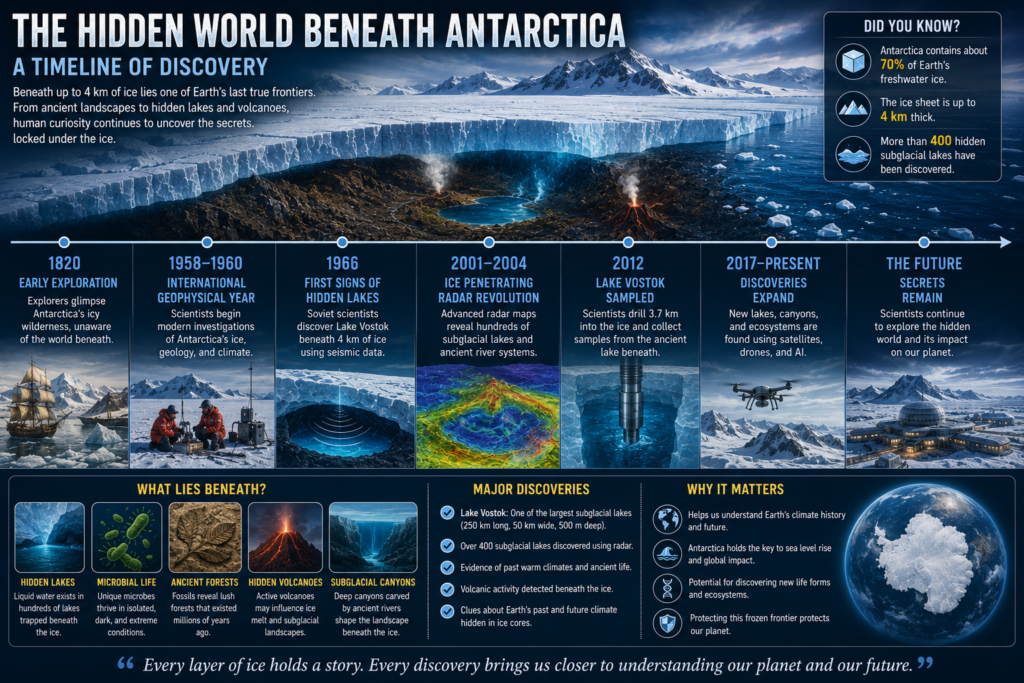
Despite decades of exploration, scientists believe they have only scratched the surface of the Hidden World Beneath Antarctica. Modern technology has revealed astonishing discoveries, but vast areas beneath the ice remain completely unexplored.
Future expeditions will rely on increasingly advanced technologies. Autonomous robots capable of traveling beneath glaciers may one day map hidden lakes and underwater rivers in unprecedented detail. Improved ice-penetrating radar will create higher-resolution maps of buried mountains, valleys, and geological structures.
Artificial intelligence is expected to play a major role in analyzing the enormous amounts of data collected from satellites, aircraft, and ground surveys. Machine learning can identify hidden patterns that might otherwise remain unnoticed, helping scientists discover previously unknown features beneath the Antarctic Ice Sheet.
Researchers are also developing cleaner drilling techniques that minimize environmental impact. Protecting Antarctica’s unique ecosystems remains a top priority because many hidden environments have remained isolated for millions of years.
Future discoveries may include:
Previously unknown mountain ranges beneath the ice.
Additional subglacial lakes connected by underground rivers.
Ancient ecosystems preserved beneath frozen sediments.
New microbial species adapted to extreme environments.
Better evidence of Antarctica’s ancient forests and rivers.
More detailed records of Earth’s past climate.
Improved understanding of glacier movement and sea-level change.
Every scientific expedition demonstrates that the Hidden World Beneath Antarctica is far more complex than researchers once imagined. Many experts believe the greatest discoveries are still waiting beneath the ice.
What the Hidden World Beneath Antarctica Can Teach Us About Other Planets
One of the most exciting reasons scientists study the Hidden World Beneath Antarctica is its connection to space exploration.
Several moons in our Solar System—including Europa (orbiting Jupiter) and Enceladus (orbiting Saturn)—are believed to contain enormous oceans hidden beneath thick layers of ice. These icy worlds may resemble Antarctica more closely than any other place on Earth.
If microorganisms can survive for millions of years beneath Antarctica’s ice without sunlight, similar forms of life might exist beneath the frozen surfaces of these distant moons.
For this reason, Antarctica serves as an ideal testing ground for future space missions. Robotic drilling systems, sterile sampling equipment, underwater exploration vehicles, and advanced sensors are first tested in Antarctica before being adapted for planetary exploration.
Astrobiologists also study Antarctic microbes to understand how life survives under extreme pressure, freezing temperatures, and limited nutrients. These findings help scientists design future missions that may search for evidence of extraterrestrial life.
In many ways, exploring the Hidden World Beneath Antarctica is preparing humanity for exploring hidden oceans elsewhere in our Solar System.
Amazing Facts About the Hidden World Beneath Antarctica
The Hidden World Beneath Antarctica continues to surprise scientists with discoveries that challenge what we know about Earth’s history. Every year, new research reveals hidden landscapes, ancient geological formations, and remarkable ecosystems buried beneath Antarctica’s massive ice sheet. Although researchers have already mapped many regions, they believe a large part of the Hidden World Beneath Antarctica remains unexplored.
One fascinating fact is that the Hidden World Beneath Antarctica contains hundreds of subglacial lakes connected by underground waterways. These hidden lakes may have remained isolated for millions of years, making them some of the most unique environments on Earth. Scientists hope that future exploration of the Hidden World Beneath Antarctica will reveal new microbial species and provide clues about how life survives in extreme conditions.
Another incredible discovery is that the Hidden World Beneath Antarctica preserves evidence of ancient forests, towering mountain ranges, volcanic systems, and river valleys that existed long before the continent became covered in ice. These discoveries help scientists understand Earth’s changing climate and the movement of continents over hundreds of millions of years.
As technology continues to improve, researchers believe the Hidden World Beneath Antarctica will reveal even more extraordinary secrets. From hidden ecosystems to clues about life beyond Earth, the Hidden World Beneath Antarctica remains one of the greatest scientific frontiers of the modern age, reminding us that our own planet still holds countless mysteries waiting to be explored.
Frequently Asked Questions (FAQs)
1. What is the Hidden World Beneath Antarctica?
The Hidden World Beneath Antarctica refers to the mountains, lakes, rivers, volcanoes, fossils, microorganisms, and geological structures buried beneath Antarctica’s massive ice sheet.
2. How thick is Antarctica’s ice?
The Antarctic Ice Sheet reaches depths of nearly 4 kilometers in some locations, making it the thickest ice sheet on Earth.
3. What is Lake Vostok?
Lake Vostok is the largest known subglacial lake in Antarctica. It lies beneath nearly 4 kilometers of ice and has remained isolated for millions of years.
4. Are there mountains beneath Antarctica?
Yes. Scientists have discovered several hidden mountain ranges, including the ancient Gamburtsev Mountains, completely buried beneath the Antarctic Ice Sheet.
5. Are there volcanoes under Antarctica?
Yes. Researchers have identified more than 130 volcanoes, including both active and dormant volcanic systems beneath Antarctica.
6. Has life been found beneath Antarctica’s ice?
Yes. Scientists have discovered microorganisms living beneath glaciers and within subglacial lakes, proving that life can survive in extreme environments.
7. Why is Antarctica important for climate research?
Antarctica stores most of Earth’s freshwater and preserves ancient climate records inside deep ice cores, helping scientists understand past and future climate change.
8. Could Antarctica help scientists discover life on other planets?
Yes. Antarctica’s hidden lakes and microbial ecosystems serve as natural laboratories for studying environments similar to those believed to exist beneath the icy surfaces of Europa and Enceladus.
Conclusion
The Hidden World Beneath Antarctica reminds us that even in the 21st century, our own planet still holds extraordinary mysteries. Hidden beneath nearly 4 kilometers of ice lies an ancient landscape filled with towering mountain ranges, vast freshwater lakes, active volcanoes, fossilized forests, unique microorganisms, and countless geological secrets waiting to be explored.
Every scientific expedition uncovers new evidence that Antarctica is far more than a frozen wilderness. It is a living archive of Earth’s history, preserving clues about ancient climates, continental movements, the evolution of life, and the forces that continue shaping our planet today.
The discoveries made beneath Antarctica are also helping scientists prepare for future exploration beyond Earth. Technologies developed to study hidden lakes and microorganisms beneath Antarctic ice may one day search for life beneath the frozen oceans of distant moons.
As technology continues to improve, researchers will reveal even more secrets hidden beneath Antarctica’s frozen surface. The Hidden World Beneath Antarctica stands as one of humanity’s greatest scientific frontiers, proving that some of Earth’s most remarkable discoveries are still waiting beneath the ice.
If you’re interested in uncovering Earth’s ancient past, be sure to read our article on How the Roman Empire Influenced the Modern World https://itshk.in/roman-empire-influenced-the-modern-world/. While the Hidden World Beneath Antarctica reveals the natural history hidden beneath Earth’s ice, the Roman Empire article explores how one of history’s greatest civilizations shaped modern law, engineering, architecture, and society. Together, these articles offer fascinating insights into our planet’s natural and human history.
If you prefer a science-to-science connection, another excellent option is to link to your Rise and Fall of Ancient Civilizations article https://itshk.in/rise-and-fall-of-ancient-civilizations/ instead, as it’s more closely related to Earth’s history and archaeology.
For more in-depth scientific information about Antarctica, visit the British Antarctic Survey (BAS), one of the world’s leading organizations for Antarctic research. Their studies cover subglacial lakes, climate change, ice sheets, hidden mountain ranges, and the latest discoveries beneath Antarctica’s ice, making it an excellent resource for readers who want to explore the science behind the Hidden World Beneath Antarctica.https://www.bas.ac.uk/