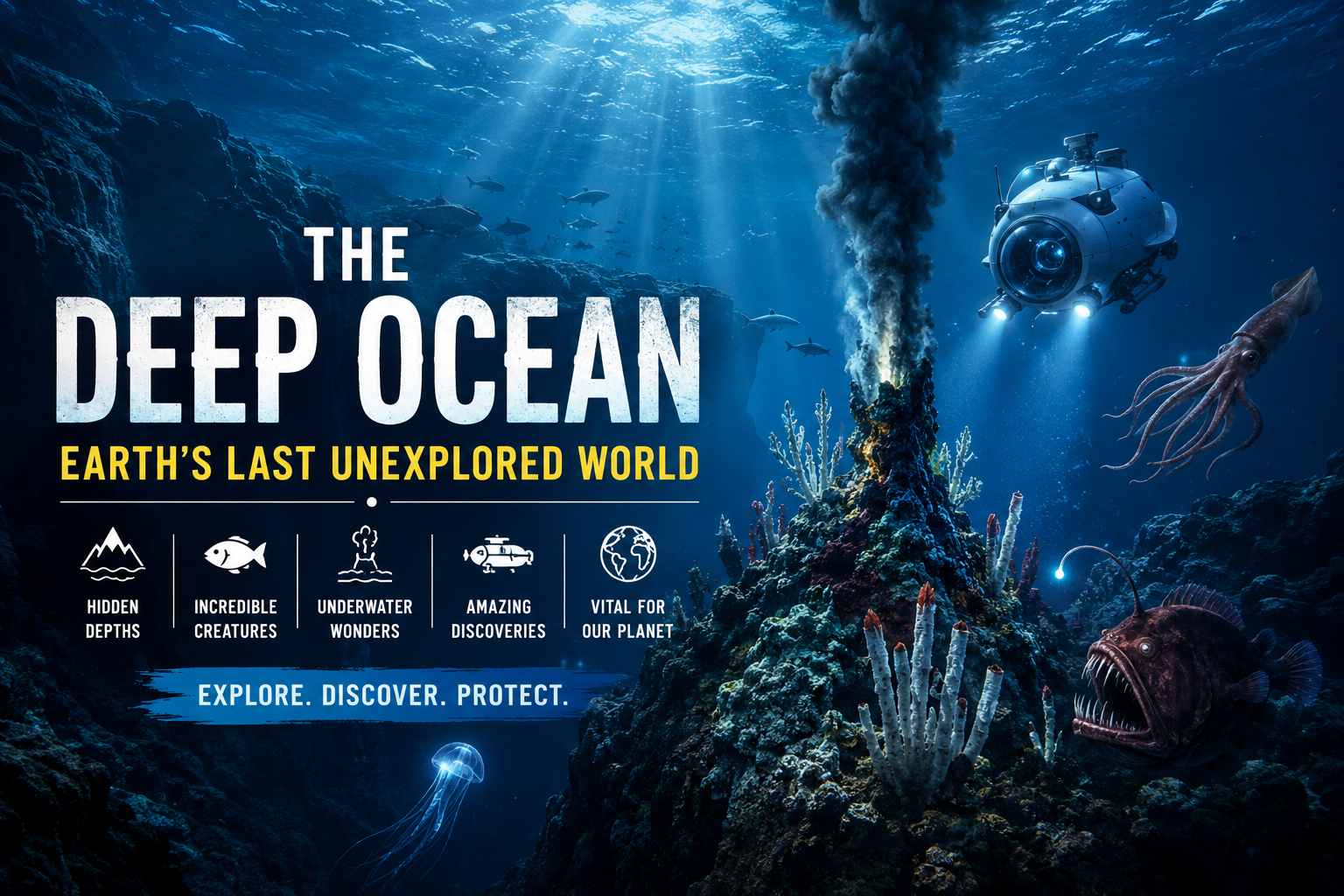
The Deep Ocean: Earth’s Last Unexplored World
Introduction
Covering more than 70% of Earth’s surface, the ocean is the planet’s largest ecosystem and one of its greatest mysteries. While humans have explored the Moon, landed spacecraft on Mars, and sent telescopes deep into the universe, much of the Deep Ocean remains unexplored. Scientists estimate that more than 80% of the ocean has never been fully mapped, explored, or observed, making it one of the last great frontiers on Earth.
The Deep Ocean is a world of complete darkness, crushing pressure, freezing temperatures, and extraordinary life forms that have evolved to survive in one of the harshest environments on the planet. Hidden beneath the waves are enormous underwater mountains, deep trenches, hydrothermal vents, and mysterious creatures unlike anything found on land.
For centuries, sailors and explorers imagined the deep sea as a place filled with sea monsters and hidden civilizations. Today, modern technology has replaced myths with scientific discovery, yet the ocean still holds countless secrets waiting to be uncovered. Every expedition reveals new species, strange geological formations, and unexpected ecosystems, reminding us how little we truly know about our own planet.
The Deep Ocean plays a vital role in regulating Earth’s climate, producing oxygen, storing carbon, supporting marine biodiversity, and influencing global weather patterns. Understanding this hidden world is essential not only for scientific research but also for protecting the future of our planet.
In this comprehensive guide, we explore the fascinating world of the Deep Ocean, including its mysterious zones, incredible wildlife, extreme environments, cutting-edge exploration technology, and the reasons why it remains Earth’s last unexplored world.
What Is the Deep Ocean?
The Deep Ocean generally refers to the parts of the ocean that lie below 200 meters (656 feet), where sunlight can no longer penetrate effectively. Beyond this depth, the environment changes dramatically. Darkness becomes permanent, temperatures drop to just a few degrees above freezing, and water pressure increases to levels that would instantly crush an unprotected human.
Scientists divide the ocean into several depth zones, each with its own unique conditions and marine life. Together, these zones create one of the most diverse and least understood ecosystems on Earth.
Unlike shallow coastal waters that receive sunlight and support coral reefs, the Deep Ocean depends on unusual sources of energy. Many organisms survive by feeding on marine snow—a constant shower of tiny organic particles drifting down from the surface—or by living near hydrothermal vents where chemicals from the Earth’s crust provide energy instead of sunlight.
Because of these harsh conditions, creatures living in the deep sea have evolved remarkable adaptations. Some produce their own light through bioluminescence, while others have enormous mouths, expandable stomachs, or transparent bodies that help them survive where food is scarce.
Why Is the Deep Ocean Still Unexplored?
Despite remarkable advances in science and engineering, exploring the Deep Ocean remains one of humanity’s greatest challenges.
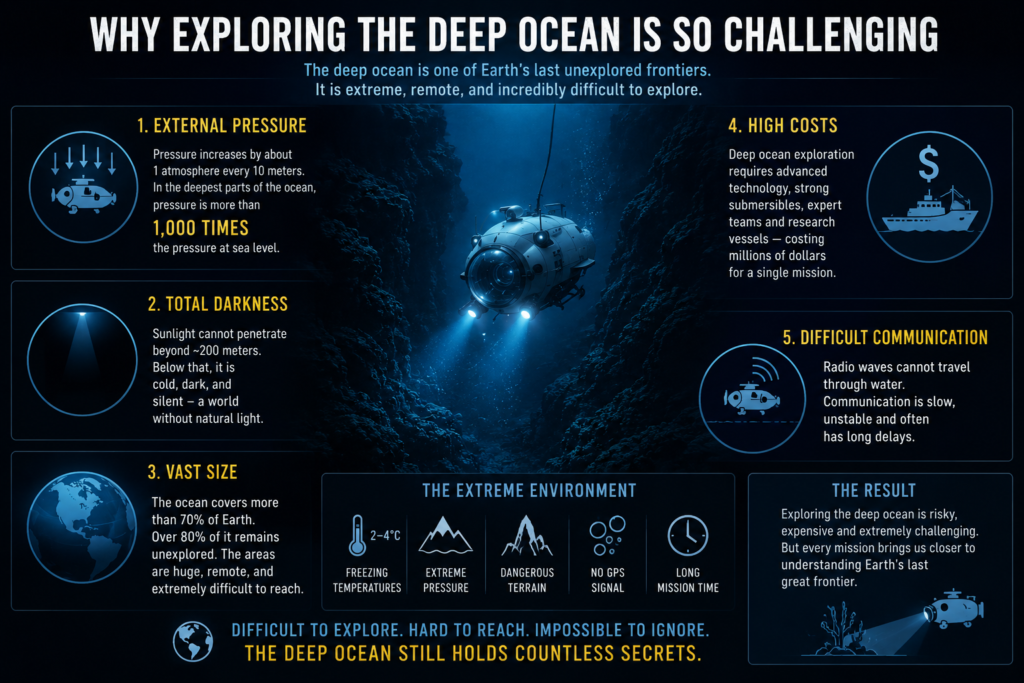
Extreme Pressure
Pressure increases rapidly with depth. At the bottom of the Mariana Trench, pressure exceeds 1,000 times the atmospheric pressure at sea level. Few materials can withstand such immense force, making exploration extremely difficult.
Total Darkness
Sunlight disappears after a few hundred meters, leaving the deep sea in permanent darkness. Scientists rely on powerful lights, sonar, and specialized cameras to observe this hidden environment.
Vast Size
The oceans cover more than 360 million square kilometers, making them far larger than all Earth’s land combined. Mapping such an enormous area requires significant time, funding, and advanced technology.
High Costs
Building deep-sea submersibles, remotely operated vehicles (ROVs), autonomous underwater vehicles (AUVs), and research vessels requires billions of dollars in investment. Only a limited number of countries and research institutions possess these capabilities.
Difficult Communication
Radio signals cannot travel effectively through seawater. Instead, underwater explorers depend on acoustic communication systems, which are slower and more limited than satellite communications used in space exploration.
For these reasons, scientists estimate that only a small fraction of the Deep Ocean has been directly explored by humans.
Why the Deep Ocean Is Important to Earth
The Deep Ocean is far more than a dark and mysterious environment. It plays a crucial role in maintaining the health of our planet and supporting life on Earth. Scientists often describe the ocean as the Earth’s life-support system because it regulates climate, stores heat, and absorbs large amounts of carbon dioxide from the atmosphere.
One of the most important functions of the Deep Ocean is its ability to store carbon. Ocean currents transport carbon-rich water into the deep sea, helping reduce the amount of carbon dioxide in the atmosphere. This natural process slows the effects of climate change and helps stabilize global temperatures.
The Deep Ocean also supports an incredible variety of marine life. Many species that live in the deep sea have adapted to survive under extreme pressure, freezing temperatures, and complete darkness. These unique organisms provide valuable insights into biology, evolution, and the possibility of life in extreme environments beyond Earth.
Researchers are also discovering new compounds from deep-sea organisms that could contribute to future medicines and scientific breakthroughs. Some bacteria and marine animals produce chemicals that may help scientists develop new antibiotics, cancer treatments, and other medical therapies.
Although much of the Deep Ocean remains unexplored, every scientific expedition reveals new species, geological formations, and ecosystems. These discoveries remind us that protecting the ocean is essential for the future of biodiversity, climate stability, and scientific research.
The Five Major Ocean Zones
Scientists divide the ocean into five primary layers based on depth.
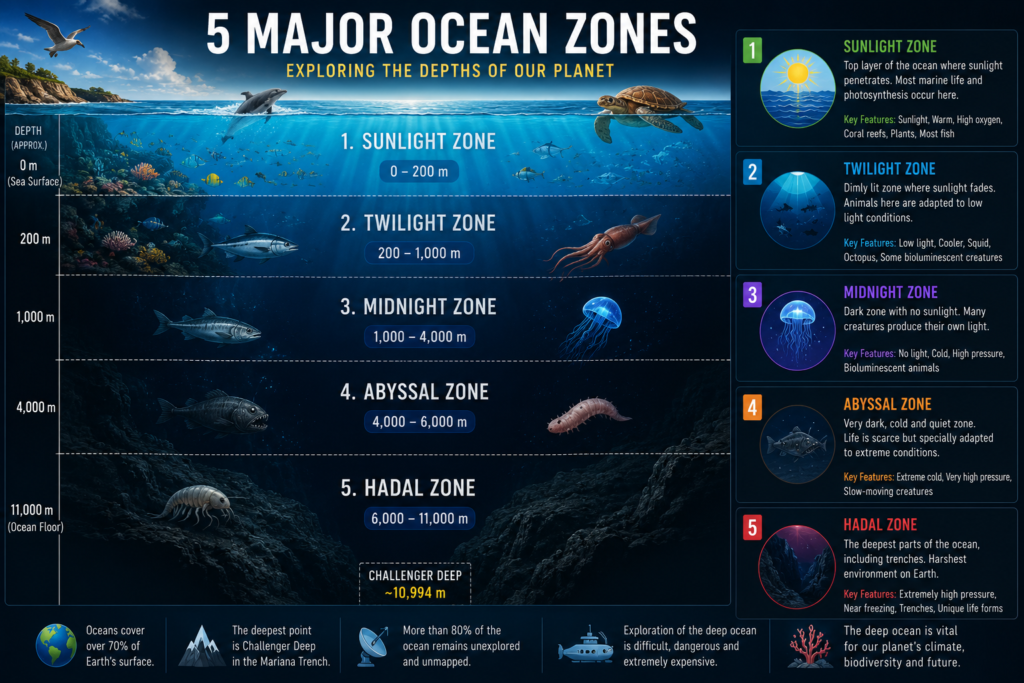
1. Sunlight Zone (0–200 meters)
This upper layer receives abundant sunlight and supports most marine life, including coral reefs, dolphins, sea turtles, and many fish species. Photosynthesis occurs here, making it the most productive ocean zone.
2. Twilight Zone (200–1,000 meters)
Light becomes extremely limited in this region. Many animals living here have large eyes to detect faint light, while others produce their own light through bioluminescence.
3. Midnight Zone (1,000–4,000 meters)
Complete darkness dominates this zone. Temperatures remain near freezing, and pressure becomes immense. Strange creatures such as anglerfish, giant squid, and gulper eels inhabit these depths.
4. Abyssal Zone (4,000–6,000 meters)
The abyssal plains cover vast areas of the ocean floor. Despite harsh conditions, this region supports sea cucumbers, brittle stars, deep-sea fish, and many microscopic organisms.
5. Hadal Zone (Below 6,000 meters)
The deepest trenches on Earth belong to the Hadal Zone, including the famous Mariana Trench. Only a few specially designed research vehicles have reached these extreme depths.
Each zone reveals a unique ecosystem, demonstrating the incredible diversity of the Deep Ocean.
The Mariana Trench – The Deepest Place on Earth
When discussing the Deep Ocean, no location is more famous than the Mariana Trench. Situated in the western Pacific Ocean, east of the Mariana Islands, it is the deepest known part of Earth’s oceans.
The trench reaches an astonishing depth of nearly 11 kilometers (about 36,000 feet) at a point known as Challenger Deep. If Mount Everest, the tallest mountain on Earth, were placed inside the Mariana Trench, its peak would still remain more than a kilometer below the ocean’s surface.
The Mariana Trench was formed millions of years ago through the movement of tectonic plates. As the Pacific Plate slowly moves beneath the smaller Mariana Plate, an enormous underwater trench was created. This geological process continues even today.
The environment inside the trench is unlike anywhere else on Earth. Temperatures remain close to freezing, sunlight never reaches these depths, and the pressure is so intense that it would crush most submarines within seconds. Despite these harsh conditions, scientists have discovered surprising forms of life living at the bottom of the trench.
Over the years, only a handful of people have visited Challenger Deep using specially designed submersibles. Each expedition has revealed new species and valuable information about the mysterious Deep Ocean, demonstrating how much remains to be discovered.
Incredible Creatures of the Deep Ocean
The Deep Ocean is home to some of the strangest and most fascinating animals on Earth. Living in complete darkness and under enormous pressure, these creatures have evolved extraordinary adaptations that help them survive.
Anglerfish
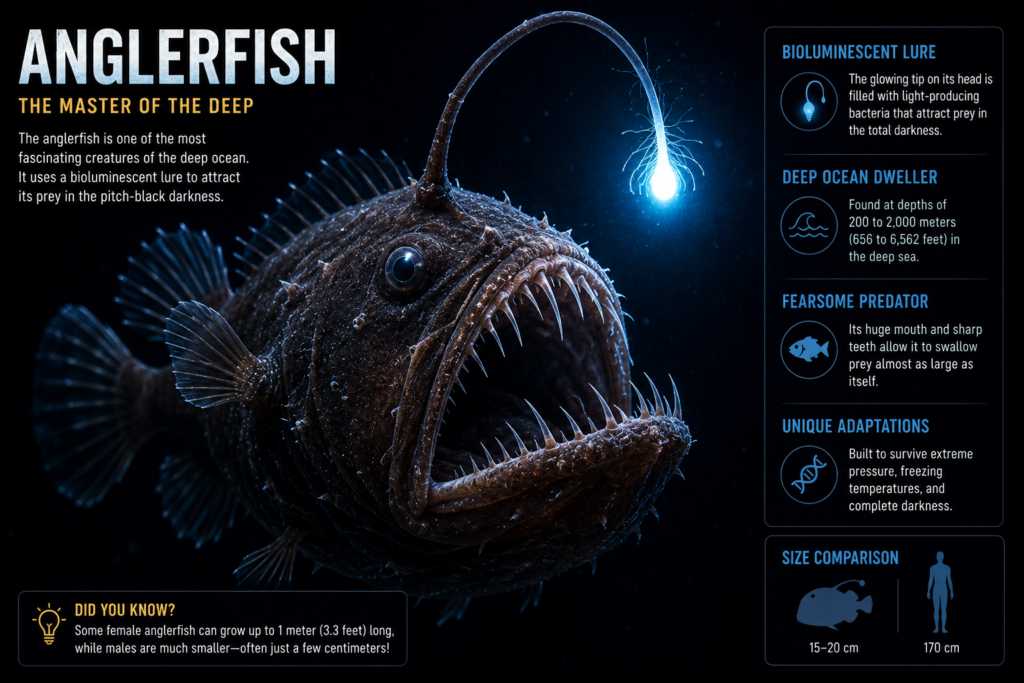
The anglerfish is one of the best-known deep-sea animals. It uses a glowing lure attached to its head to attract prey in the darkness. Once another animal approaches, the anglerfish quickly captures it with its large mouth and sharp teeth.
Giant Squid
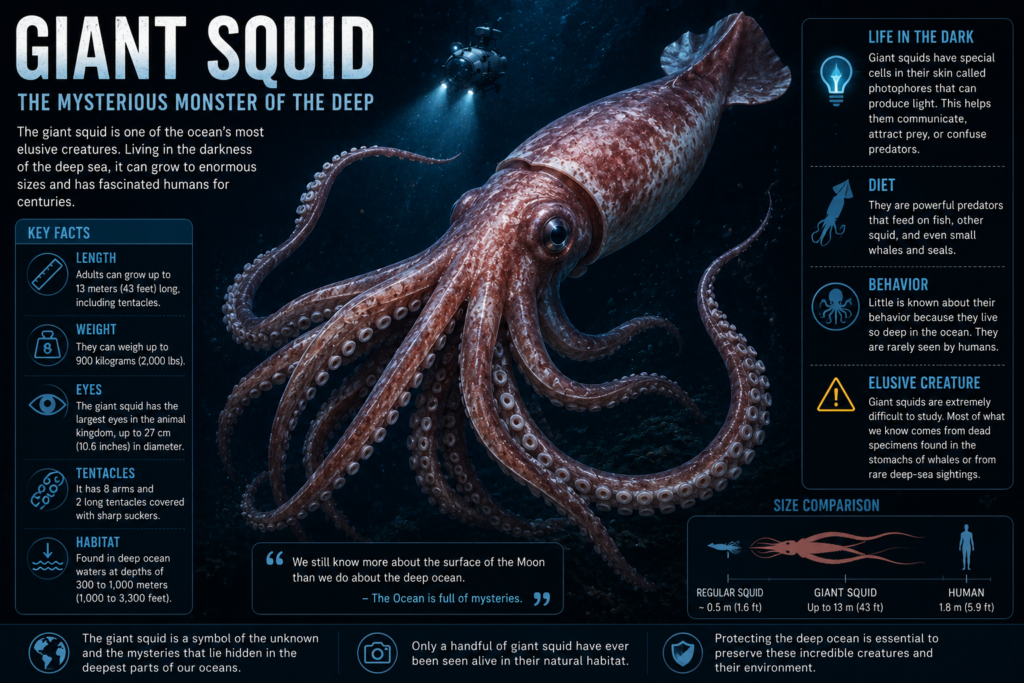
The giant squid has fascinated scientists and storytellers for centuries. Growing to impressive lengths, it inhabits deep waters where encounters with humans are extremely rare. Modern cameras have finally captured images of these elusive animals in their natural habitat.
Vampire Squid
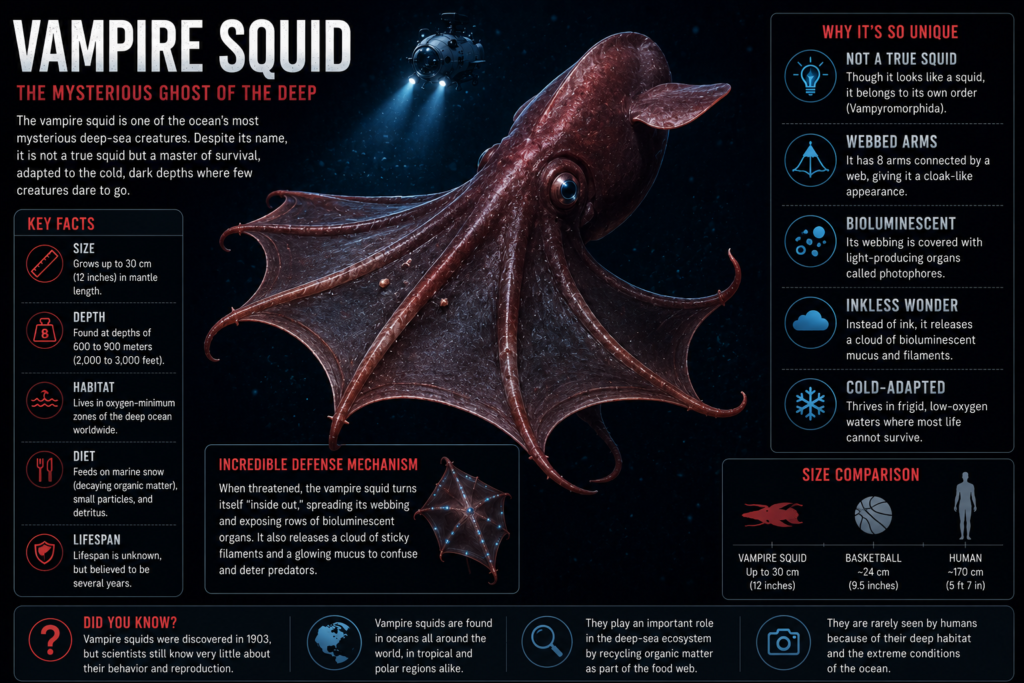
Despite its frightening name, the vampire squid is a gentle deep-sea creature that feeds mainly on tiny organic particles drifting through the water. Its dark coloration and webbed arms help it survive in the low-light conditions of the Deep Ocean.
Dumbo Octopus
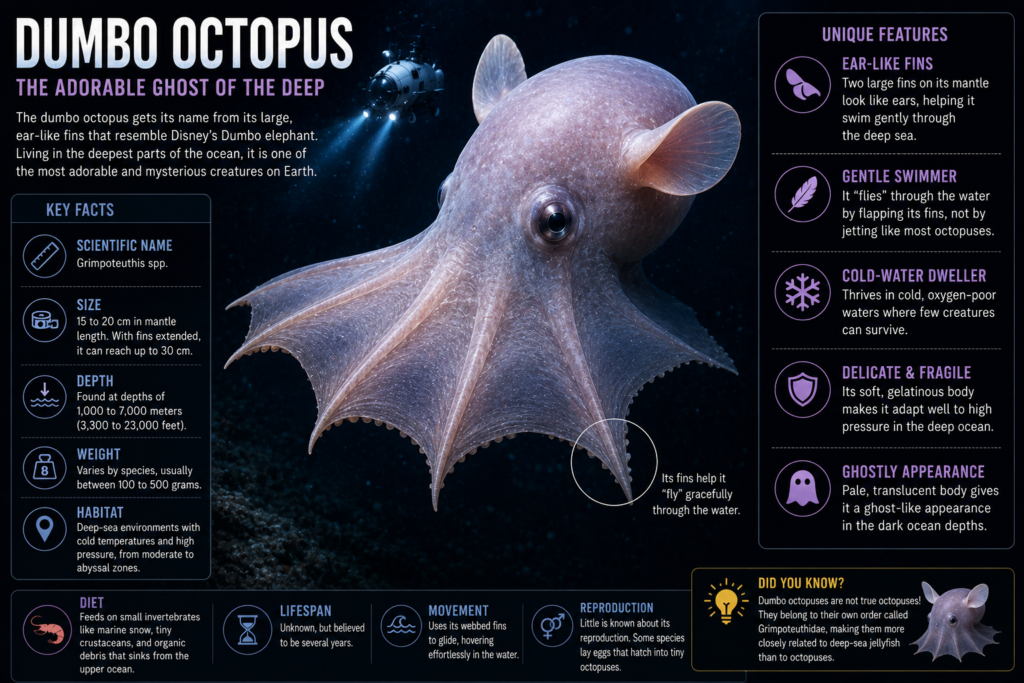
Named after the famous Disney elephant because of its ear-like fins, the Dumbo octopus lives at depths of several thousand meters. It gracefully swims above the ocean floor searching for worms, crustaceans, and other small prey.
Deep-Sea Dragonfish
The dragonfish is one of the ocean’s most effective predators. It possesses transparent teeth and produces its own light through bioluminescence, allowing it to hunt efficiently in total darkness.
Scientists estimate that thousands of deep-sea species have not yet been discovered, making every expedition into the Deep Ocean an opportunity for new scientific discoveries.
Hydrothermal Vents – Life Without Sunlight
One of the most remarkable discoveries in the history of ocean exploration was the discovery of hydrothermal vents.
Hydrothermal vents are cracks in the ocean floor where extremely hot, mineral-rich water flows out from inside the Earth. Water temperatures near these vents can exceed 350°C, yet unique ecosystems thrive around them.
Unlike almost every other ecosystem on Earth, hydrothermal vent communities do not depend on sunlight. Instead, specialized bacteria convert chemicals such as hydrogen sulfide into energy through a process called chemosynthesis.
These bacteria form the foundation of an ecosystem supporting giant tube worms, crabs, shrimp, mussels, and many other unusual species.
The discovery of hydrothermal vents changed scientists’ understanding of life on Earth and even influenced the search for life on other planets and moons.
How Scientists Explore the Deep Ocean
Exploring the Deep Ocean requires advanced technology capable of surviving extreme pressure and complete darkness.
Remotely Operated Vehicles (ROVs)
ROVs are underwater robots controlled by scientists aboard research ships. Equipped with cameras, robotic arms, and scientific instruments, they collect samples and capture detailed images from great depths.
Autonomous Underwater Vehicles (AUVs)
Unlike ROVs, AUVs operate independently using onboard computers. They map the ocean floor, measure water conditions, and explore areas that are difficult for humans to reach.
Human-Occupied Submersibles
Specialized submersibles allow scientists to personally visit the deepest parts of the ocean. These vehicles are constructed from extremely strong materials capable of withstanding enormous pressure.
Sonar Mapping
Since light cannot penetrate the Deep Ocean, researchers often use sonar technology to create detailed maps of the ocean floor. Sound waves bounce off underwater features and return to the ship, allowing computers to produce accurate maps.
Modern technology continues to improve our understanding of the ocean, yet much of the seafloor remains unexplored.
Amazing Discoveries Beneath the Sea
Every expedition into the Deep Ocean brings exciting discoveries.
Researchers have found:
Previously unknown species.
Underwater volcanoes.
Massive coral reefs.
Hidden mountain ranges.
Ancient shipwrecks.
Deep-sea ecosystems unlike anywhere else on Earth.
Scientists believe thousands of marine species have yet to be discovered, making the Deep Ocean one of the most promising areas for future scientific exploration.
The Deep Ocean and Earth’s Climate
The Deep Ocean plays one of the most important roles in regulating Earth’s climate. Although it remains hidden beneath the surface, it acts as a giant reservoir that stores heat and carbon dioxide, helping stabilize global temperatures.
Ocean currents constantly move warm and cold water around the planet. Warm water from tropical regions travels toward the poles, while cold water from polar regions sinks into the Deep Ocean and slowly circulates back toward the surface. This continuous movement, known as the global ocean conveyor belt or thermohaline circulation, helps distribute heat across the Earth.
Without these deep ocean currents, many parts of the world would experience far more extreme temperatures. Scientists estimate that the oceans absorb more than 90% of the excess heat trapped by greenhouse gases, making them essential in reducing the effects of climate change.
The Deep Ocean also stores enormous amounts of carbon. Marine plants near the surface absorb carbon dioxide during photosynthesis, and when they die, some of this carbon sinks into the deep sea. This process, known as the biological carbon pump, helps remove carbon dioxide from the atmosphere and store it for hundreds or even thousands of years.
Because of these functions, protecting the Deep Ocean is critical for maintaining Earth’s climate balance.
Deep-Sea Mining – Opportunities and Risks
As technology advances, companies and governments are becoming increasingly interested in the mineral resources hidden within the Deep Ocean.
The ocean floor contains valuable materials such as:
Nickel
Cobalt
Copper
Manganese
Rare Earth Elements
These minerals are essential for manufacturing electric vehicle batteries, smartphones, computers, wind turbines, and renewable energy technologies.
However, deep-sea mining remains highly controversial.
Potential Benefits
Supports renewable energy technologies.
Provides important industrial minerals.
Reduces dependence on land-based mining.
Environmental Concerns
Scientists warn that mining could damage fragile deep-sea ecosystems that have taken millions of years to develop.
Possible impacts include:
Habitat destruction
Increased underwater noise
Sediment pollution
Loss of biodiversity
Damage to undiscovered species
Since much of the Deep Ocean remains unexplored, researchers argue that more scientific studies should be completed before large-scale mining begins.
Plastic Pollution Reaching the Deep Ocean
Many people assume that pollution remains near beaches or floating on the ocean surface. Unfortunately, research shows that plastic waste has reached even the deepest parts of the Deep Ocean.
Scientists have discovered:
Plastic bags
Fishing nets
Microplastics
Food packaging
Beverage bottles
Thousands of meters below the surface.
Microplastics have even been found inside deep-sea animals living near the Mariana Trench.
Plastic pollution threatens marine ecosystems by:
Injuring wildlife
Entering the food chain
Damaging habitats
Reducing biodiversity
Because ocean currents transport waste across the globe, pollution created in one country can eventually reach remote parts of the Deep Ocean.
Reducing plastic waste, improving recycling systems, and protecting marine environments are essential steps toward preserving Earth’s last unexplored world.
Famous Deep Ocean Exploration Missions
Over the past century, several remarkable expeditions have expanded our understanding of the Deep Ocean.
HMS Challenger Expedition (1872–1876)
Often considered the beginning of modern oceanography, this expedition collected thousands of marine specimens and measured ocean depths across the world.
Trieste Expedition (1960)
Swiss engineer Jacques Piccard and U.S. Navy Lieutenant Don Walsh became the first humans to reach Challenger Deep inside the Mariana Trench.
Their historic dive demonstrated that human exploration of the deepest ocean was possible.
James Cameron’s Solo Dive (2012)
Film director James Cameron completed the first solo journey to Challenger Deep using the Deepsea Challenger submersible.
During the expedition, he collected valuable scientific data and captured high-quality images of the ocean floor.
Five Deeps Expedition (2018–2019)
Explorer Victor Vescovo became the first person to visit the deepest point in all five of Earth’s oceans.
His expedition revealed new species and improved scientific understanding of deep-sea ecosystems.
These missions have transformed our knowledge of the Deep Ocean, but they represent only a tiny fraction of what remains unexplored.
Amazing Facts About the Deep Ocean
The Deep Ocean contains countless surprising facts that continue to amaze scientists.
More than 80% of the ocean remains unexplored.
The Mariana Trench is deeper than Mount Everest is tall.
Some deep-sea animals produce their own light through bioluminescence.
Hydrothermal vents can release water hotter than 350°C.
The deepest parts of the ocean receive no sunlight at all.
Underwater mountain ranges are longer than any mountain range on land.
Thousands of marine species remain undiscovered.
The Deep Ocean stores vast amounts of carbon, helping regulate Earth’s climate.
Some deep-sea creatures can survive under pressures impossible for most life forms.
Scientists continue discovering new ecosystems during nearly every major expedition.
Mysteries That Still Puzzle Scientists
Although researchers have learned a great deal about the Deep Ocean, many mysteries remain unsolved.
Scientists continue investigating questions such as:
How many undiscovered species still exist?
What unknown ecosystems remain hidden beneath the ocean floor?
Could entirely new forms of life exist in unexplored trenches?
How do some organisms survive extreme pressure?
What secrets remain buried beneath deep-sea sediments?
Every expedition raises new questions while answering old ones.
For this reason, many scientists consider the Deep Ocean to be Earth’s final great frontier.
The Future of Deep Ocean Exploration
Although humanity has made remarkable progress in exploring the Deep Ocean, scientists believe we have only scratched the surface of what lies beneath the waves. Advances in robotics, artificial intelligence, autonomous underwater vehicles, and high-pressure submersibles are making deep-sea exploration safer and more efficient than ever before.
Future expeditions are expected to map unexplored regions of the ocean floor, discover new marine species, and study underwater volcanoes, hydrothermal vents, and deep-sea ecosystems in greater detail. Researchers also hope to learn more about how the Deep Ocean influences Earth’s climate and supports life across the planet.
International cooperation will play an important role in future exploration. Many countries are working together to share scientific knowledge, improve ocean mapping, and protect fragile marine habitats. Projects such as the Seabed 2030 initiative aim to create a complete map of the world’s ocean floor, helping scientists better understand the largest environment on Earth.
As technology continues to improve, the Deep Ocean may reveal discoveries that change our understanding of biology, geology, medicine, and even the possibility of life beyond Earth.
Why Protecting the Deep Ocean Matters
The Deep Ocean is one of Earth’s most valuable ecosystems, yet it is increasingly threatened by human activities. Pollution, climate change, overfishing, and proposed deep-sea mining projects all have the potential to damage fragile habitats that have taken millions of years to develop.
Many deep-sea species grow slowly and reproduce less frequently than animals living in shallow waters. This means damaged ecosystems may require centuries to recover.
Protecting the Deep Ocean is essential because it helps regulate global climate, stores carbon, supports biodiversity, and provides valuable scientific knowledge. Governments, scientists, conservation organizations, and individuals all have a role to play in preserving this unique environment.
Simple actions such as reducing plastic waste, supporting sustainable fishing practices, and encouraging marine conservation can contribute to protecting the oceans for future generations.
The Deep Ocean and Space Exploration
Scientists often compare exploring the Deep Ocean with exploring outer space because both environments are extremely hostile and difficult to access.
The technologies used for deep-sea exploration have many similarities to those used in space missions. Submersibles and spacecraft must both survive extreme environments while operating independently for long periods.
Researchers studying deep-sea organisms also gain insights into how life might survive on other worlds. Moons such as Europa, which orbits Jupiter, and Enceladus, which orbits Saturn, are believed to contain vast oceans beneath their icy surfaces. The unique ecosystems found around hydrothermal vents in the Deep Ocean provide valuable clues about the possibility of life in these distant oceans.
By studying Earth’s oceans, scientists improve their understanding of the universe and expand the search for extraterrestrial life.
Fascinating Facts About the Deep Ocean
The Deep Ocean continues to surprise researchers with remarkable discoveries and extraordinary natural phenomena.
More than 80% of the world’s oceans remain unexplored.
The deepest point in the ocean is deeper than Mount Everest is tall.
Some deep-sea fish can produce their own light using bioluminescence.
Hydrothermal vent ecosystems survive without sunlight.
Underwater volcanoes are more numerous than volcanoes on land.
The longest mountain range on Earth lies beneath the ocean.
The Deep Ocean absorbs enormous amounts of heat and carbon dioxide, helping regulate Earth’s climate.
Thousands of new marine species are discovered every year.
Some deep-sea organisms may help scientists develop future medicines.
Ocean exploration continues to reveal new ecosystems unlike anything previously known.
Frequently Asked Questions
What is the Deep Ocean?
The Deep Ocean refers to ocean regions deeper than approximately 200 meters, where sunlight becomes extremely limited or disappears completely.
Why is the Deep Ocean difficult to explore?
Extreme pressure, freezing temperatures, permanent darkness, enormous distances, and high exploration costs make the Deep Ocean one of the most challenging environments on Earth.
What is the deepest place in the ocean?
The deepest known location is Challenger Deep within the Mariana Trench in the western Pacific Ocean.
Why is the Deep Ocean important?
The Deep Ocean regulates Earth’s climate, stores carbon, supports biodiversity, influences weather patterns, and contains valuable scientific information about life on Earth.
Have humans explored the entire Deep Ocean?
No. Scientists estimate that most of the Deep Ocean remains unexplored, making it one of Earth’s last great frontiers.
Conclusion
The Deep Ocean remains one of the greatest mysteries on our planet. Hidden beneath kilometers of water lies a world filled with extraordinary creatures, towering underwater mountains, hydrothermal vents, ancient geological formations, and ecosystems unlike anywhere else on Earth.
Although scientific expeditions have revealed remarkable discoveries, the majority of the Deep Ocean remains unexplored. Every new mission uncovers species never seen before, improves our understanding of Earth’s climate, and expands our knowledge of life under extreme conditions.
As technology advances, future generations will continue exploring this hidden frontier, uncovering secrets that could transform science, medicine, and environmental conservation. Protecting the Deep Ocean is essential not only for preserving biodiversity but also for ensuring the health and stability of our planet.
The Deep Ocean reminds us that even in the 21st century, Earth still holds extraordinary mysteries waiting to be discovered.
If you enjoyed learning about the Deep Ocean, you may also like these related articles:
Legends of India: Heroes, Myths, Mysteries, and the Stories That Shaped a Civilization
https://itshk.in/legends-of-india/
Top 10 Unsolved Mysteries of India That Still Baffle Experts
https://itshk.in/top-10-unsolved-mysteries-of-india/
Top 10 Upcoming Space Missions That Could Change the Future
https://itshk.in/top-10-technology-trends-in-india-2026/
The Deep Ocean remains one of the least explored environments on Earth, and ongoing scientific expeditions continue to uncover new discoveries about marine life, underwater geology, and ocean ecosystems. Readers interested in learning more about ocean exploration, deep-sea research, and marine science can visit the official resources provided by the National Oceanic and Atmospheric Administration (NOAA).
Many of the world’s most important discoveries about the Deep Ocean come from advanced marine research and technological innovation. To explore detailed information about ocean science, underwater robotics, climate research, and deep-sea expeditions, readers can visit the official website of the Woods Hole Oceanographic Institution (WHOI).
1 thought on “The Ultimate Guide to the Deep Ocean: 15 Incredible Secrets Beneath the Sea”