What Makes the September 2026 Night Sky Special?
The September 2026 night sky is offering several interesting sights for skywatchers across India. This month features a particularly bright Venus, changing Moon views, visible planets, the September equinox and the month’s Harvest Moon. Several of these events can be observed without a telescope if you have a clear sky and a reasonably dark viewing location.
One of the biggest highlights comes on September 18, when Venus reaches its greatest illuminated extent during its 2026 evening appearance. The planet will appear extremely bright low in the western sky shortly after sunset, making it one of the easiest celestial objects to spot.
Later in the month, the September equinox arrives around September 22–23, followed by the Harvest Moon on September 26. The full Moon will appear near Saturn, while much fainter Neptune will require optical aid to observe.
For Indian observers, the month provides opportunities to enjoy astronomy from rooftops, balconies, open fields and darker locations away from city lights. You don’t necessarily need expensive equipment—knowing when to look, where to look and what you’re looking for can make the experience much more rewarding.
Best Time to Watch the September 2026 Night Sky
The best time to observe the September 2026 night sky depends on the event you want to see. Some objects are easiest to spot shortly after sunset, while others become more visible later in the evening or before sunrise.
🌅 Shortly After Sunset
Venus is the main attraction in the western sky during September. On September 18, it reaches its greatest illuminated extent during this evening appearance, making it exceptionally bright and relatively easy to identify. Look toward the western horizon soon after sunset, provided you have a clear view without tall buildings or trees blocking the horizon.
🌙 Around the Full Moon
The Harvest Moon occurs on September 26, 2026. A full Moon is naturally one of the easiest objects to observe because it is bright enough to see even from heavily light-polluted cities. This year’s Harvest Moon also appears close to Saturn in the sky, creating an interesting pairing for skywatchers.
🌃 After Dark
For fainter stars and deep-sky objects, choose a location away from streetlights and other sources of artificial light. Give your eyes around 20–30 minutes to adapt to darkness, and avoid looking directly at bright phone screens while observing.
You don’t need a telescope for many of September’s highlights. Binoculars can be useful, while a telescope can reveal additional details on the Moon and planets.
🇮🇳 A Simple Tip for Indian Skywatchers
If you’re observing from India, check the local sunset time and use a reliable astronomy app to identify the direction of the planets and major constellations. Weather and local visibility can vary significantly, so a clear western or eastern horizon can make a big difference.
10 Celestial Events to Watch in September 2026
The September 2026 night sky has several interesting events for Indian skywatchers. Some are easy to observe with the naked eye, while others are better viewed with binoculars or a telescope. Exact visibility and timing can vary by location, so use local sky charts when planning your observation.
🌟 1. Venus at Its Brightest — September 18
Venus is one of the easiest planets to spot because of its exceptional brightness. Around September 18, it reaches a notable point in its evening appearance and can be found low in the western sky after sunset.
🌙 2. First Quarter Moon — September 18
The Moon reaches its First Quarter phase on September 18. A half-lit Moon is particularly interesting through binoculars or a telescope because the angle of sunlight creates prominent shadows around lunar craters and mountains.
🪐 3. Saturn Visible for Most of the Night
Saturn is another major attraction this month. From India, it rises around sunset and remains visible through much of the night. Under dark skies, it can be identified without optical equipment, while a telescope can reveal its famous rings.
🔭 4. Uranus Becomes an Early-Morning Target
Uranus is much fainter than Venus or Saturn. During September, it becomes visible for several hours late at night and into the early morning, although binoculars or a telescope are recommended for finding it.
🌌 5. Neptune Is Visible With Optical Aid
Neptune is also observable during September, but it is too faint to be an easy naked-eye target. A telescope or suitable binoculars can help experienced skywatchers locate it.
☀️ 6. September Equinox — September 23
The September equinox occurs on September 23, 2026. It marks the astronomical transition into autumn in the Northern Hemisphere and spring in the Southern Hemisphere. Around the equinox, day and night are approximately equal in length, although the exact duration isn’t identical everywhere.
🌕 7. Harvest Moon — September 26
The September full Moon, traditionally known as the Harvest Moon, reaches full phase on September 26. It will be one of the month’s easiest celestial sights because the bright Moon can be viewed without a telescope.
🪐 8. Moon and Saturn Pairing
Around the Harvest Moon period, the Moon appears close to Saturn in the sky. This creates a simple and attractive target for beginners because both objects can be observed together, weather permitting.
✨ 9. Moon–Planet Encounters
September features several occasions when the Moon appears close to bright planets. These apparent close approaches are called conjunctions and can make attractive skywatching opportunities, particularly when the Moon passes near an easily identifiable planet.
🌠 10. Dark-Sky Stargazing
Beyond specific dates, September is also a good month to simply spend time under a darker sky. Moving away from city lights can reveal significantly more stars and make faint celestial objects easier to locate.
Which Planets Can You See From India in September 2026?
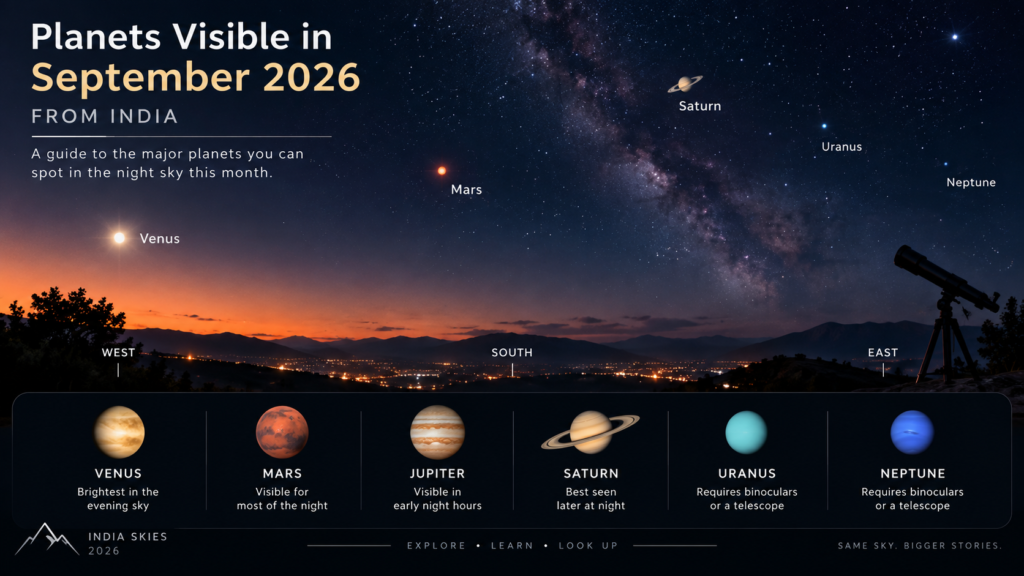
The September 2026 night sky offers several planets for Indian skywatchers, although their visibility changes throughout the night. Bright planets such as Venus and Saturn are easier to identify, while distant planets such as Uranus and Neptune require optical equipment.
🟡 Venus — The Easiest Planet to Spot
Venus is the standout planet for evening observation. It appears low in the western sky shortly after sunset and is bright enough to be visible from many urban locations when the horizon is unobstructed. Around September 18, Venus reaches a particularly notable point in its evening appearance.
🪐 Saturn — Best for Night-Time Viewing
Saturn becomes a prominent evening and nighttime target during September. It rises around sunset and remains visible for much of the night. With a telescope, its rings make it one of the most rewarding planets for beginners to observe.
🔵 Uranus — Better With Binoculars or a Telescope
Uranus is considerably fainter than Venus and Saturn. It can be located during the late evening and early morning hours, but finding it is much easier with binoculars or a telescope and a star chart.
🔵 Neptune — A Telescope Target
Neptune is even fainter and is not an easy naked-eye object. A telescope and accurate sky map are recommended if you want to locate it.
👀 What About Mercury, Mars and Jupiter?
Planetary visibility changes rapidly during the year. Depending on the exact date, time and location, some planets may be too close to the Sun or positioned below the horizon during convenient viewing hours. Before heading outside, check a location-specific astronomy chart for your city rather than relying on a general planet list.
🇮🇳 Best Approach for Beginners
If you’re new to astronomy, start with Venus and Saturn. They’re much easier to identify than the distant planets. Once you’ve learned the basic directions in the sky, you can move on to fainter targets using binoculars or a telescope.
Moon Events and Interesting Alignments in September 2026
The September 2026 night sky becomes especially interesting as the Moon moves through its different phases and passes near other celestial objects. These events are easy for beginners to follow because the Moon is bright and can be located without special equipment.
🌙 First Quarter Moon — September 19
The Moon reaches its First Quarter phase on September 19. This is one of the best phases for observing the lunar surface because sunlight falls at an angle across the Moon, creating long shadows around craters, mountains and valleys.
Even a small pair of binoculars can reveal more detail than the naked eye.
🌕 Harvest Moon — September 26
The month’s full Moon occurs on September 26 and is traditionally known as the Harvest Moon. It will be one of the easiest events in the September 2026 night sky to observe because no telescope is required.
The Moon will appear especially attractive shortly after it rises, when it is low above the horizon. Its apparent size can also seem larger because of the well-known Moon illusion, although this is a perception effect rather than the Moon physically becoming much larger.
🪐 Moon Near Saturn
Around the full-Moon period, the Moon appears close to Saturn in the sky. This type of apparent close approach is called a conjunction. The two objects can be viewed together, making it a particularly simple target for beginners.
📸 A Great Opportunity for Photography
You don’t need a professional camera to photograph these events. A smartphone can capture the Moon if you reduce exposure and keep the phone steady. For better results, use a tripod or rest the phone against a stable surface.
If you want to photograph the Moon alongside a planet, try taking several shots at different exposure levels. This can help preserve details on the bright lunar surface.
🔭 Do You Need a Telescope?
Not for the major Moon events. The First Quarter and Harvest Moon can easily be observed with the naked eye. Binoculars can reveal additional lunar detail, while a telescope provides an even closer view.
For the September 2026 night sky, the Moon is therefore one of the easiest starting points for anyone who wants to explore astronomy.
How to Watch the September 2026 Night Sky From India
Watching the September 2026 night sky from India doesn’t require expensive equipment. With a clear sky, a good view of the horizon and a little preparation, beginners can enjoy several of this month’s celestial events.
🇮🇳 Choose a Dark Location
Light pollution is one of the biggest obstacles to stargazing. If possible, move away from bright streetlights, large buildings and busy city areas. Rural locations, open fields and darker areas on the outskirts of cities generally provide better views.
🕘 Check the Local Time
The exact rising and setting times of celestial objects depend on your location. An event visible from Bengaluru may appear at a slightly different time in Delhi, Mumbai or Kolkata.
Before observing, check a reliable astronomy application or sky chart for your exact city.
👀 Give Your Eyes Time to Adjust
When you reach a dark location, avoid bright phone screens for around 20–30 minutes. Your eyes gradually become more sensitive to faint light, allowing you to see more stars.
If you need your phone while observing, reduce its brightness as much as possible.
🔭 Start With Easy Targets
If you’re new to astronomy, don’t immediately try to find faint planets. Start with the Moon, Venus and Saturn. They are considerably easier to identify and can help you become familiar with the night sky.
📱 Use Your Phone as a Sky Guide
Astronomy apps can show the positions of planets, stars and constellations based on your location. Pointing your phone toward the sky can help you identify objects that might otherwise be difficult to recognize.
☁️ Check the Weather
Clouds can completely hide an otherwise visible astronomical event. Check your local weather forecast before going outside, especially if you’re planning to travel to a darker location.
With a little preparation, the September 2026 night sky can provide an enjoyable astronomy experience even for someone using nothing more than their eyes and a smartphone.
Best Stargazing Tips for Beginners
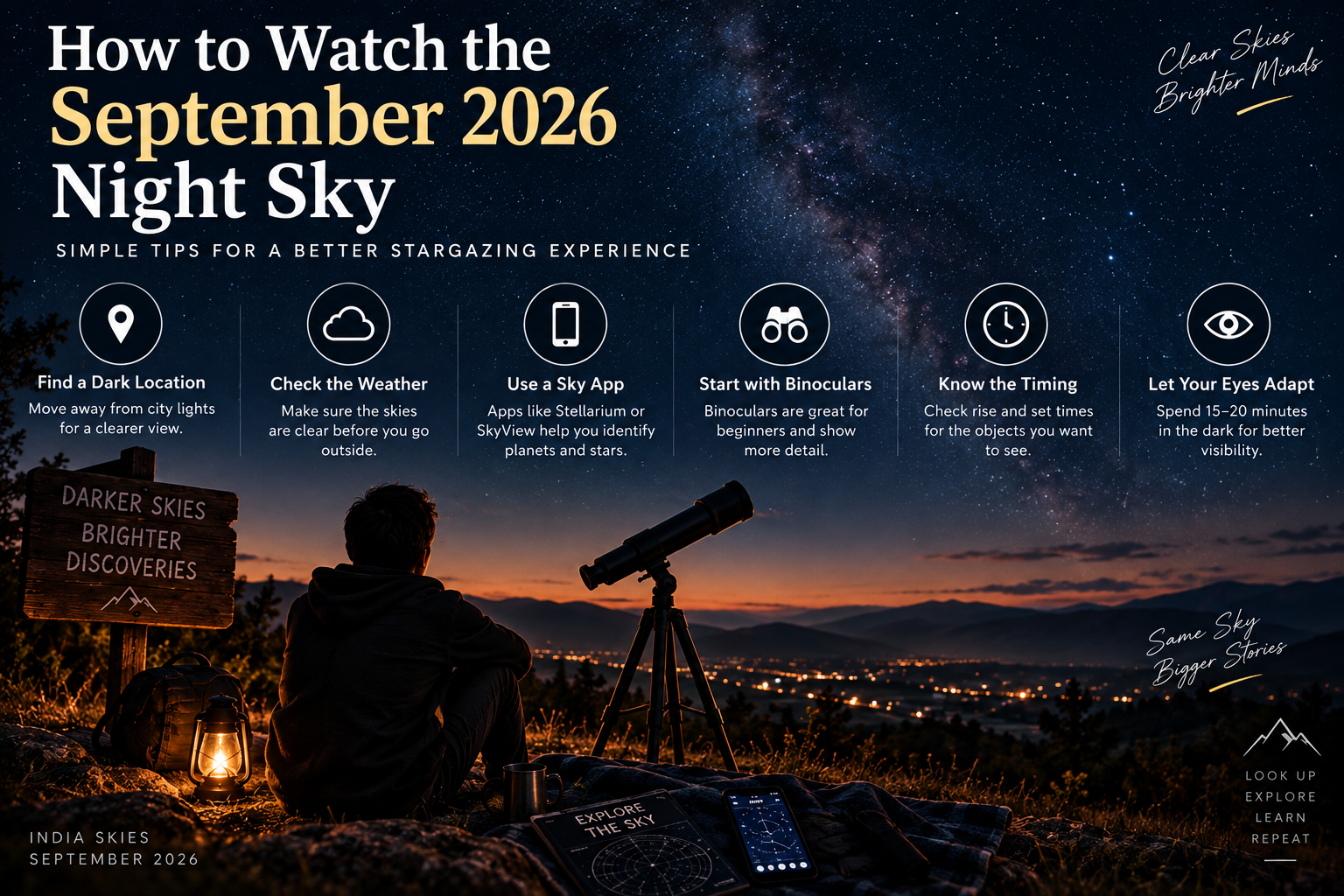
You don’t need expensive equipment to enjoy the September 2026 night sky. A few simple habits can make a big difference, especially if you’re watching from a city.
🌃 1. Find the Darkest Spot You Can
Move away from streetlights, bright buildings and other artificial lights. Even travelling a short distance outside a city can reveal many more stars.
🧭 2. Learn the Basic Directions
Knowing where east, west, north and south are makes finding planets much easier. A compass on your phone can help you get oriented before you begin.
👁️ 3. Let Your Eyes Adjust
Give your eyes around 20–30 minutes to adapt after moving into darkness. Avoid looking at bright screens during this period.
🔭 4. Don’t Start With Expensive Equipment
For beginners, your eyes are enough for the Moon and bright planets such as Venus and Saturn. Binoculars can be your next step before investing in a telescope.
📱 5. Use an Astronomy App
A sky-map application can help identify planets, stars and constellations. It is particularly useful when you’re trying to locate a faint object such as Uranus or Neptune.
📸 6. Keep Your Camera Steady
For smartphone photography, place your phone on a stable surface or use a tripod. For the Moon, lower the camera exposure so its bright surface doesn’t appear completely white.
☁️ 7. Check Clouds Before Going Outside
Even a perfectly positioned planet won’t be visible through thick clouds. Check the local forecast before planning a dedicated observation session.
🚫 8. Never Look Directly at the Sun
Some astronomical events occur during daylight or near sunrise and sunset. Never look directly at the Sun through binoculars, a telescope or a camera without a proper solar filter, as this can cause permanent eye damage.
With these basic precautions, beginners can enjoy many of the highlights of the September 2026 night sky safely and comfortably.
Best Stargazing Apps and Tools for September 2026
Finding planets and stars becomes much easier when you know exactly where to look. For the September 2026 night sky, several simple tools can help beginners identify celestial objects without needing advanced astronomy equipment.
📱 1. Use a Sky-Mapping App
Sky-mapping apps use your phone’s location and sensors to display stars, planets and constellations in the direction you’re pointing. They’re particularly useful when trying to identify Saturn or locate fainter objects.
🧭 2. Use Your Phone’s Compass
A basic compass can help you determine the direction you’re facing. Knowing whether you’re looking west, east or another direction makes it easier to follow astronomy guides.
🔭 3. Try Binoculars Before a Telescope
If you’re interested in exploring beyond the brightest objects, binoculars can be a practical first step. They provide a wider field of view than many telescopes, making it easier for beginners to locate objects.
🌦️ 4. Check Weather and Cloud Cover
Always check your local weather conditions before an observation session. Clear skies are essential for seeing planets, stars and the Moon.
🗓️ 5. Keep an Astronomy Calendar
An astronomy calendar can help you track lunar phases, planetary conjunctions, equinoxes and other events throughout the month. Marking important dates in advance means you won’t accidentally miss an event.
🌃 6. Use a Light-Pollution Map
If you want to see more stars, a light-pollution map can help you find darker locations near your city. The difference between an urban sky and a genuinely dark sky can be dramatic.
For beginners, a smartphone, a weather app and a simple sky map are already enough to get started. You can add binoculars or a telescope later as your interest in astronomy grows.
Common Stargazing Mistakes to Avoid
Even when the September 2026 night sky has excellent viewing opportunities, a few simple mistakes can make celestial objects difficult to see.
🌆 1. Staying Under Bright City Lights
Light pollution can hide faint stars and planets. Try moving away from brightly lit roads, buildings and advertising signs whenever possible.
📱 2. Using a Bright Phone Screen
Looking at a bright screen repeatedly makes it harder for your eyes to remain adapted to darkness. Keep your screen brightness low and use night mode when available.
⏰ 3. Going Out at the Wrong Time
Some celestial objects are visible only during specific parts of the night. Always check the object’s rise and set times for your location before heading outside.
☁️ 4. Ignoring the Weather
Cloud cover can completely block your view. Check the forecast shortly before your observation session rather than relying only on the forecast from several days earlier.
🔭 5. Buying a Telescope Too Quickly
A telescope isn’t necessary for many beginner targets. Start by learning the sky with your eyes or binoculars before spending money on advanced equipment.
🌕 6. Expecting Every Event to Look Dramatic
Astronomical events can look different in real life than they do in edited photographs. Some events involve subtle changes in position or brightness rather than spectacular visual effects.
☀️ 7. Forgetting Solar Safety
Never look directly at the Sun through binoculars, a telescope or a camera without proper solar-filter equipment. Ordinary sunglasses are not sufficient protection.
A little preparation can make observing the September 2026 night sky much more enjoyable and help beginners avoid unnecessary frustration.
September 2026 Night Sky Calendar: Important Dates at a Glance
If you want to plan your stargazing sessions, this September 2026 night sky calendar brings the month’s main highlights together in one place.
Date
Celestial event
What to expect
September 18
Venus reaches a notable evening appearance
Look low toward the western sky after sunset
September 18
First Quarter Moon
Excellent time to observe lunar craters and shadows
September 23
September Equinox
Astronomical transition between seasons
September 26
Harvest Moon
September’s Full Moon
Around September 26
Moon near Saturn
Interesting pairing visible in the night sky
Exact viewing times can vary depending on your location in India, so check a location-specific astronomy calendar before observing.
🌟 Which Dates Should Beginners Mark?
If you’re new to astronomy, September 18, September 19 and September 26 are particularly easy dates to remember. Venus and the Moon are bright enough to be located without specialized equipment, while the Moon–Saturn pairing offers an opportunity to try identifying two different celestial objects together.
The September 23 equinox is also scientifically significant, although it isn’t necessarily a dramatic visual event in the sky.
Keep this calendar handy and check local weather conditions before heading outside. A clear, dark sky can make a much bigger difference than expensive equipment.
Frequently Asked Questions About the September 2026 Night Sky
What is the main event in the September 2026 night sky?
One of the month’s notable highlights is Venus on September 18, followed by the Harvest Moon on September 26. The September equinox also occurs around September 23.
Can I see these events from India?
Yes. Many of the month’s major events can be observed from India, although the exact viewing time and position depend on your location.
Do I need a telescope?
No. Venus and the Moon can be observed with the naked eye. Binoculars or a telescope become useful for fainter objects such as Uranus and Neptune.
What is the best place for stargazing?
A location with clear skies and minimal light pollution is ideal. Rural areas and locations away from bright city lights generally offer better views.
Can I photograph the Moon with my phone?
Yes. A smartphone can capture the Moon, particularly when it is bright. Keep the phone steady and lower the exposure to prevent the lunar surface from appearing overexposed.
What time should I go stargazing?
There isn’t one universal time. It depends on the object you’re trying to observe. Check a location-specific astronomy app or sky chart before going outside.
Is it safe to watch planets with the naked eye?
Yes. Looking at planets such as Venus and Saturn with the naked eye is safe. Never look directly at the Sun, however, whether with your eyes or optical equipment without proper solar protection.
Will every event be visible everywhere in India?
Not necessarily. Cloud cover, light pollution, latitude and the object’s position above the horizon can affect visibility. Always check local conditions before planning an observation.
Conclusion
The September 2026 night sky offers plenty for both beginners and experienced skywatchers, from the bright appearance of Venus to the First Quarter Moon, the September equinox and the Harvest Moon.
You don’t need expensive equipment to get started. A clear view, low light pollution and a basic sky-mapping app can be enough to identify some of the month’s most interesting sights. Binoculars or a telescope can then help you explore fainter objects such as Uranus and Neptune.
For the best experience, check the weather and local viewing times before heading outside. Remember that astronomical events can look different depending on where you are in India.
So, mark the important dates on your calendar, find a darker location if possible, and look up at the sky. September 2026 is a great opportunity to spend some time exploring the night sky from India. 🌌🔭
September 2026 Skywatching Guide
Anchor text: NASA’s September 2026 skywatching guide https://www.nasa.gov/
If you’re interested in exploring more about India’s future in space, check out our guide to upcoming space missions in India https://itshk.in/top-10-upcoming-space-missions-in-india/