The End of Apps? How AI Agents Could Change Your Smartphone Forever
Introduction: What If You Didn’t Need to Open Apps?
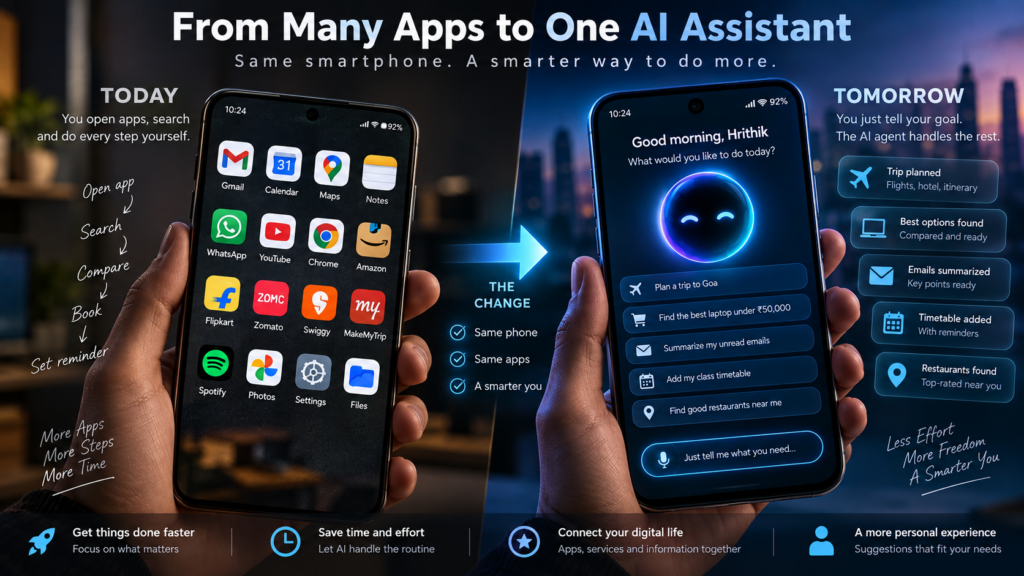
For more than a decade, using a smartphone has meant opening an app whenever we want to do something. Want to book a cab? Open an app. Need to send a message? Open another app. Looking for information? Open a browser or search engine.
But that familiar routine could be starting to change.
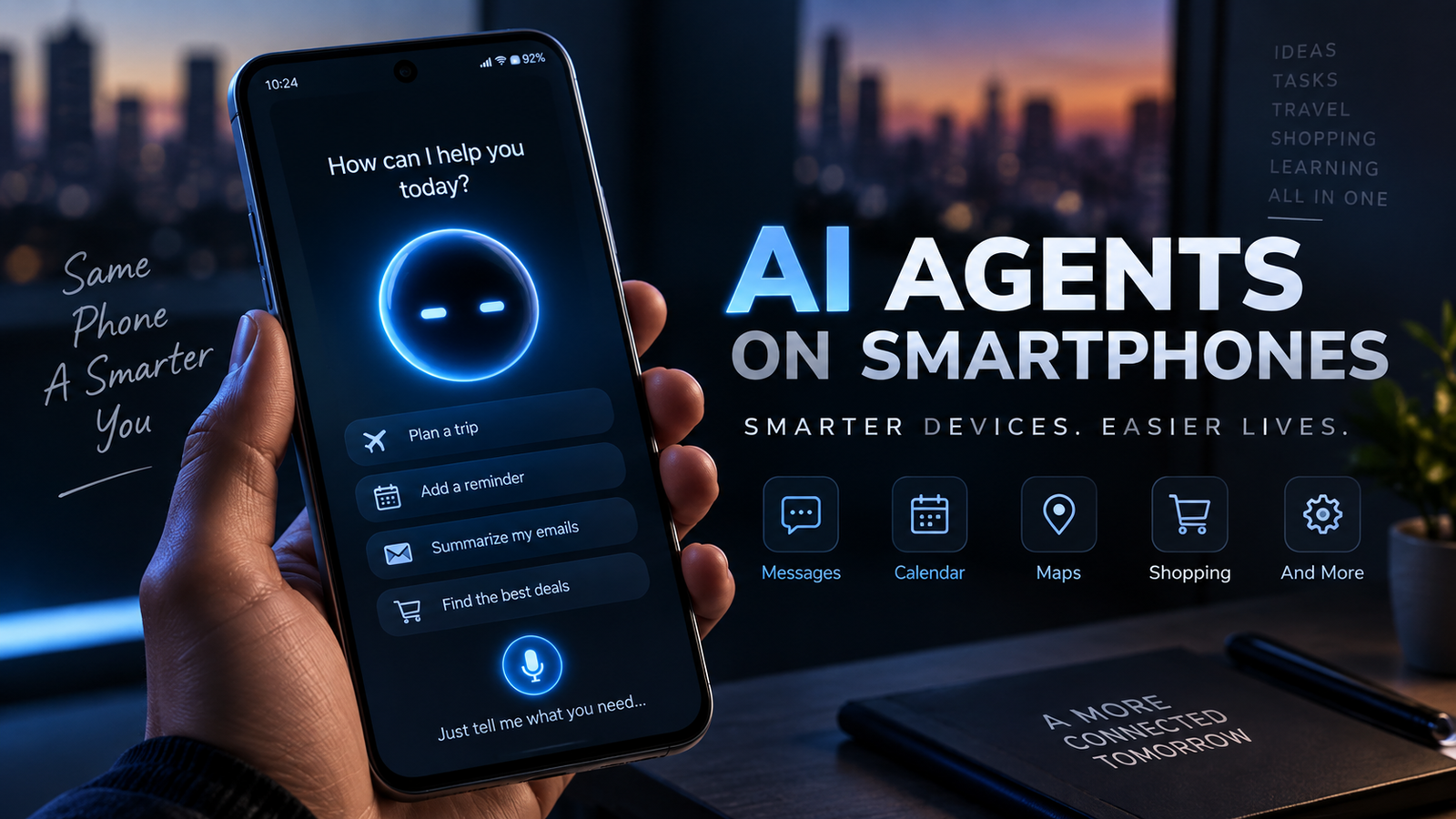
AI agents on smartphones are being developed to do more than simply answer questions. Instead of waiting for users to tell them every individual step, these systems are designed to understand a goal, plan a sequence of actions and help complete tasks across different services.
The idea sounds futuristic, but parts of this technology are already appearing in today’s smartphones. Companies developing mobile processors and AI platforms are increasingly focusing on agentic AI, while smartphone manufacturers are exploring ways for AI to interact more deeply with everyday tasks.
This doesn’t mean traditional apps are suddenly disappearing. There are still major challenges involving privacy, reliability, permissions and user control. But the direction is interesting: your smartphone could gradually become less about which app you open and more about what you want to accomplish.
So, could AI agents on smartphones eventually change the way we use our phones?
Let’s look at what this emerging technology can actually do, where it is heading, and whether it could really challenge the app-based smartphone experience.
Like other emerging sci-fi technologies, AI agents are gradually moving from futuristic ideas toward real-world applications https://itshk.in/sci-fi-technologies-2026/
What Exactly Are AI Agents?
To understand why AI agents on smartphones could be different from today’s assistants, it helps to separate an AI chatbot from an AI agent.
A traditional chatbot mainly responds to what you type or say. You ask a question, and it generates an answer. An AI agent is designed to go a step further: it can understand a goal, break that goal into smaller steps and, when given the appropriate permissions, take actions using connected tools or services.
Imagine saying:
> “Find a good restaurant nearby, check the available time, and put the booking details in my calendar.”
A conventional chatbot might tell you how to do those things. An agent could potentially handle several of those steps itself—searching, comparing information and carrying out actions—with you approving important steps.
That’s the bigger idea behind AI agents on smartphones.
🧠 From Answers to Actions
The difference can be summarized simply:
Chatbot: “Here’s how you can do it.”
AI agent: “I can help you do it.”
This doesn’t mean agents should have unlimited access to everything on your phone. Permissions and user confirmation are extremely important, particularly when an action involves money, private messages, accounts or personal information.
But as smartphones gain more capable AI processors and software, AI agents on smartphones could increasingly work as a layer between users and the apps they currently use.
Instead of remembering which app performs a particular task, you could eventually describe the outcome you want and let the AI figure out the appropriate steps.
That is the fundamental shift that makes AI agents on smartphones so interesting.
From Chatbots to AI That Takes Action
The biggest change could be the move from AI that answers questions to AI that can actually complete tasks.
Today, you might ask an AI assistant to write a message, summarize an email or explain something. You would then open another app and carry out the task yourself.
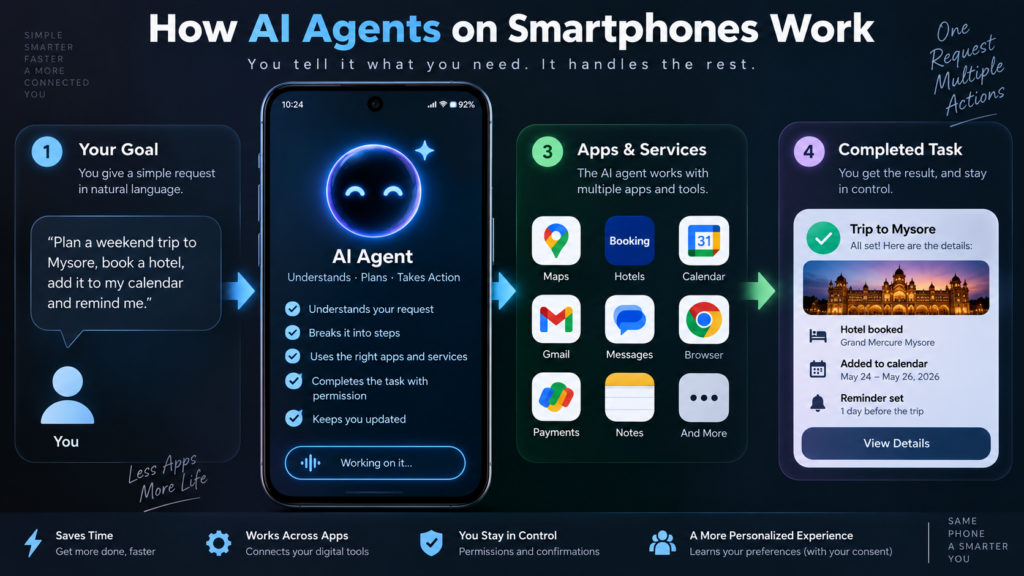
With AI agents on smartphones, the process could become more direct. An agent could potentially understand your request, decide which tools are needed, and complete several steps for you.
For example, imagine saying:
“Find my latest flight confirmation, check the departure time and remind me two hours before I need to leave.”
Instead of manually opening your email, finding the booking, checking the details and creating a reminder, an AI agent could potentially coordinate those steps.
Why This Is Different
The important part isn’t simply that the AI can understand language. It’s that AI agents on smartphones are designed around completing a goal rather than just producing a response.
A task could involve:
Understanding what you want
Breaking the request into smaller steps
Finding relevant information
Using connected apps or services
Asking for permission when necessary
Completing the task
Reporting what it did
This could make smartphones feel less like collections of separate apps and more like a single intelligent system.
However, AI agents on smartphones will still need clear permissions. Users should know when an agent is reading information, accessing an app or attempting an important action.
That balance between convenience and control could become one of the most important parts of the next generation of smartphone AI.
How AI Agents Could Change Your Smartphone
The real impact of AI agents on smartphones could be seen in everyday tasks. Instead of opening several apps and moving information between them, users could simply describe what they want.
One Request Instead of Multiple Apps
Imagine saying:
“Plan a weekend trip, find a suitable hotel, check the weather and create a simple schedule.”
Today, that could require several different apps. In the future, AI agents on smartphones could potentially coordinate these steps through connected services.
Other examples could include:
Messages: Draft and organize replies based on your conversations.
Travel: Compare travel information and build an itinerary.
Shopping: Find products based on your requirements and compare options.
Calendar: Suggest suitable times and help organize appointments.
Photos: Find specific pictures using natural-language descriptions.
Work: Summarize information and turn it into tasks or reminders.
Settings: Help change certain phone settings based on what you ask.
Your Phone Could Understand the Goal
The interesting part is that AI agents on smartphones don’t necessarily need you to explain every individual step.
Instead of saying:
“Open my calendar → find Friday → create an event → add this location…”
you could simply say:
“Add my meeting at 4 PM on Friday.”
The agent could determine the required steps and ask for confirmation when an action needs your approval.
This is why AI agents on smartphones could represent a bigger change than simply adding another AI chatbot to a phone. The goal is to make the smartphone understand what you want to accomplish, not just what question you are asking.
AI tools to save timehttps://itshk.in/ai-tools-to-save-time/
Real Examples Already Appearing in 2026
The idea of AI agents on smartphones is no longer limited to science-fiction concepts. In 2026, major technology companies are increasingly working on AI systems that can understand context, interact with services and perform multiple steps on behalf of users.
Google Is Moving Toward More Agentic Android AI
Google has been expanding Gemini’s role on Android beyond traditional question-and-answer interactions. The company has demonstrated AI features designed to help users complete multi-step tasks, showing how an assistant could become more capable of taking action rather than simply generating information.
That direction is important for AI agents on smartphones because Android already connects users with apps, accounts and device features.
Gemini multi-step tasks on Androidhttps://blog.google/innovation-and-ai/products/gemini-app/android-multi-step-tasks/
Smartphone Chips Are Being Built for Agentic AI
Qualcomm has also been highlighting agentic AI as an important direction for mobile devices. Newer smartphone platforms are being designed to handle more AI processing directly on the device while supporting increasingly complex AI workloads.
For AI agents on smartphones, this matters because faster on-device processing could reduce the need to send every task to a cloud server. Google Gemini Intelligence on Android https://blog.google/products-and-platforms/platforms/android/gemini-intelligence/
The Technology Is Still Developing
These examples don’t mean that smartphones can already perform every task automatically. Current systems still have limitations involving permissions, accuracy, app compatibility and privacy.
But the direction is becoming clearer: AI agents on smartphones are moving from a concept toward a technology that companies are actively developing.
That makes the next question even more interesting: could these agents eventually reduce our dependence on traditional apps
Could AI Agents Actually Replace Apps?
The idea of AI agents on smartphones replacing traditional apps sounds dramatic, but it is more likely that both will exist together for a long time.
Apps are built for specific experiences. A banking app, for example, gives users direct access to transactions, security controls and account information. A food-delivery app provides menus, restaurants, payments and order tracking in one place.
An AI agent could sit above these services and help users navigate them more naturally.
Apps Could Become the Tools Behind the AI
Instead of opening an app yourself, you might eventually tell an agent:
“Order my usual dinner from the restaurant I normally choose.”
The agent could potentially use the relevant service while you interact mainly with the AI.
In this model, AI agents on smartphones wouldn’t necessarily eliminate apps. Instead, apps could become the underlying services that agents interact with.
Some Apps Will Still Matter
Certain activities will probably continue to benefit from dedicated apps.
For example:
Banking and financial management
Gaming
Video editing
Photography
Social media
Professional software
Services requiring detailed visual interfaces
For these tasks, directly opening an app can still make more sense.
So the more realistic future for AI agents on smartphones may not be an “app-free phone.” It could be a phone where you decide what you want to accomplish, while AI helps determine which apps and services are needed to accomplish it.
That would be a significant change in how we interact with smartphones.
Biggest Problems: Privacy, Mistakes & Control
While AI agents on smartphones could make everyday tasks easier, giving AI more control over a phone also creates important challenges.
Privacy
A useful agent may need access to information such as messages, calendars, locations or files. That creates an obvious question: how much access should an AI actually have?
Ideally, users should be able to control which apps and types of information an agent can access. Sensitive actions should also require clear permission.
Mistakes
AI can misunderstand instructions or make incorrect decisions. An agent that gives you a wrong answer is one thing; an agent that takes the wrong action could be much more serious.
For example, an AI agent could misunderstand a booking request, select the wrong item or interpret a message incorrectly.
That’s why AI agents on smartphones need safeguards, confirmation steps and clear ways for users to stop or reverse actions.
Who Is Really in Control?
The biggest question may not be whether AI can perform tasks, but who controls what it is allowed to do.
A smartphone assistant should ideally make its actions visible to the user rather than quietly performing important tasks in the background.
For AI agents on smartphones to become widely trusted, convenience will need to develop alongside privacy, reliability and user control.
What Smartphones Might Look Like Next
If AI agents on smartphones continue improving, the biggest change may not be a completely new type of phone. Instead, the way we interact with existing phones could gradually change.
You may still have the same screen, apps and hardware, but AI could become a layer connecting everything together.
From Apps to Intent
Today, we usually think:
App → Feature → Action
The future could move closer to:
Goal → AI → Action
For example, instead of searching through different apps for information, you could simply explain what you need and let the agent work out the relevant steps.
More AI Processing on the Device
As smartphone processors become better at handling AI workloads, some tasks could increasingly be processed directly on the phone.
That could potentially improve responsiveness and reduce the need to send certain information to remote servers, although the exact balance between on-device and cloud processing will depend on the technology and service.
A More Personal Smartphone
The long-term vision for AI agents on smartphones is a device that understands more context about what you’re trying to accomplish.
It could know which information is relevant, suggest the next step and help connect different services—while still keeping the user in control.
We are not there yet. But if these systems continue improving, AI agents on smartphones could become one of the biggest changes in smartphone interaction since the rise of app stores.
FAQs About AI Agents on Smartphones
What are AI agents on smartphones?
AI agents on smartphones are AI systems designed to understand a user’s goal, plan multiple steps and potentially perform actions using apps, services or device features with the required permissions.
How are AI agents different from chatbots?
A chatbot mainly provides information or generates responses. An AI agent is designed to go further by planning and carrying out tasks.
Can AI agents replace smartphone apps?
Not necessarily. AI agents on smartphones could work alongside apps by helping users interact with different services without manually opening every app. Dedicated apps will still be useful for many complex tasks.
Are AI agents safe to use?
Safety depends on how the system handles permissions, personal information and actions. Users should review permissions and be careful when allowing AI to access sensitive data or perform important actions.
Do AI agents work without the internet?
Some AI features can run on the device, depending on the phone’s hardware and software. More complex tasks may still require an internet connection or cloud-based AI services.
When will AI agents become common on smartphones?
Some agent-like capabilities are already appearing, but the technology is still developing. Wider adoption will depend on improvements in reliability, privacy, app compatibility and user control.
Conclusion
AI agents on smartphones could represent a major shift in how we interact with our devices. Instead of constantly opening apps, searching for information and completing every step ourselves, we could increasingly tell our phones what we want to accomplish and let AI help with the process.
The technology is still developing, and important challenges remain around privacy, accuracy, permissions and user control. Traditional apps are also unlikely to disappear overnight.
But the direction is clear: smartphones are becoming more capable of understanding context and helping with multi-step tasks.
If AI agents on smartphones continue to improve, the future of the smartphone may be less about which app you use and more about what you want to get done.