Introduction: When Sci-Fi Starts Becoming Reality
We’ve all watched cinematic masterpieces or futuristic anime and thought, “There is no way we will ever see that in our lifetime.”
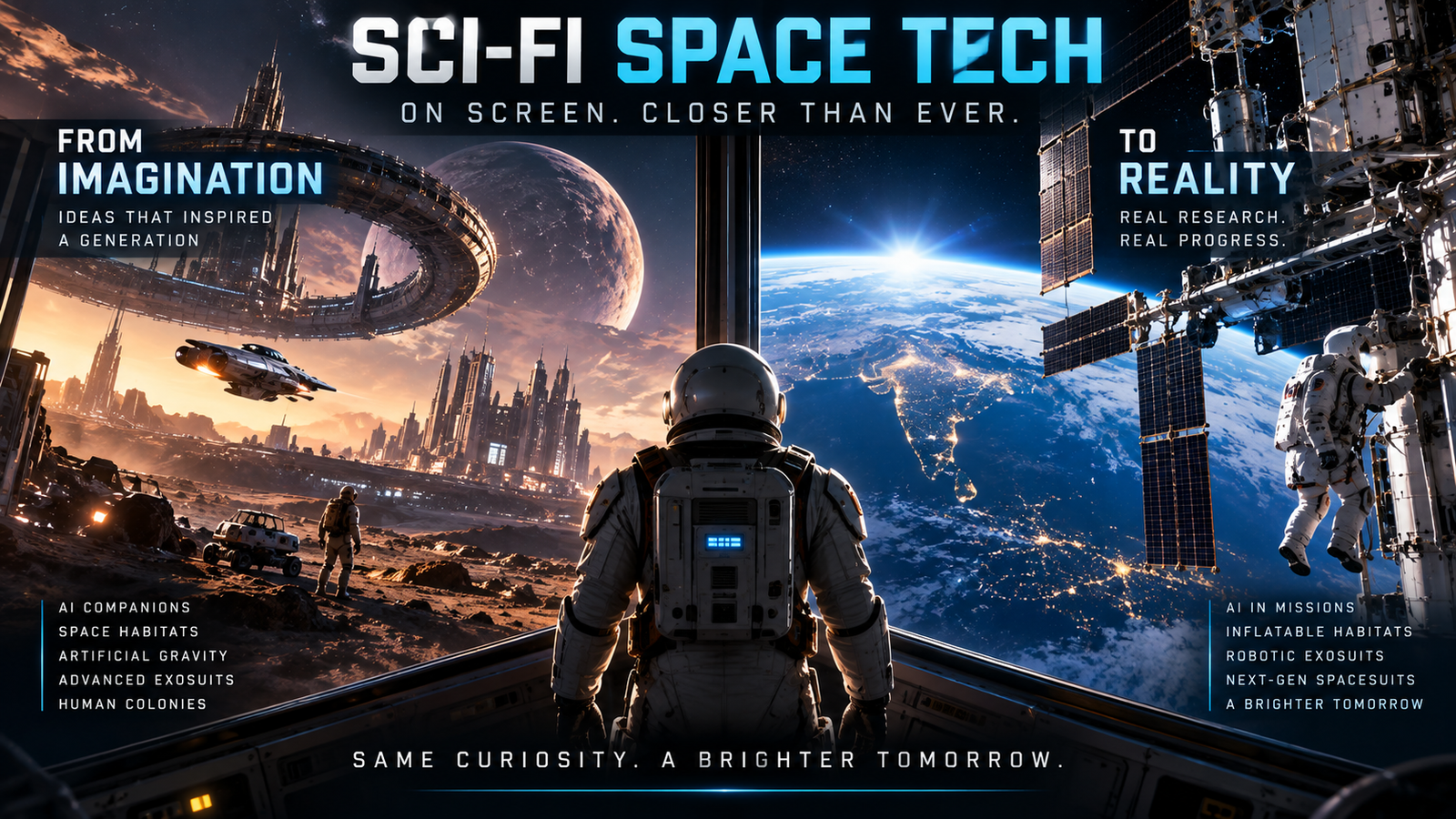
For decades, science fiction imagined technologies that seemed far beyond the limits of real engineering—from hyper-intelligent spacecraft assistants and artificial gravity to mechanical power armor designed for extreme environments.
But the gap between fiction and reality is getting smaller.
Today, researchers and engineers are developing technologies that resemble ideas once reserved for movies and anime. AI is becoming capable of handling increasingly complex tasks, aerospace companies are exploring new approaches to living and working in space, and robotic exoskeletons are already moving from science fiction into practical applications.
The real technology isn’t as futuristic—or as perfect—as Hollywood makes it look. But the similarities are fascinating.
In this article, we’ll explore three sci-fi technologies that engineers are actually working to make practical: intelligent AI assistants, advanced space habitats and robotic exosuits.
Pillar 1: AI Companions — From TARS to Real Spacecraft Assistance
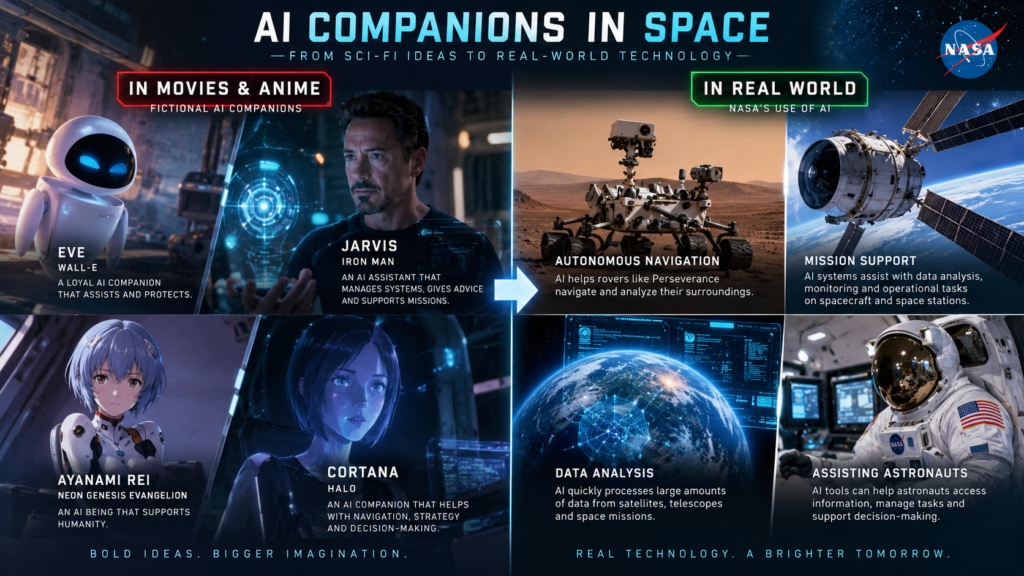
In science fiction, an AI companion can feel almost like another member of the crew. TARS from Interstellar can communicate with astronauts, while HAL 9000 from 2001: A Space Odyssey represents a much more autonomous—and dangerous—vision of spacecraft intelligence.
Real space technology isn’t at that level of independence, but the basic idea of using AI to help astronauts is no longer purely fictional.
NASA is actively researching AI for spaceflight, including systems that can support mission planning, autonomous vehicles, data analysis and crew operations. NASA’s Johnson Space Center has also identified applications such as digital assistants for fault diagnosis, predictive analytics, computer vision and life-support control.
🤖 AI That Can Actually Help Astronauts
One interesting example is NASA’s work on AI assistants for astronauts.
NASA’s SUITS program has explored artificial-intelligence assistants designed to reduce astronauts’ cognitive workload during lunar surface operations. The concept includes voice-based interaction, allowing an astronaut to request information such as equipment or oxygen status without having to navigate complicated systems manually.
NASA has also tested AI-assisted tools aboard the International Space Station for tasks including speech-to-text documentation and data handling.
More recently, NASA’s ASTRA project field-tested autonomous robotic systems that could adjust their activities based on new information during planetary exploration. The long-term idea is to allow robotic explorers to make useful decisions when humans are too far away to provide constant instructions.
NASA’s use of artificial intelligence https://www.nasa.gov/artificial-intelligence/?utm_source=chatgpt.com
🚀 From Fictional Companions to Practical Assistants
The difference between science fiction and reality is important.
We’re not talking about a fully independent HAL 9000 making critical decisions on its own. Current systems are designed around specific tasks, human oversight, reliability and safety.
But the underlying concept is remarkably similar: give astronauts intelligent tools that can process information and help them make decisions faster.
That’s why sci-fi technologies are becoming increasingly interesting—not because movies predicted the future perfectly, but because some fictional ideas are inspiring real engineering problems today.
Pillar 2: Space Habitats — From Rotating Cities to Real Engineering
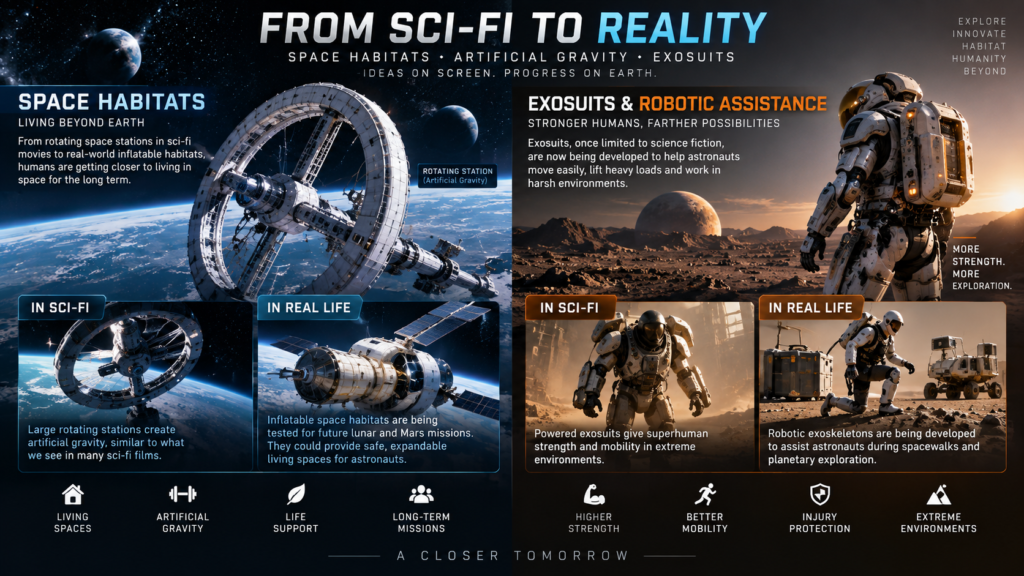
Artificial gravity is one of the most recognizable ideas in science fiction. Movies often show enormous rotating spacecraft where astronauts can walk normally, even while traveling through deep space.
The concept is based on a real physical principle: rotation can create an outward acceleration that can feel similar to gravity.
But building a giant rotating space city is an enormous engineering challenge.
inflatable space habitats https://www.nasa.gov/general/nasa-begins-testing-habitation-prototypes/?utm_source=chatgpt.com
🛰️ Why Artificial Gravity Is So Difficult
Astronauts living in microgravity for extended periods can experience changes to their muscles, bones and cardiovascular systems. That’s why researchers have long investigated ways of creating artificial gravity or reducing the effects of weightlessness.
One possible solution is a centrifuge—a rotating system that produces acceleration.
Instead of constructing a massive spinning spacecraft like the ones seen in science fiction, researchers can investigate smaller systems that rotate only part of a spacecraft or habitat.
🏠 What About Actual Space Habitats?
The more immediate goal is making space habitats safer and more practical.
NASA and its commercial partners are developing technologies for future commercial space stations, including inflatable and expandable habitat concepts. One example is LIFE, an inflatable habitat concept developed by Sierra Space for potential future commercial stations.
Inflatable structures are particularly interesting because they can be launched in a relatively compact configuration and expanded once they reach space.
NASA has also investigated rotating habitats and centrifuge concepts as possible ways to address the health challenges associated with long-duration spaceflight.
So while we’re nowhere near building a giant rotating city in orbit, the basic science behind fictional artificial-gravity systems is very real.
The difference is that today’s engineers are approaching the problem step by step, testing smaller and more practical solutions before attempting anything on the scale imagined by science fiction.
AI tools to save time https://itshk.in/ai-tools-to-save-time/
Pillar 3: Exosuits — From Power Armor to Real Machines
Mechanical power armor has been a science-fiction favorite for decades. From the heavy combat suits in Aliens to futuristic exoskeletons in games and anime, these machines promise to give humans greater strength, endurance and protection.
The real versions are far less dramatic—but the technology is already being developed.
🦾 Exoskeletons Are Already Real
Modern robotic exoskeletons can be worn by a person and use mechanical systems to assist certain movements. Depending on the design, they can help with lifting, walking, rehabilitation or repetitive industrial tasks.
Companies and research institutions have been developing powered exoskeletons for workplaces where employees repeatedly handle heavy equipment or perform physically demanding movements.
The technology is particularly interesting because it doesn’t necessarily need to make someone superhuman. Even reducing the physical effort required for a repetitive task can make an exoskeleton useful.
NASA robotic exoskeletons https://robotics.jpl.nasa.gov/what-we-do/research-tasks/exoskeleton/?utm_source=chatgpt.com
🚀 Could Astronauts Eventually Use Them?
Space exploration creates another interesting possibility.
Astronauts working outside a spacecraft already deal with restrictive spacesuits, limited mobility and physically demanding tasks. A future suit with advanced joints, sensors and powered assistance could potentially make certain movements easier.
Researchers have explored robotic and powered systems that could assist human movement, although a fully autonomous sci-fi-style power suit isn’t currently standard spaceflight equipment.
The challenge is making these systems lightweight, reliable, energy-efficient and safe. Every additional motor, battery and mechanical component adds mass and complexity—two things spacecraft designers work hard to minimize.
That’s why real sci-fi technologies often develop differently from their fictional counterparts. Instead of producing a giant suit with incredible strength overnight, engineers gradually solve individual problems until the technology becomes practical.
upcoming space missions in India https://itshk.in/top-10-upcoming-space-missions-in-india/
What Sci-Fi Gets Right—and What It Still Gets Wrong
Science fiction is rarely a perfect prediction of the future. Its greatest value is often that it asks “What if?” long before engineers have a practical way to answer that question.
The three examples above show a similar pattern.
AI assistants are becoming increasingly capable, but today’s systems still operate within carefully defined tasks and human oversight. Space habitats are becoming more advanced, but enormous rotating cities remain an engineering challenge. Exoskeletons can already assist human movement, but they are nowhere near the effortless power armor shown in blockbuster movies.
🚀 Reality Moves More Slowly Than Fiction
Movies can skip the difficult parts. A fictional spacecraft can suddenly have artificial gravity, an intelligent computer and a powerful exosuit without explaining the thousands of engineering problems required to make those systems work together.
Real engineers don’t have that luxury.
They have to consider energy consumption, weight, reliability, heat, radiation, materials, safety and maintenance. A technology that works perfectly in a laboratory may still require years of testing before it can be trusted in space.
That’s why the real versions of sci-fi technologies often look less spectacular than their fictional counterparts—but they’re arguably more impressive because they have to work under real physical constraints.
And that slow transition from imagination to engineering is what makes the future so interesting.
The Future: Which Sci-Fi Technology Comes Next?
The most exciting part is that today’s technology is still at an early stage. AI assistants, advanced habitats and robotic exoskeletons could eventually become much more capable as engineers solve the problems that currently limit them.
Future spacecraft could use increasingly intelligent systems to help crews manage complicated missions. Space habitats may become larger and more comfortable as commercial space stations develop. Exoskeleton technology could also become lighter and more efficient, potentially expanding its use in industrial work, healthcare and space exploration.
But the next breakthrough doesn’t necessarily have to come from a famous science-fiction movie.
Sometimes an idea that seems completely ordinary today can become the technology that changes the future.
That is why sci-fi technologies are so fascinating. Science fiction gives engineers a starting point for imagining what might be possible, while real-world science determines what can actually be built.
The future may not look exactly like the movies—but it could end up being even more interesting. 🚀
game and anime adaptations https://itshk.in/game-and-anime-adaptations/
Frequently Asked Questions About Sci-Fi Technologies
Are sci-fi technologies becoming real?
Some fictional concepts have inspired real research and engineering, but the real versions are usually more limited than their movie counterparts. AI assistants, robotic exoskeletons and advanced space-habitat concepts are examples of technologies being actively developed.
Can AI really help astronauts?
Yes. AI can potentially assist with tasks such as processing information, analyzing data, supporting mission operations and helping astronauts access information more efficiently. However, critical spaceflight decisions still require appropriate human oversight and highly reliable systems.
Will humans live in rotating space stations?
Rotating habitats are a theoretical way to create artificial gravity, but large-scale rotating stations remain an engineering challenge. Researchers continue to study different approaches to artificial gravity and long-duration human spaceflight.
Are robotic exoskeletons already being used?
Yes. Exoskeleton technology is already being developed and used in areas such as industrial work and rehabilitation. However, modern systems are much more specialized than the powerful suits commonly shown in science fiction.
Which movie predicted today’s technology?
There isn’t one definitive answer. Science fiction has imagined many technologies that resemble modern developments, but similarities don’t necessarily mean a movie accurately predicted the technology. Often, engineers and scientists were working on related concepts independently.
Could we build something like Iron Man’s suit?
A complete Iron Man-style suit isn’t currently practical. Individual technologies such as powered exoskeletons, advanced helmets, sensors and compact computing exist, but combining them into one lightweight, highly mobile system remains a major engineering challenge.
Conclusion: When Fiction Inspires the Future
Science fiction has always given us a way to imagine technologies that don’t exist yet. But some of those ideas are no longer confined to movie screens or anime worlds.
AI systems are becoming useful assistants, researchers are exploring new approaches to artificial gravity and space habitats, and robotic exoskeletons are helping humans perform physically demanding tasks.
The real versions may not look as dramatic as the technology we see in movies. They are slower, heavier and far more complicated. But they’re real—and they’re improving.
The most interesting part is that today’s engineers aren’t simply trying to copy science fiction. They’re taking ambitious ideas, testing them against the laws of physics and gradually turning parts of those ideas into practical technology.
If you could instantly bring one sci-fi technology into the real world tomorrow, what would it be? Drop your answer in the comments! 🚀