What Is the New UPI Rule From October 2026?
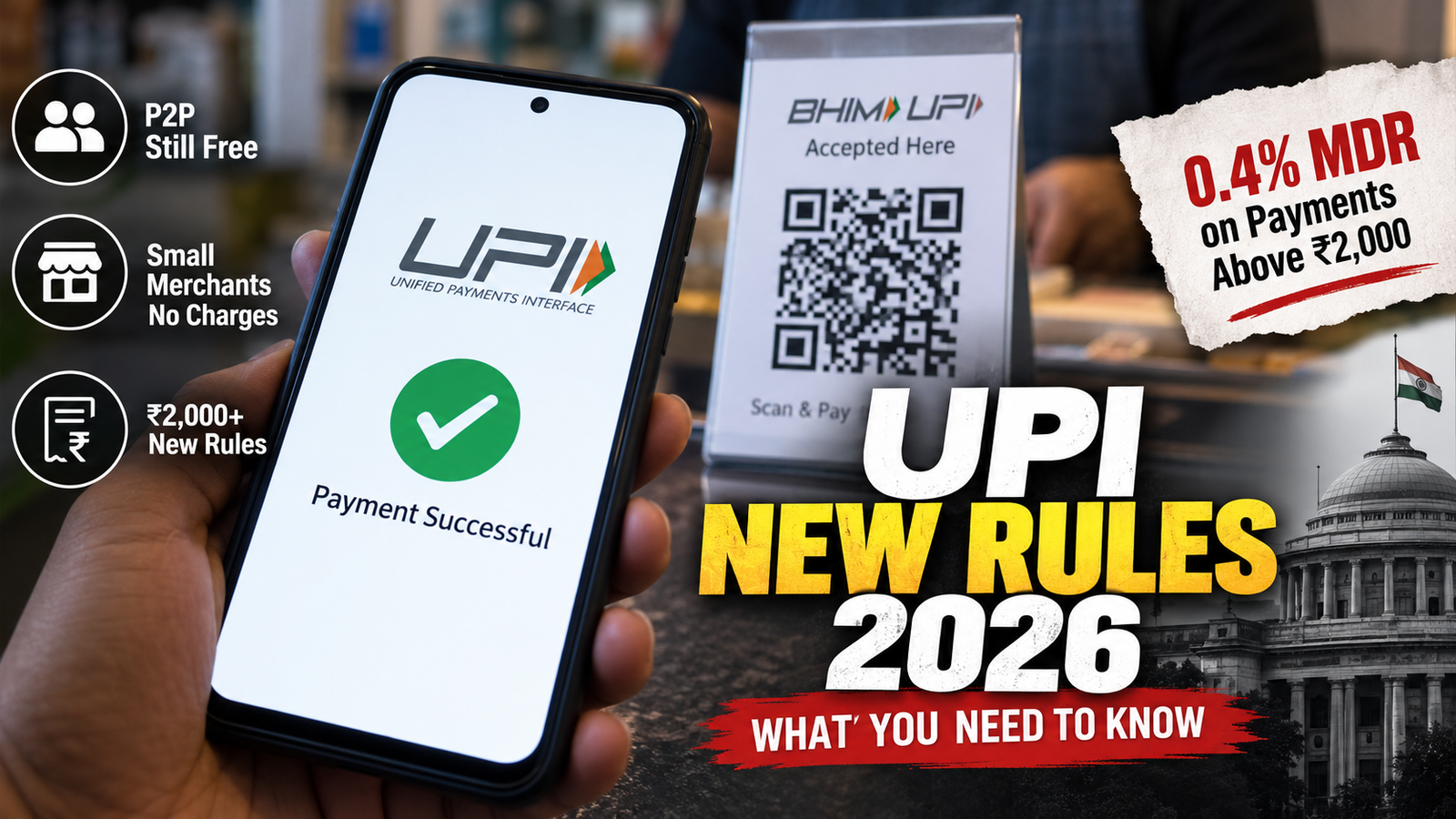
UPI charges 2026 have become a major topic of discussion in India after the introduction of a new Merchant Discount Rate (MDR) framework. From October 15, 2026, specified merchant UPI payments above ₹2,000 will be subject to new MDR rules.
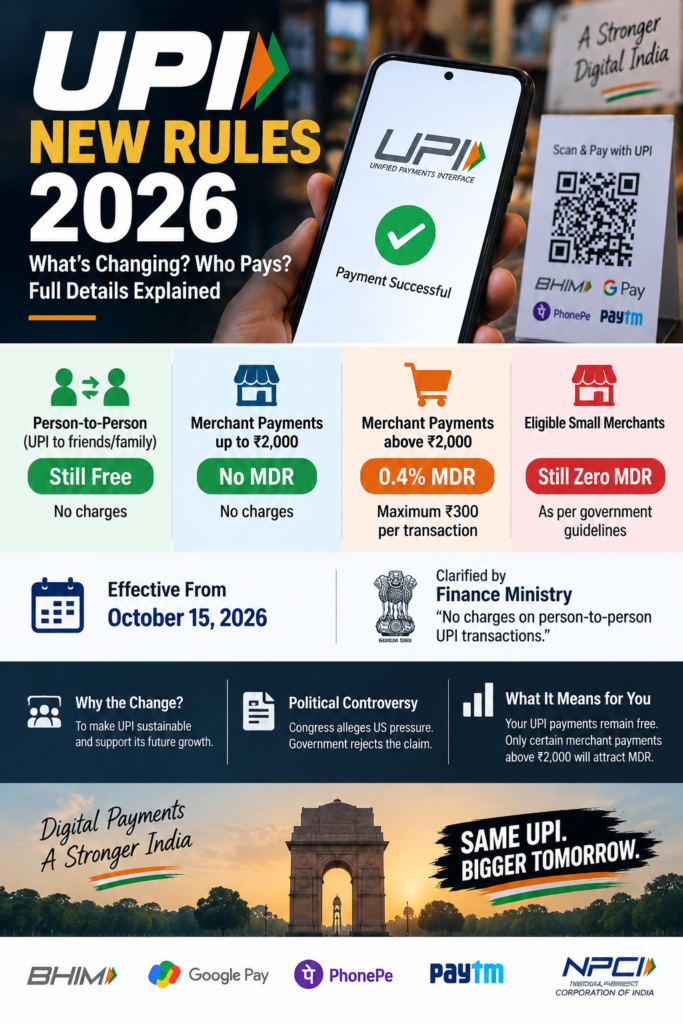
Under the new framework, eligible UPI payments made to merchants above ₹2,000 will attract an MDR of 0.4%, subject to a maximum charge of ₹300 per transaction. The fee is paid within the payment ecosystem by the merchant and is not a direct UPI charge on consumers.
For example, a ₹10,000 eligible merchant payment would have an MDR of ₹40, while a ₹75,000 payment reaches the ₹300 maximum. Payments between individuals, such as sending money to friends or family, remain outside this MDR framework.
The change does not mean that Indians will suddenly have to pay a UPI fee every time they scan a QR code. Payments up to ₹2,000 remain outside the new MDR, and the Finance Ministry has clarified that UPI continues to be free for person-to-person transactions.
Important: Merchants are not supposed to simply add the MDR as a separate charge to the customer’s UPI bill. The Ministry of Finance has advised banks to ensure that the new merchant-side charges are not passed on to customers.
Will Customers Have to Pay UPI Charges?
No. Under the new MDR framework, customers will not be charged the 0.4% fee when making an eligible UPI payment to a merchant.
For example, if you buy something worth ₹3,000 and pay through UPI, your bank account should still be debited ₹3,000, not ₹3,012. The ₹12 MDR is a merchant-side charge within the payment ecosystem.
The same applies to larger payments. A ₹50,000 eligible merchant transaction would generate ₹200 in MDR, but the customer still pays the merchant ₹50,000. For transactions of ₹75,000 or more, the standard MDR is capped at ₹300.
What about sending money to another person?
Person-to-person (P2P) UPI transfers remain completely free, regardless of the amount transferred. So sending ₹5,000 to a friend or family member will not attract the new MDR.
The government has also said banks should ensure that merchants do not pass the MDR on to customers, while UPI apps cannot add a separate platform fee or hidden charge under this framework.
In simple words:
👉 Customer: No MDR
👉 Merchant: MDR on specified transactions above ₹2,000
👉 P2P transfer: Free
👉 UPI payment up to ₹2,000: Free
What Is the 0.4% MDR on UPI?
MDR stands for Merchant Discount Rate. It is a fee paid by a merchant to the payment ecosystem for processing an eligible digital payment. Under the new UPI framework, the standard MDR will be 0.4% on specified merchant UPI transactions above ₹2,000, starting October 15, 2026.
For example:
₹2,001 payment → ₹8.004 MDR
₹5,000 payment → ₹20 MDR
₹10,000 payment → ₹40 MDR
₹50,000 payment → ₹200 MDR
₹75,000 payment → ₹300 MDR
₹1,00,000 payment → capped at ₹300
The ₹300 maximum applies to transactions of ₹75,000 and above.
The MDR is distributed among participants in the payment ecosystem, including banks, payment service providers and UPI application providers. It is not a government tax and is not supposed to be added directly to the customer’s bill.
Important point
Not every merchant payment above ₹2,000 will necessarily use the standard 0.4% rate. Certain sectors have special MDR structures, which we’ll cover later in the article.
Which UPI Payments Above ₹2,000 Are Actually Affected?
The new MDR framework does not apply to every UPI transaction above ₹2,000. It mainly covers eligible Person-to-Merchant (P2M) payments, with different rates depending on the type of merchant or service. The changes take effect from October 15, 2026.
For most regular merchant payments above ₹2,000, the standard MDR is 0.4%, capped at ₹300 per transaction. However, some sectors have separate concessional rates.
Payments that remain outside the standard MDR
Person-to-person (P2P) transfers — sending money to friends or family remains free.
Merchant payments of ₹2,000 or less — remain outside MDR.
Eligible small merchants — certain small merchants can continue receiving UPI payments without MDR under the new framework.
Some sectors have a ₹5 flat MDR
Certain categories, including railways, telecommunications, insurance and fuel, have a concessional ₹5 MDR for qualifying payments above ₹2,000 rather than the standard 0.4%. Some utility payments also fall under the concessional structure.
So, a ₹50,000 payment doesn’t automatically mean a ₹200 MDR. The applicable rate depends on the merchant category and transaction type.
Important: These are merchant-side charges. They should not be presented to readers as a new 0.4% tax or fee that consumers must automatically pay.
How Much Is the UPI Charge? Real Examples
The new MDR rate can be easier to understand with a few simple examples. For eligible merchant transactions, the standard rate is 0.4%, with the MDR capped at ₹300 per transaction. The amount is calculated on the transaction value, but it is a merchant-side charge rather than a direct fee to the customer.
UPI payment
0.4% MDR
₹3,000
₹12
₹5,000
₹20
₹10,000
₹40
₹20,000
₹80
₹50,000
₹200
₹75,000
₹300
₹1,00,000
₹300*
*The standard MDR is capped at ₹300, so it does not keep increasing beyond that amount for an eligible transaction.
Does the customer pay this amount?
No. If you make an eligible purchase worth ₹10,000, the new MDR does not mean that ₹10,040 should automatically be deducted from your bank account.
The MDR is part of the payment ecosystem’s merchant-side fee structure. The government has also directed that the charge should not be passed on to customers as a separate UPI fee.
However, the exact MDR can differ for certain merchant categories because some sectors have separate rates.
Which UPI Payments Will Remain Free?
Despite the new MDR framework, most UPI payments will continue to remain free. The government says approximately 96% of person-to-merchant (P2M) UPI transactions will remain unaffected.
Here are the main types of transactions that will remain free:
👥 1. Person-to-Person Payments
Sending money to friends, family members or other individuals will remain completely free, regardless of the amount. For example, sending ₹5,000 or ₹50,000 to another person through UPI will not attract the new MDR.
🛍️ 2. Merchant Payments Up to ₹2,000
UPI payments of ₹2,000 or less to merchants will remain outside the MDR framework. So, a ₹500 grocery purchase or a ₹2,000 restaurant bill paid through UPI will not attract MDR.
🏪 3. Payments to Eligible Small Merchants
Small merchants receiving up to ₹1 lakh per month through UPI QR codes under the P2PM category will continue to receive payments without MDR. This includes many small local businesses and street vendors.
💳 4. RuPay Debit Card Transactions on UPI
RuPay debit card transactions are also outside the new MDR structure.
So, the new system doesn’t mean every UPI transaction above ₹2,000 suddenly becomes chargeable. The merchant’s category and the type of transaction determine whether MDR applies.
Special ₹5 MDR for Fuel, Railways, Telecom and Other Services
Not every eligible UPI merchant payment above ₹2,000 will use the standard 0.4% MDR. Some important categories have been given a separate flat ₹5 MDR for qualifying transactions above ₹2,000.
These include categories such as:
🚆 Railway payments
⛽ Fuel purchases
📱 Telecom services
🛡️ Insurance
💡 Electricity and water utility payments
🌾 Certain agricultural-input payments
🎓 Education fees
For example, if an eligible ₹10,000 fuel payment falls under the ₹5 category, the merchant-side MDR would be ₹5, rather than ₹40 under the standard 0.4% rate.
What about the customer?
The ₹5 MDR is not a ₹5 UPI fee charged directly to the customer. The MDR is part of the merchant-side payment ecosystem, and banks have been advised to ensure merchants do not pass it on as a separate UPI charge.
There are also separate rates for some financial-market transactions, so the exact MDR depends on the merchant category rather than simply the amount paid.
Why Is NPCI Introducing UPI Charges?
The new MDR framework is mainly intended to create a more financially sustainable model for UPI as transaction volumes continue to grow.
According to the government and NPCI, MDR revenue will help fund areas such as UPI infrastructure, cybersecurity, fraud prevention, reliability and customer service. The framework also includes a dedicated fund aimed at expanding UPI acceptance among small merchants, particularly in smaller cities and rural areas.
UPI has grown enormously since its launch. In August 2026 alone, it processed about 24.5 billion transactions worth ₹29.823 trillion, according to official data cited by Reuters.
The government says the new structure is designed to balance two goals:
Keep everyday, low-value UPI payments free
Create a revenue stream to support the long-term UPI ecosystem
The framework therefore targets only specified merchant transactions above ₹2,000, while P2P transfers and most smaller merchant payments remain outside MDR.
The policy is scheduled to take effect on October 15, 2026.
How Could the New UPI Rule Affect Merchants?
The biggest direct change will be for merchants who receive eligible UPI payments above ₹2,000. From October 15, 2026, the standard MDR will be 0.4%, subject to a maximum of ₹300 per transaction.
For example, if a merchant receives an eligible ₹10,000 UPI payment, the MDR would be ₹40. On a ₹50,000 payment, it would be ₹200.
However, small merchants receiving up to ₹1 lakh per month through eligible UPI QR payments remain under the zero-MDR treatment. This is intended to protect smaller businesses and encourage continued UPI acceptance.
🏪 What does this mean for larger merchants?
Larger retailers, restaurants, online businesses and other eligible merchants will have to account for the payment-processing cost in their business operations. The MDR is deducted within the payment ecosystem rather than being charged directly to the customer. Banks have also been instructed to ensure that merchants do not pass the MDR on to customers as a separate UPI fee.
The new revenue is intended to support areas such as payment infrastructure, cybersecurity, fraud prevention and continued expansion of UPI. A portion is also being directed toward encouraging UPI acceptance among smaller merchants and businesses in less-served areas.
So, the impact will depend largely on the merchant’s category, monthly UPI collections and the type of payment they receive.
What UPI Users Should Know Before October 15, 2026
For most people, very little will change in everyday UPI usage. The new framework mainly affects specified merchant transactions above ₹2,000, while person-to-person transfers remain free.
Here are the key points users should remember:
💰 1. You don’t need to stop using UPI
You can continue paying shops, restaurants and other businesses through UPI. The new MDR is a merchant-side charge, not a general fee for customers.
👥 2. Sending money to another person remains free
Whether you’re sending ₹500 or ₹50,000 to a friend or family member, the new MDR does not apply to P2P transactions. There are also no monthly quotas or transaction limits on free P2P UPI usage.
🏪 3. Check the merchant category
For eligible merchant payments above ₹2,000, the applicable MDR can depend on the merchant category. Some sectors have special flat-rate structures rather than the standard 0.4%.
⚠️ 4. Be careful about misleading “UPI tax” claims
The MDR is not a government tax. The Finance Ministry says it is distributed among participants in the payment ecosystem to support the operation and expansion of UPI.
📱 5. UPI apps aren’t supposed to add a hidden fee
The new framework does not introduce a monthly subscription or platform fee for ordinary UPI users. Banks have also been advised to ensure that merchants don’t pass the MDR on to customers.
Overall, the government says around 96% of P2M transactions will remain unaffected, so the change is narrower than some headlines suggest.
Political Controversy: Congress Alleges US Pressure Over UPI Charges
The new UPI MDR framework has also triggered a political dispute between the government and the Congress.
Congress has alleged that the change was introduced because of pressure from the United States, arguing that American payment companies such as Visa and Mastercard have previously raised concerns about India’s zero-MDR UPI model. Congress leaders have questioned whether the new 0.4% MDR could make it easier for foreign card networks to compete with UPI.
Rahul Gandhi and other Congress leaders have criticised the government over the decision and called for the move to be withdrawn. Congress has also argued that merchants could eventually pass the cost on to consumers through higher prices.
Government’s Response
The Finance Ministry has rejected the allegation of foreign influence, saying India’s UPI policy decisions are made independently. It said the purpose of the MDR framework is to build a self-sustaining, inclusive and affordable digital-payment ecosystem and support its continued operation and expansion.
The government has also stressed that MDR is not a government tax and that consumers will not directly pay the merchant-side MDR.
So, at present, the foreign-pressure allegation is a claim made by Congress that the government has rejected. The two sides have offered different explanations for the policy, and readers should distinguish the political allegations from the confirmed details of the MDR framework.
UPI Charges 2026: Frequently Asked Questions
Will UPI become chargeable for normal users?
No. Consumers will continue to use UPI without paying MDR. The new charge is applied within the merchant-payment ecosystem.
Will sending money to friends or family cost money?
No. Person-to-person UPI transfers remain free regardless of the amount transferred.
From when will the new MDR apply?
The new framework takes effect from October 15, 2026.
What is the standard MDR rate?
For specified P2M transactions above ₹2,000, the standard MDR is 0.4%, with a maximum of ₹300 per transaction.
Will a ₹2,000 UPI payment attract MDR?
No. Merchant payments up to ₹2,000 remain outside the MDR framework.
Can a shopkeeper add the MDR to my bill?
The framework says merchants should not pass the MDR on to customers as a separate charge. UPI apps are also not permitted to impose a platform fee or hidden charge under this framework.
Are small merchants affected?
Eligible small merchants receiving up to ₹1 lakh per month through UPI QR codes under the specified P2PM category continue to receive zero-MDR treatment.
Is MDR a new UPI tax?
No. The government states that MDR is neither a tax nor a charge collected by the government or NPCI. It is distributed among participants in the payment ecosystem.
Will UPI apps start charging monthly fees?
No. NPCI’s framework says consumers will not face monthly quotas or platform fees for ordinary UPI usage.
Are all payments above ₹2,000 charged at 0.4%?
No. Certain categories have different MDR structures, so the applicable rate depends on the type of merchant transaction.
Conclusion
The new UPI MDR framework is a change mainly for eligible merchant transactions, rather than a general charge on people using UPI.
From October 15, 2026, the standard MDR for specified merchant payments above ₹2,000 will be 0.4%, capped at ₹300 per transaction. Meanwhile, person-to-person transfers will remain free, and merchant payments up to ₹2,000 will remain outside the standard MDR framework. Eligible small merchants also continue to receive zero-MDR treatment.
For consumers, the important point is simple: you are not being asked to pay the MDR directly when making a UPI payment. The charge operates within the merchant payment ecosystem.
Because different merchant categories have different MDR structures, users should avoid assuming that every payment above ₹2,000 will automatically attract the standard 0.4% rate.
UPI will therefore continue to be an important part of India’s digital-payment system, while the new framework changes how some higher-value merchant transactions are funded.
official UPI information from NPCI https://www.npci.org.in/circulars/upi
If you like this article check out my article on ganesha chaturthi https://itshk.in/ganesh-chaturthi-2026/