Black Holes Explained: The Ultimate Guide to the Universe’s Greatest Mystery
Introduction
The universe is filled with extraordinary wonders, but few are as fascinating and mysterious as black holes. For decades, scientists, astronomers, and space enthusiasts have tried to understand these invisible cosmic giants that possess gravity so powerful that not even light can escape. This is why Black Holes Explained has become one of the most searched topics in modern astronomy.
Although black holes cannot be seen directly, their presence can be detected through their powerful gravitational effects on nearby stars, gas, and even entire galaxies. Thanks to advanced telescopes and space missions, researchers have made incredible discoveries about black holes, yet they remain one of the greatest mysteries in the universe.
The idea of a black hole was once considered purely theoretical. In the 18th century, scientists first suggested that an object with extremely strong gravity might exist. Later, Albert Einstein’s Theory of General Relativity provided the mathematical foundation showing that such objects were possible. Over the past century, observations from ground-based observatories and space telescopes have confirmed that black holes are real and are found throughout the universe.
Today, black holes are known to exist in different sizes. Some are only a few times more massive than the Sun, while others contain billions of times the Sun’s mass and lie at the centers of galaxies. Scientists believe our own Milky Way galaxy contains a supermassive black hole called Sagittarius A*, located about 26,000 light-years from Earth.
Understanding black holes helps scientists answer some of the biggest questions about gravity, space, time, and the evolution of the universe. These mysterious objects also provide valuable clues about how galaxies form and change over billions of years.
In this comprehensive guide, Black Holes Explained, we will explore how black holes form, the different types of black holes, their structure, famous discoveries, scientific theories, and why they continue to challenge our understanding of physics.
What Is a Black Hole?
To understand Black Holes Explained, it is important to first know what a black hole actually is.
A black hole is a region in space where gravity becomes so strong that nothing—not even light—can escape once it crosses a certain boundary called the event horizon. Unlike planets or stars, black holes do not have a solid surface. Instead, they are regions where enormous amounts of mass have been compressed into an incredibly small area.
Because no light escapes from them, black holes are invisible against the darkness of space. Scientists detect them by observing how nearby stars, gas clouds, and light behave under their immense gravitational influence.
When material falls toward a black hole, it often forms a rapidly spinning disk called an accretion disk. As this material heats up to millions of degrees, it emits powerful X-rays and other forms of radiation that astronomers can detect using specialized telescopes.
Despite their reputation as cosmic vacuum cleaners, black holes do not randomly pull everything toward them. If our Sun were somehow replaced by a black hole with the same mass, Earth would continue orbiting it almost exactly as it does today. The only difference would be the absence of sunlight and heat.
How Do Black Holes Form?
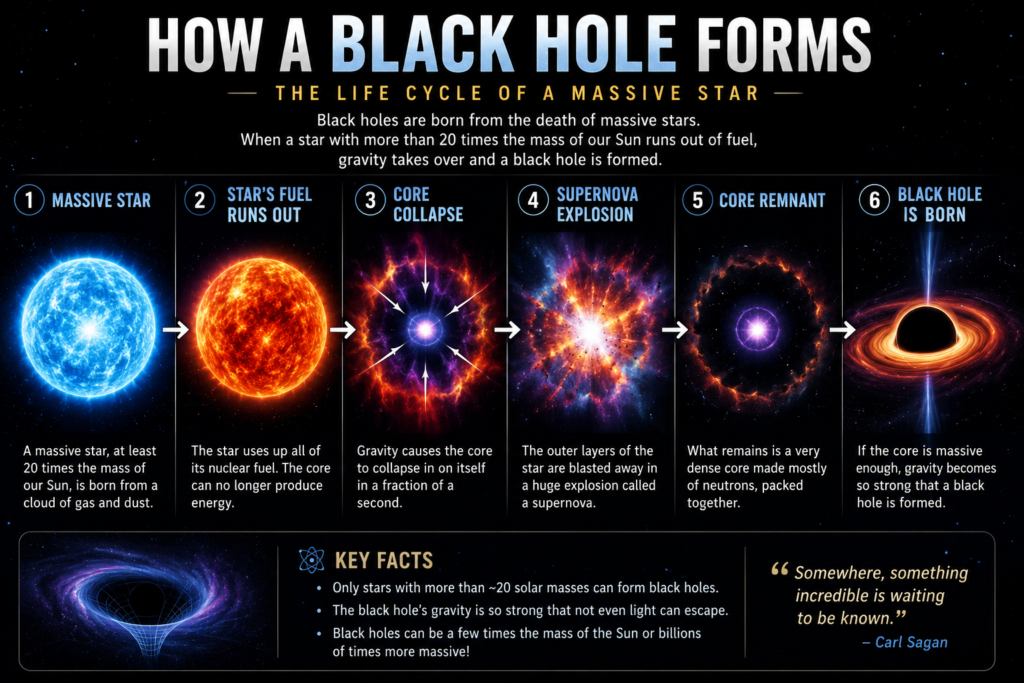
One of the most fascinating parts of Black Holes Explained is understanding how these incredible objects are created.
Most black holes begin their lives as massive stars. Throughout their lifetime, stars generate energy by fusing hydrogen into helium inside their cores. This nuclear fusion creates outward pressure that balances the inward pull of gravity.
Eventually, the star runs out of fuel.
For stars much larger than our Sun, gravity becomes overwhelmingly powerful once nuclear fusion stops. Without enough outward pressure to support the star, the core collapses under its own weight within seconds.
This collapse triggers a spectacular explosion called a supernova, one of the brightest events in the universe. After the explosion, if the remaining core is sufficiently massive, gravity compresses it into a black hole.
The newly formed black hole contains tremendous mass packed into an incredibly small volume, creating one of the strongest gravitational fields known in nature.
Scientists believe black holes have been forming throughout the universe for billions of years, contributing to the growth and evolution of galaxies.
Why Are Black Holes So Important?
Studying black holes is about much more than understanding unusual objects in space. They provide scientists with natural laboratories where the laws of physics can be tested under conditions impossible to recreate on Earth.
Black holes help researchers investigate:
Gravity under extreme conditions.
The behavior of space and time.
The evolution of stars.
The formation of galaxies.
The origin of high-energy cosmic radiation.
The possibility of new discoveries in physics.
Modern observatories continue discovering new black holes every year, expanding our understanding of the universe and revealing phenomena that were once thought impossible.
The study of Black Holes Explained also inspires new technologies, improves space exploration, and encourages future generations to pursue careers in science and astronomy.
Early Theories About Black Holes
Long before black holes were confirmed through observation, scientists had already begun imagining objects with gravity so strong that light could not escape.
In 1783, English scientist John Michell proposed the idea of “dark stars,” suggesting that extremely massive objects could trap light using gravity.
More than a century later, Albert Einstein’s Theory of General Relativity revolutionized our understanding of gravity by showing that massive objects bend space and time. His equations predicted that extremely dense objects like black holes could exist.
Initially, even Einstein doubted that such objects would actually form in nature. However, later research by physicists such as Karl Schwarzschild, Subrahmanyan Chandrasekhar, and Stephen Hawking helped establish black holes as one of the most important areas of modern astrophysics.
Today, black holes are no longer just theoretical concepts. They are among the best-studied extreme objects in the universe, though many mysteries remain unsolved.
Why Black Holes Continue to Fascinate Scientists
One reason Black Holes Explained remains one of the most fascinating topics in astronomy is that black holes challenge our understanding of the universe. They push the laws of physics to their limits, creating environments where gravity becomes incredibly powerful and space and time behave in unusual ways. Scientists use black holes to test Einstein’s Theory of General Relativity and search for clues that could eventually unite gravity with quantum mechanics, two of the most important yet currently incompatible theories in modern physics.
Black holes also play a major role in shaping galaxies. Supermassive black holes located at the centers of galaxies can influence the movement of billions of stars and enormous clouds of gas. Their powerful gravitational pull and energetic jets affect how galaxies grow and evolve over billions of years. By studying these extraordinary cosmic objects, researchers hope to answer some of the biggest questions in science, including how the universe formed, what happens inside a black hole, and whether new laws of physics remain undiscovered. As telescopes and space missions become more advanced, the study of Black Holes Explained will continue to reveal exciting discoveries that expand our knowledge of the cosmos.
Types of Black Holes
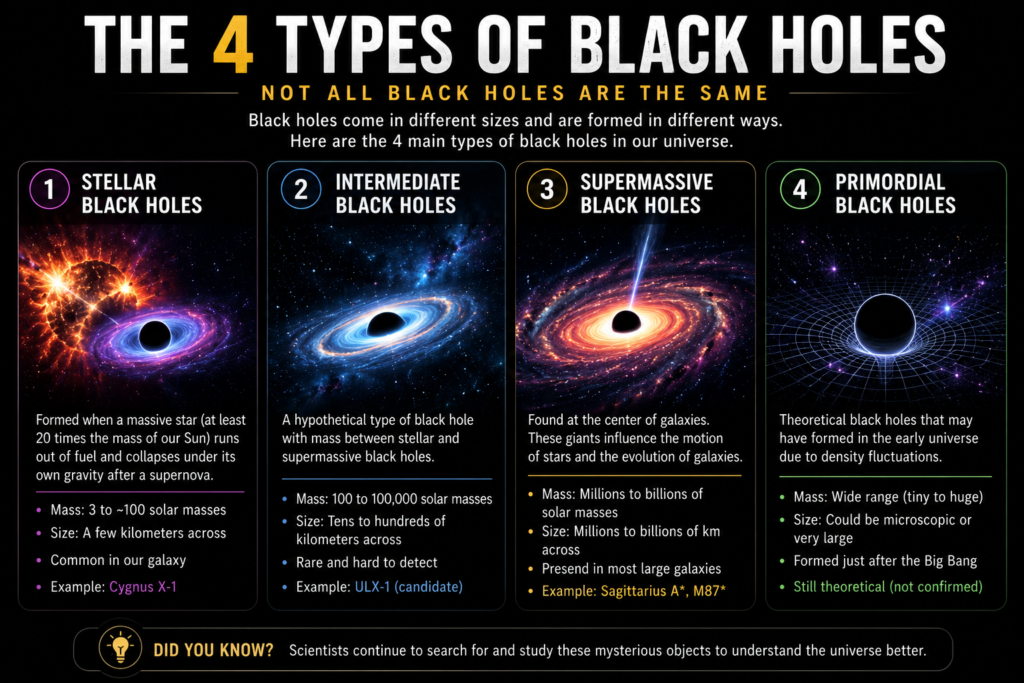
One of the most important aspects of Black Holes Explained is understanding that not all black holes are the same. Scientists classify black holes into different categories based on their mass and the way they form. Although all black holes possess incredibly strong gravity, their sizes and origins vary greatly.
Today, astronomers recognize four main types of black holes: stellar black holes, intermediate black holes, supermassive black holes, and the hypothetical primordial black holes. Each type plays a unique role in the evolution of the universe.
1. Stellar Black Holes
The most common type discussed in Black Holes Explained is the stellar black hole.
A stellar black hole forms when a massive star—typically more than 20 times the mass of our Sun—runs out of nuclear fuel. Without the outward pressure created by fusion, gravity causes the star’s core to collapse, leading to a supernova explosion. If enough mass remains after the explosion, the collapsed core becomes a black hole.
Most stellar black holes contain between 5 and 100 times the mass of the Sun. Despite their enormous mass, they are surprisingly compact, often measuring only a few dozen kilometers across.
Astronomers have discovered many stellar black holes within the Milky Way, often by observing companion stars that orbit invisible objects with extremely strong gravity.
2. Intermediate Black Holes
Intermediate black holes are among the most mysterious objects in modern astronomy.
Scientists believe these black holes have masses ranging from 100 to 100,000 times the mass of the Sun, making them much larger than stellar black holes but far smaller than supermassive black holes.
For many years, astronomers searched for evidence that intermediate black holes actually existed. Recent observations have identified several strong candidates, although researchers continue studying them to understand how they form.
Some theories suggest they result from repeated mergers between smaller black holes inside dense star clusters.
Because they are difficult to detect, intermediate black holes remain one of the most exciting topics in Black Holes Explained.
3. Supermassive Black Holes
The largest known black holes belong to the category of supermassive black holes.
These cosmic giants contain millions or even billions of times the mass of the Sun and are believed to exist at the centers of nearly every large galaxy.
Our own Milky Way galaxy contains a supermassive black hole called Sagittarius A*.
Unlike stellar black holes, scientists are still investigating exactly how supermassive black holes formed. Some theories suggest they grew by merging with other black holes, while others propose they formed rapidly during the early universe.
These enormous black holes influence the movement of stars, gas, and dust throughout entire galaxies.
Without supermassive black holes, galaxies may have evolved very differently.
4. Primordial Black Holes
One of the most fascinating theories in Black Holes Explained involves primordial black holes.
Unlike other black holes, primordial black holes would not have formed from collapsing stars.
Instead, scientists hypothesize that they may have formed during the first moments after the Big Bang, when the universe was incredibly hot and dense.
Although no primordial black holes have been confirmed, researchers continue searching for evidence because these objects could help explain dark matter and several other cosmic mysteries.
If they exist, primordial black holes could range from microscopic sizes to objects much larger than mountains.
Event Horizon Explained
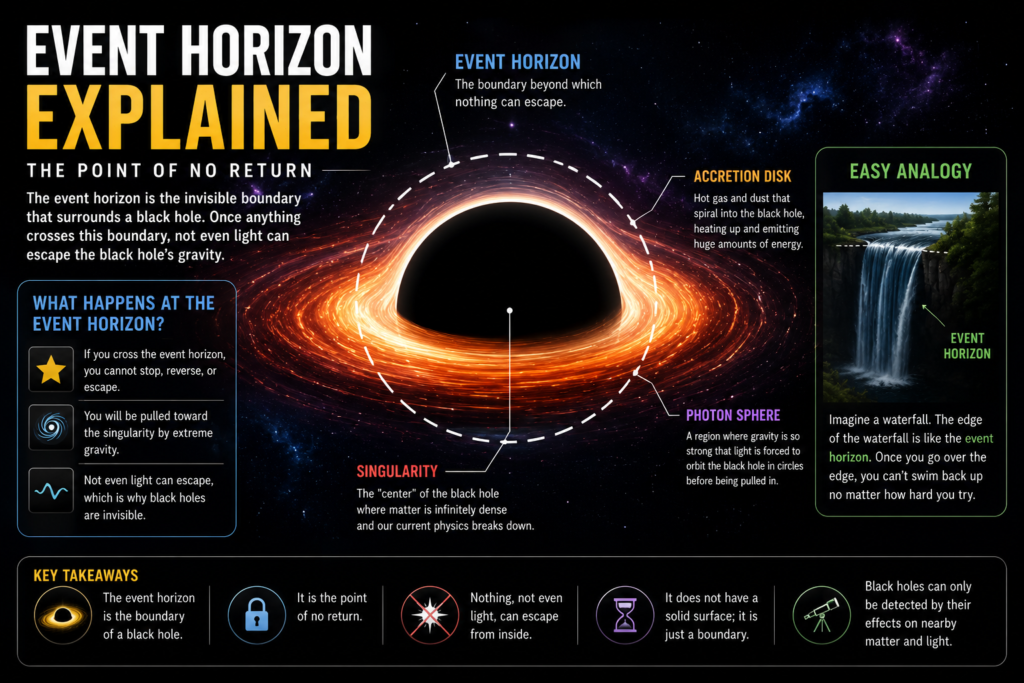
Perhaps the most famous feature in Black Holes Explained is the event horizon.
The event horizon is often described as the “point of no return.”
Once any object crosses this invisible boundary, escaping the black hole becomes impossible because the escape velocity exceeds the speed of light.
From an outside observer’s perspective, an object approaching the event horizon appears to move more slowly due to the effects of Einstein’s theory of relativity.
Eventually, the object seems to freeze and gradually fade from view.
However, according to the object itself, it continues falling toward the center of the black hole.
This strange behavior makes the event horizon one of the most fascinating predictions of modern physics.
What Is a Singularity?
At the center of every black hole lies a theoretical region called the singularity.
According to General Relativity, all the mass inside the black hole becomes compressed into an extremely tiny point where density becomes enormous.
At the singularity, gravity becomes infinitely strong, and the known laws of physics break down.
Scientists believe our current theories are incomplete because quantum mechanics and General Relativity produce conflicting predictions under such extreme conditions.
Developing a successful theory of quantum gravity may eventually explain what truly exists inside a black hole.
Until then, the singularity remains one of the greatest mysteries in Black Holes Explained.
How Scientists Detect Black Holes
Because black holes emit no visible light, scientists must detect them indirectly.
Studying Nearby Stars
Astronomers observe stars orbiting invisible objects. If a star moves as though it is orbiting an extremely massive unseen companion, that companion may be a black hole.
X-ray Observations
Gas falling into a black hole forms an accretion disk that becomes extremely hot.
This hot gas emits powerful X-rays that space telescopes can detect.
Gravitational Waves
In 2015, scientists made history by detecting gravitational waves produced by two merging black holes.
These tiny ripples in space-time confirmed one of Einstein’s greatest predictions and opened an entirely new way to study the universe.
Direct Imaging
Although black holes themselves remain invisible, scientists can photograph the glowing gas surrounding them.
In 2019, the Event Horizon Telescope captured the first-ever image of a black hole, marking one of the greatest achievements in astronomy.
The First Image of a Black Hole
One of the greatest milestones in Black Holes Explained occurred on April 10, 2019.
The Event Horizon Telescope collaboration released humanity’s first image of a black hole.
The image showed the supermassive black hole M87* located approximately 55 million light-years from Earth.
Rather than showing the black hole itself, the photograph revealed the glowing ring of hot gas surrounding its event horizon.
This historic achievement required combining observations from radio telescopes located across several continents, effectively creating an Earth-sized virtual telescope.
The image provided strong confirmation of Einstein’s General Theory of Relativity and represented one of the greatest scientific accomplishments of the 21st century.
Sagittarius A* – The Supermassive Black Hole at the Center of the Milky Way
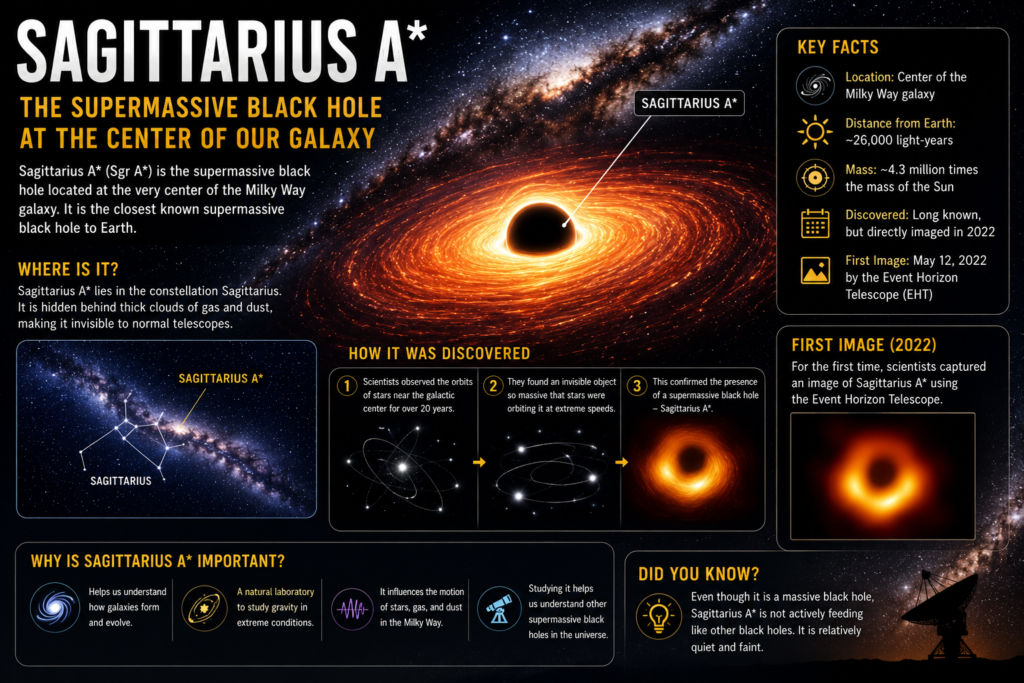
One of the most fascinating chapters in Black Holes Explained is the story of Sagittarius A* (pronounced “Sagittarius A-star”). This enormous black hole lies at the very center of our Milky Way galaxy, approximately 26,000 light-years from Earth.
Astronomers estimate that Sagittarius A* contains about 4 million times the mass of the Sun, making it the gravitational heart of our galaxy. Nearly every star in the Milky Way, including our own Sun, orbits around this invisible giant.
Although Sagittarius A* is incredibly massive, it is relatively quiet compared to many other supermassive black holes. It occasionally consumes nearby gas and dust, producing bursts of X-rays and radio waves that astronomers can observe.
In 2022, the Event Horizon Telescope collaboration released the first direct image of Sagittarius A*. This achievement confirmed decades of research and provided another powerful test of Einstein’s General Theory of Relativity.
Studying Sagittarius A* helps scientists understand how galaxies form, how supermassive black holes grow, and how gravity behaves under extreme conditions. It remains one of the most important objects in Black Holes Explained.
M87* – The First Black Hole Ever Photographed
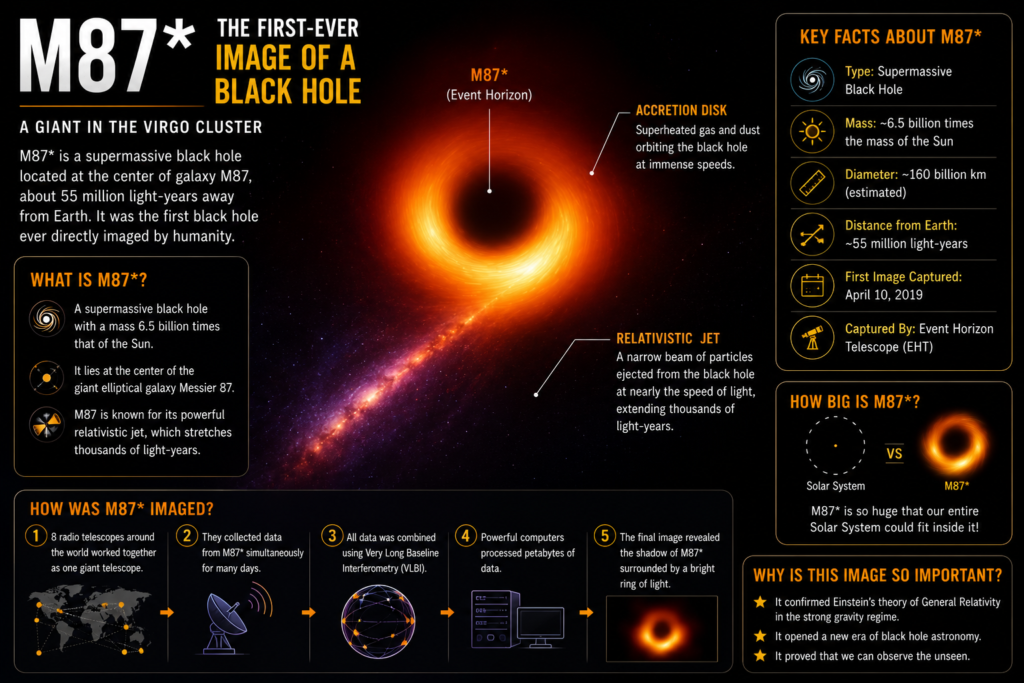
Among the greatest achievements in modern astronomy was capturing the first-ever image of a black hole, known as M87*.
Located about 55 million light-years away in the galaxy Messier 87, M87* is one of the largest known black holes. Scientists estimate its mass to be about 6.5 billion times that of the Sun.
Unlike ordinary photographs, the famous image captured in 2019 does not show the black hole itself. Instead, it reveals a bright ring of glowing gas surrounding the dark shadow created by the event horizon.
Creating this historic image required linking radio telescopes around the world into a single virtual telescope nearly the size of Earth. The project, known as the Event Horizon Telescope, involved hundreds of scientists from many countries working together.
The image of M87* provided strong evidence supporting Einstein’s predictions and demonstrated that black holes truly exist as described by modern physics.
Hawking Radiation Explained
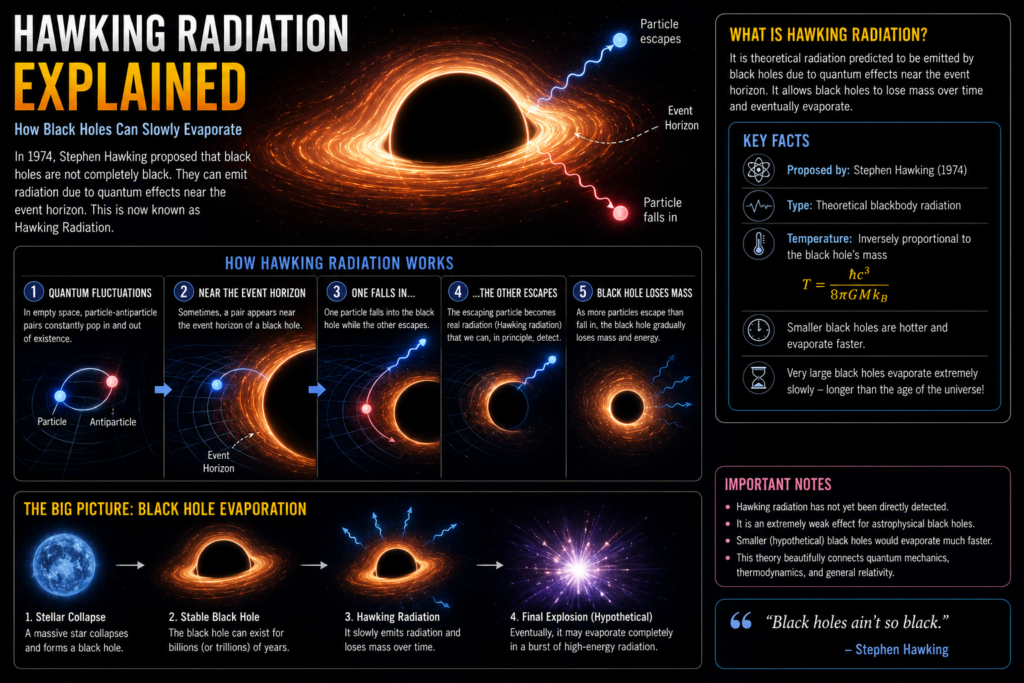
One of the most revolutionary ideas in Black Holes Explained came from the famous physicist Stephen Hawking.
In 1974, Hawking proposed that black holes are not completely black.
According to quantum physics, tiny particle-antiparticle pairs constantly appear and disappear in empty space. Near the event horizon of a black hole, one particle may fall inside while the other escapes into space.
To an outside observer, this process appears as though the black hole is emitting radiation.
This theoretical phenomenon is called Hawking Radiation.
If Hawking’s theory is correct, black holes slowly lose energy over incredibly long periods of time. Large black holes would take far longer than the current age of the universe to disappear completely.
Although Hawking Radiation has not yet been directly observed, it remains one of the most important predictions connecting quantum mechanics with gravity.
Can Black Holes Die?
One of the biggest questions in Black Holes Explained is whether black holes last forever.
For many years, scientists believed black holes could only grow larger by absorbing matter.
However, Hawking Radiation suggests a different possibility.
As a black hole emits Hawking Radiation, it gradually loses mass.
Over trillions upon trillions of years, this process could eventually cause the black hole to evaporate completely.
The smallest black holes would disappear first, while supermassive black holes may survive for unimaginable lengths of time.
Although this process occurs far too slowly to observe directly, it remains one of the most fascinating predictions in theoretical physics.
What Happens If You Fall Into a Black Hole?
Perhaps the most famous question in Black Holes Explained is what would happen if a person entered a black hole.
The answer depends on the size of the black hole.
If someone approached a small stellar black hole, the difference in gravity between their head and feet would become enormous. This stretching effect is called spaghettification.
The person’s body would be pulled into an extremely long, thin shape before reaching the event horizon.
However, if the black hole were supermassive, such as Sagittarius A*, the tidal forces near the event horizon would be much weaker. A person might cross the event horizon without immediately noticing anything unusual.
What happens after crossing the event horizon remains one of the greatest unsolved mysteries in physics.
Current scientific theories cannot fully describe conditions inside a black hole because gravity becomes too extreme.
Spaghettification Explained
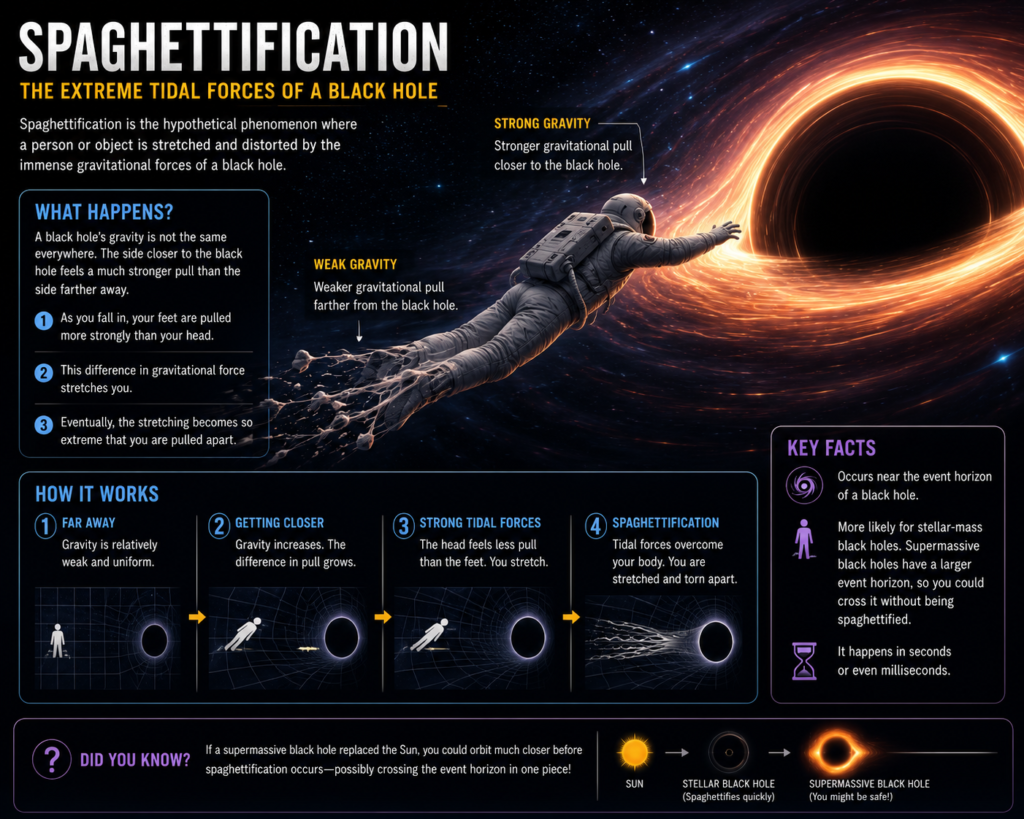
Spaghettification is one of the strangest consequences of Einstein’s General Relativity.
As an object falls toward a black hole, gravity acting on the part closest to the black hole becomes much stronger than gravity acting on the farthest part.
This difference in gravitational force stretches the object while compressing it sideways.
Eventually, the object becomes an incredibly thin stream of matter resembling spaghetti, which is how the phenomenon received its unusual name.
Although often shown dramatically in movies, spaghettification is based on genuine scientific predictions.
Could Black Holes Be Wormholes?
Some scientists have proposed that black holes might be connected to hypothetical tunnels through space-time called wormholes.
A wormhole is a theoretical shortcut linking two distant regions of the universe.
If wormholes exist, they could potentially allow travel across enormous cosmic distances.
However, there is currently no observational evidence confirming that black holes are wormholes.
Most physicists believe stable wormholes would require exotic forms of matter with unusual properties that have never been discovered.
Even so, wormholes remain a fascinating area of research in theoretical physics and science fiction.
The Biggest Unsolved Mysteries About Black Holes
Despite decades of research, many mysteries remain.
Scientists continue searching for answers to questions such as:
What exists inside the singularity?
Does information truly disappear inside black holes?
Can quantum mechanics and gravity be unified?
Do primordial black holes exist?
Are wormholes real?
What happens beyond the event horizon?
Could black holes create entirely new universes?
How did supermassive black holes form so quickly after the Big Bang?
These unanswered questions ensure that Black Holes Explained remains one of the most exciting fields in modern astronomy.
Every new observation from powerful telescopes brings humanity closer to understanding these extraordinary cosmic objects.
Latest Black Hole Discoveries
The field of Black Holes Explained continues to evolve as astronomers make remarkable discoveries using powerful telescopes and advanced computer simulations. Every year, scientists uncover new evidence that helps us better understand how black holes form, grow, and influence the universe.
Modern observatories such as the Event Horizon Telescope, the James Webb Space Telescope, and gravitational-wave detectors have transformed black hole research. These instruments allow astronomers to observe the effects of black holes with unprecedented precision.
Researchers continue discovering previously unknown black holes hidden within distant galaxies. Some studies suggest that supermassive black holes formed much earlier than scientists once believed, raising important questions about how the young universe evolved so rapidly.
The study of Black Holes Explained remains one of the fastest-growing areas of modern astrophysics, with new discoveries regularly challenging existing theories.
Black Holes and Time
One of the strangest aspects of Black Holes Explained involves the effect of gravity on time itself.
According to Einstein’s General Theory of Relativity, gravity can slow the passage of time. Near a black hole, gravity becomes so powerful that time passes much more slowly compared to someone far away.
Imagine two identical clocks.
One remains safely on Earth.
The other travels close to a black hole before returning.
The clock near the black hole would show less elapsed time than the one on Earth.
This effect, called gravitational time dilation, has been confirmed through experiments involving satellites and atomic clocks, although the effect near black holes would be dramatically stronger.
This extraordinary prediction demonstrates how black holes influence not only space but also time itself.
Black Holes vs Neutron Stars
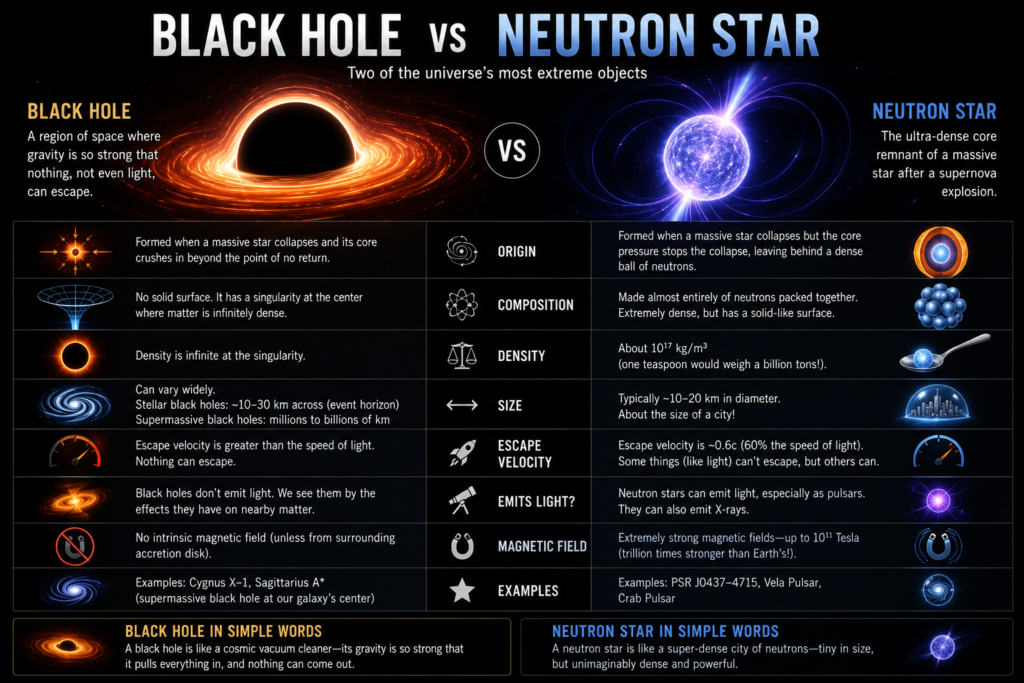
Many people confuse black holes with neutron stars.
Although both form after massive stars die, they are very different objects.
Black Holes
Gravity is so strong that not even light can escape.
Surrounded by an event horizon.
Contains a singularity according to current theory.
Invisible except for their effects on nearby matter.
Neutron Stars
Extremely dense but still possess a physical surface.
Light can escape from their surface.
Often observed as pulsars that emit regular beams of radiation.
Can have incredibly strong magnetic fields.
Scientists study both objects to better understand how stars evolve and how matter behaves under extreme conditions.
Could Black Holes Help Us Understand the Universe?
The study of Black Holes Explained extends far beyond astronomy.
Black holes provide natural laboratories where scientists test the laws of physics under the most extreme conditions imaginable.
Research into black holes contributes to:
Understanding gravity.
Investigating quantum mechanics.
Studying galaxy formation.
Exploring dark matter theories.
Searching for a unified theory of physics.
Many physicists believe solving the mysteries of black holes could lead to one of the greatest scientific breakthroughs in history.
Amazing Facts About Black Holes
The universe contains countless fascinating black hole facts.
The first image of a black hole was released in 2019.
Sagittarius A* lies about 26,000 light-years from Earth.
M87* has a mass of approximately 6.5 billion Suns.
Some black holes spin at incredible speeds.
Black holes can merge together.
These mergers create gravitational waves.
The Milky Way contains millions of stellar black holes.
Supermassive black holes exist at the centers of most large galaxies.
Hawking Radiation suggests black holes slowly lose mass.
Black holes are not cosmic vacuum cleaners—they only strongly affect objects that come close.
Time slows dramatically near a black hole.
Scientists have never directly observed a singularity.
The largest known black holes contain tens of billions of solar masses.
Black holes continue growing by absorbing gas, dust, and sometimes stars.
Much about black holes remains unknown, making them one of the greatest mysteries in science.
Frequently Asked Questions
What is a black hole?
A black hole is a region of space where gravity is so powerful that nothing, not even light, can escape after crossing the event horizon.
How are black holes formed?
Most black holes form when massive stars collapse after exhausting their nuclear fuel, often following a supernova explosion.
Can light escape from a black hole?
No. Once light crosses the event horizon, it cannot escape the black hole’s gravitational pull.
What is the biggest black hole?
Some of the largest known black holes contain tens of billions of times the mass of the Sun. Astronomers continue discovering even larger candidates.
Is Sagittarius A* dangerous to Earth?
No. Sagittarius A* is about 26,000 light-years away and poses no threat to our Solar System.
Has anyone ever entered a black hole?
No human has ever traveled to a black hole.
Do black holes eventually disappear?
According to Stephen Hawking’s theory, black holes slowly lose energy through Hawking Radiation and may eventually evaporate over incredibly long periods.
Conclusion
The journey of Black Holes Explained reveals one of the most extraordinary stories in modern science. From the collapse of massive stars to the formation of supermassive giants at the centers of galaxies, black holes continue to challenge our understanding of gravity, space, and time.
Although scientists have made remarkable progress through advanced telescopes, space missions, and theoretical physics, many mysteries remain unanswered. Questions surrounding singularities, Hawking Radiation, quantum gravity, and the true nature of space-time continue inspiring researchers around the world.
Every new discovery brings us closer to understanding these mysterious cosmic objects. As technology advances, future generations of astronomers may uncover secrets that completely transform our understanding of the universe.
Black holes remind us that even in an age of incredible scientific achievement, the universe still holds mysteries beyond our imagination. Their study continues to inspire curiosity, innovation, and the search for knowledge, proving that exploration does not end at the edge of our planet but extends into the deepest reaches of space.
Explore More
If you enjoyed learning about Black Holes Explained, you may also like these articles:
The Deep Ocean: Earth’s Last Unexplored World https://itshk.in/the-deep-ocean-earths-last-unexplored-world/
Top 10 Upcoming Space Missions That Could Change the Future https://itshk.in/top-10-upcoming-space-missions-in-india/
Legends of India: Heroes, Myths, Mysteries, and the Stories That Shaped a Civilization https://itshk.in/legends-of-india/
Black holes remain one of the most exciting areas of modern astronomy, and scientists continue to study their formation, evolution, and effects on the universe. Readers who want to explore official information about black holes, space missions, and the latest discoveries can visit the National Aeronautics and Space Administration (NASA) for trusted educational resources and scientific updates.http://NASA – Black Holes
The study of black holes is an international scientific effort involving powerful telescopes and space observatories around the world. To learn more about astronomy, space exploration, and ongoing research into black holes and the universe, readers can explore the official resources provided by the European Space Agency (ESA).http://European Space Agency (ESA)
1 thought on “Black Holes Explained: The Ultimate Guide to the Universe’s Greatest Mystery (2026)”