Table of Contents
Introduction
Why Space Fascinates Humanity
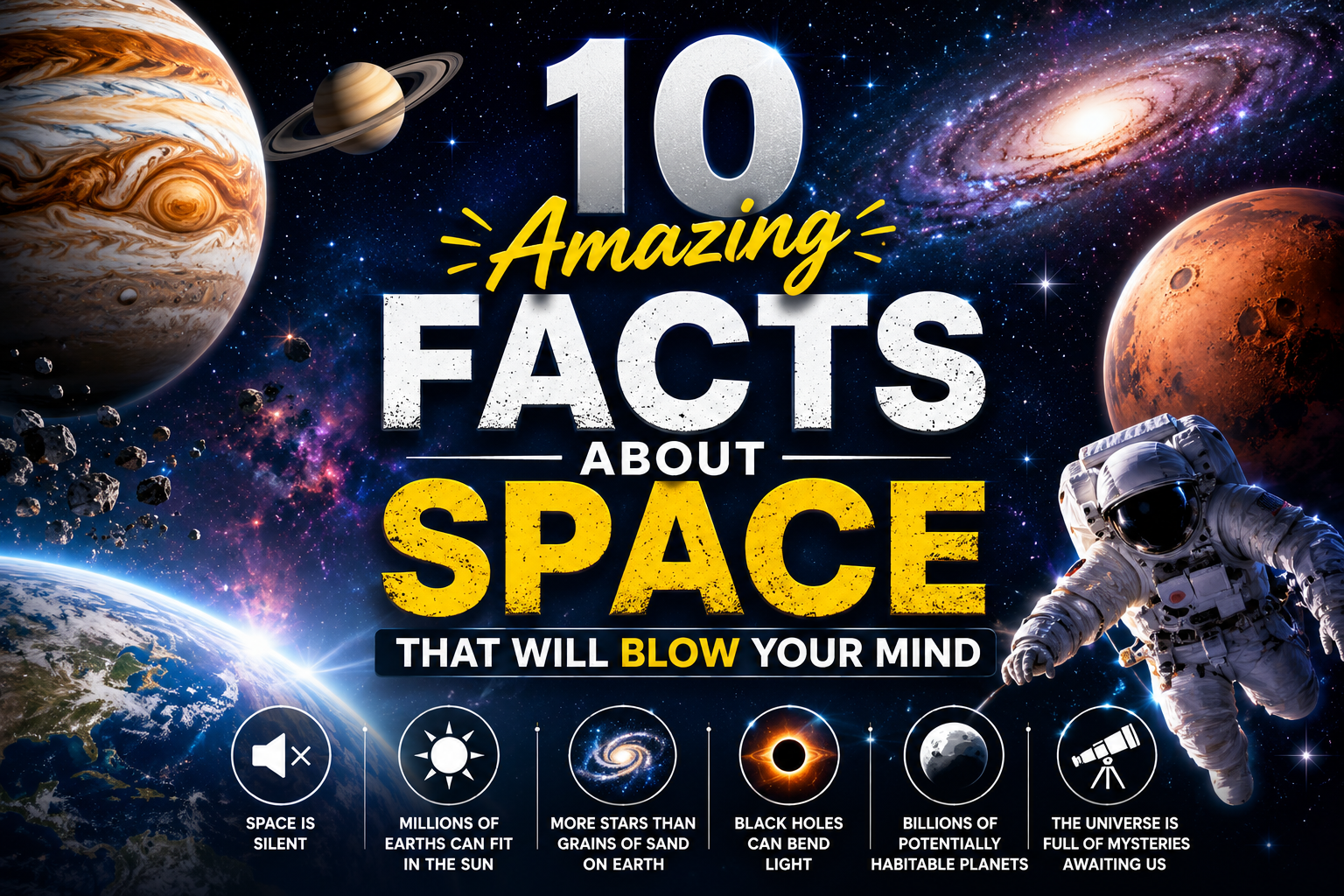
10 Amazing Facts About Space
What We Still Don’t Know About Space
The Future of Space Exploration
Conclusion
FAQs
Introduction
Space is one of the greatest mysteries of the universe. It stretches far beyond our imagination and contains billions of stars, planets, galaxies, and cosmic wonders. Scientists continue to explore space every day, making discoveries that change our understanding of the universe.
These amazing facts about space reveal just how incredible and mysterious the cosmos truly is. Whether you’re a student, science enthusiast, or simply curious about the universe, these facts are sure to impress you.
Why Space Fascinates Humanity
Humans have always looked at the night sky with wonder. Ancient civilizations studied stars to navigate and understand the world around them. Today, advanced telescopes and spacecraft allow us to explore distant planets and galaxies.
The vastness of space reminds us how small Earth is compared to the universe. Every new discovery brings more questions and excitement and this led to the research of space and the humans got to know more and more about space and some amazing facts about space.
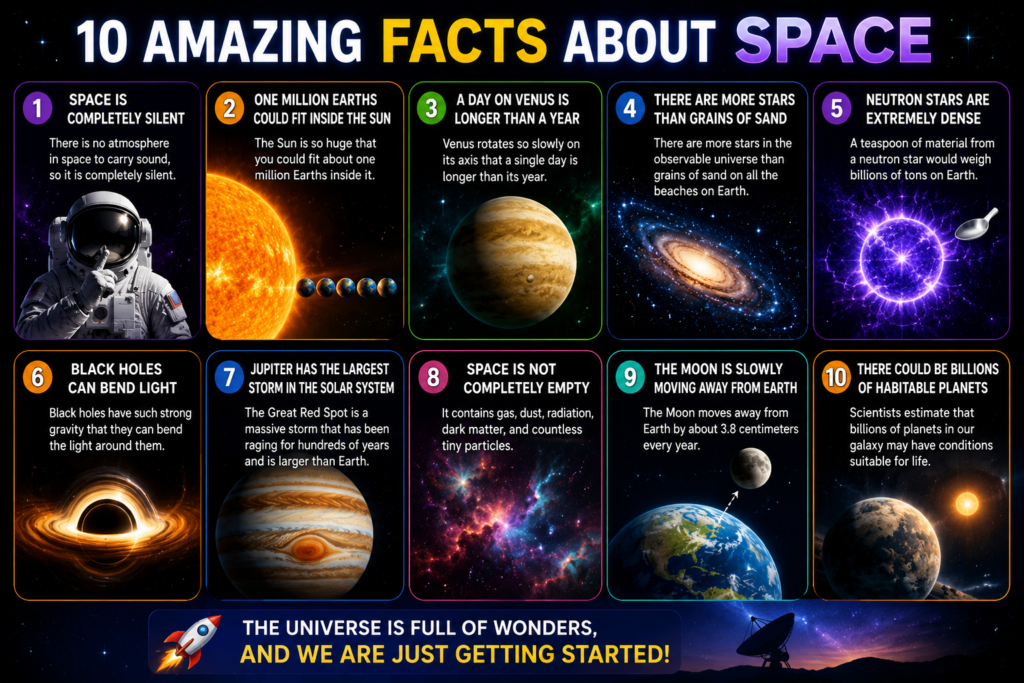
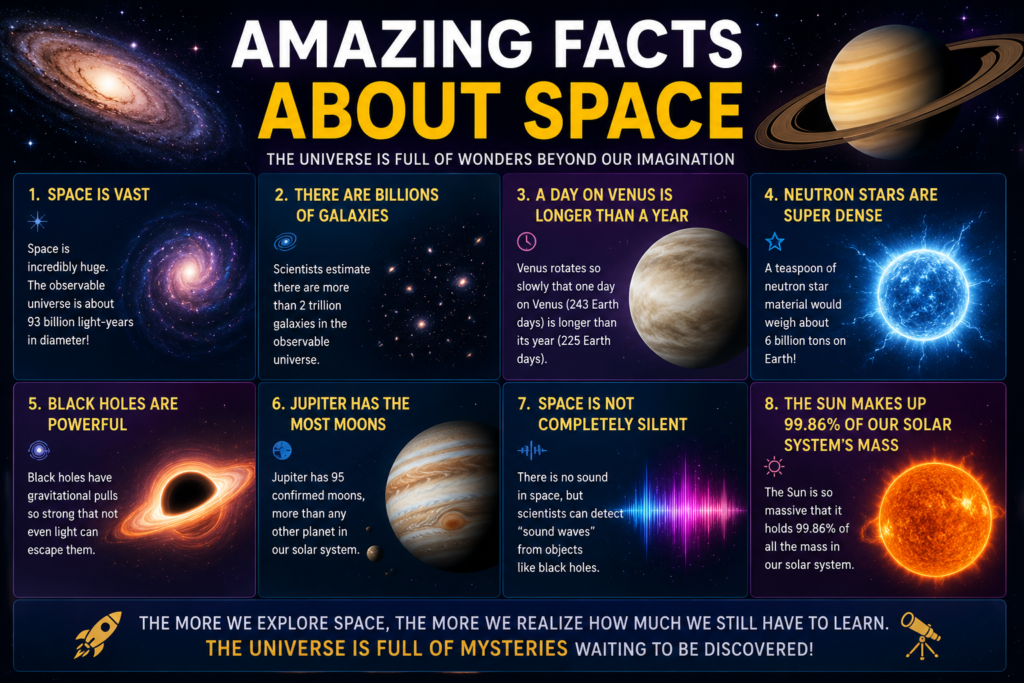
10 Amazing Facts About Space
1. Space Is Completely Silent
Unlike Earth, space has no atmosphere to carry sound waves. This means astronauts cannot hear sounds directly in space, making it completely silent.This amazing fact about space fascinates everyone.
2. One Million Earths Could Fit Inside the Sun
The Sun is enormous compared to our planet. Scientists estimate that approximately one million Earths could fit inside the Sun.
3. A Day on Venus Is Longer Than a Year
Venus rotates extremely slowly. It takes about 243 Earth days to complete one rotation, while it takes only 225 Earth days to orbit the Sun.
4. There Are More Stars Than Grains of Sand
Astronomers believe there are more stars in the observable universe than grains of sand on all the beaches on Earth.
5. Neutron Stars Are Extremely Dense
A teaspoon of material from a neutron star would weigh billions of tons on Earth due to its incredible density.This one is also amazing facts about space
6. Black Holes Can Bend Light
Black holes have such strong gravity that they can bend light itself, creating fascinating effects known as gravitational lensing.
7. Jupiter Has the Largest Storm in the Solar System
The Great Red Spot on Jupiter is a massive storm that has been raging for hundreds of years and is larger than Earth.
8. Space Is Not Completely Empty
Although it appears empty, space contains gas, dust, radiation, dark matter, and countless tiny particles.
9. The Moon Is Slowly Moving Away From Earth
The Moon drifts away from Earth by about 3.8 centimeters each year.
10. There Could Be Billions of Habitable Planets
Scientists estimate that billions of planets in our galaxy alone may have conditions suitable for life.
What We Still Don’t Know About Space
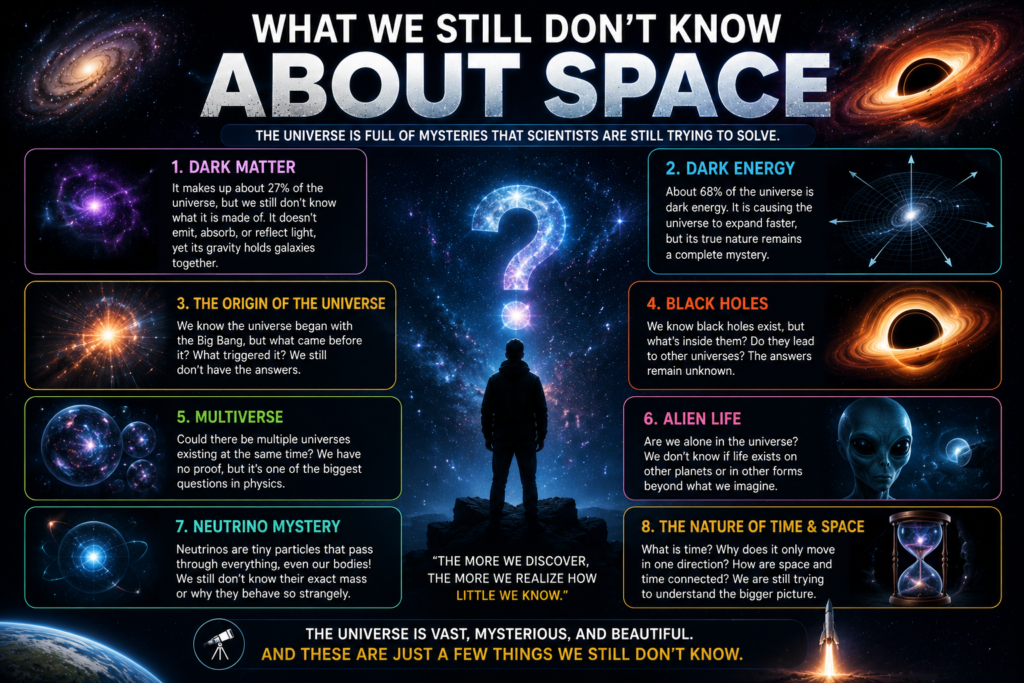
Despite major discoveries, many mysteries remain unsolved.
Scientists are still trying to understand:
Dark Matter
Dark Energy
Black Holes
The Origin of the Universe
The Possibility of Alien Life
These mysteries continue to inspire new missions and research projects.
The Future of Space Exploration
The future of space exploration looks exciting. Space agencies and private companies are planning missions to the Moon, Mars, and beyond.
Future goals include:
Human missions to Mars
Permanent lunar bases
Advanced space telescopes
Search for extraterrestrial life
Deep-space exploration
These missions could completely transform our understanding of the universe.
Incredible Space Missions That Changed History
Humanity has made remarkable progress in space exploration through several groundbreaking missions. These missions have expanded our understanding of the universe and inspired future generations.
Apollo 11
Apollo 11 became the first mission to land humans on the Moon in 1969. Neil Armstrong and Buzz Aldrin made history by walking on the lunar surface.
Voyager Program
The Voyager spacecraft were launched in 1977 and continue to travel through interstellar space. They have provided valuable information about the outer planets and beyond.
Hubble Space Telescope
The Hubble Space Telescope has captured breathtaking images of distant galaxies, nebulae, and stars. It has transformed modern astronomy.
James Webb Space Telescope
The James Webb Space Telescope allows scientists to observe some of the earliest galaxies formed after the Big Bang. Its discoveries are helping researchers understand the origins of the universe.
How Space Exploration Benefits Everyday Life
Many people believe space exploration only benefits scientists, but it also improves daily life on Earth.
Some technologies developed through space programs include:
GPS navigation systems
Weather forecasting satellites
Medical imaging technologies
Water purification systems
Advanced communication networks
Improved solar panels
These innovations demonstrate how investments in space research benefit society.
Fascinating Objects Found in Space
The universe contains countless extraordinary objects that continue to amaze scientists.
Nebulae
Nebulae are giant clouds of gas and dust where new stars are born.
Pulsars
Pulsars are rapidly spinning neutron stars that emit beams of radiation.
Quasars
Quasars are among the brightest objects in the universe and are powered by supermassive black holes.
Exoplanets
Exoplanets are planets located outside our solar system. Thousands have already been discovered.
Why Learning About Space Is Important
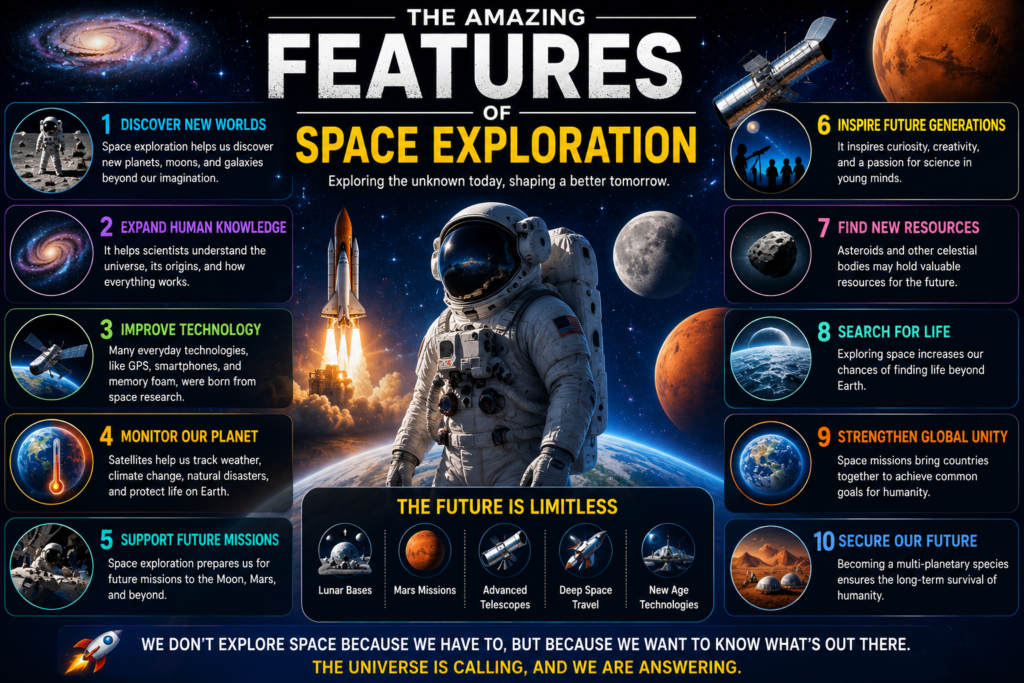
Studying space helps humanity answer fundamental questions about existence and our place in the universe.
Benefits include:
Encouraging scientific curiosity
Advancing technology
Inspiring future scientists
Improving international cooperation
Expanding human knowledge
As our understanding grows, future generations may achieve discoveries that seem impossible today.
Conclusion
The universe is filled with wonders that continue to amaze scientists and ordinary people alike. From giant stars and mysterious black holes to distant galaxies and potentially habitable planets, space remains one of humanity’s greatest frontiers.
These amazing facts about space remind us how extraordinary the universe truly is. As technology advances, future discoveries may reveal even more incredible secrets hiding among the stars.
Frequently Asked Questions (FAQs)
What is the most interesting fact about space?
One of the most interesting facts is that there are more stars in the universe than grains of sand on Earth.
Is space completely silent?
Yes, space is mostly silent because there is no atmosphere to carry sound waves.
How big is the universe?
Scientists believe the observable universe is about 93 billion light-years across.
Could life exist on other planets?
Many scientists believe it is possible because billions of planets may have conditions suitable for life.
For more visit: https://itshk.in/
To learn more about space discoveries and ongoing missions, visit the official http://nasa.gov