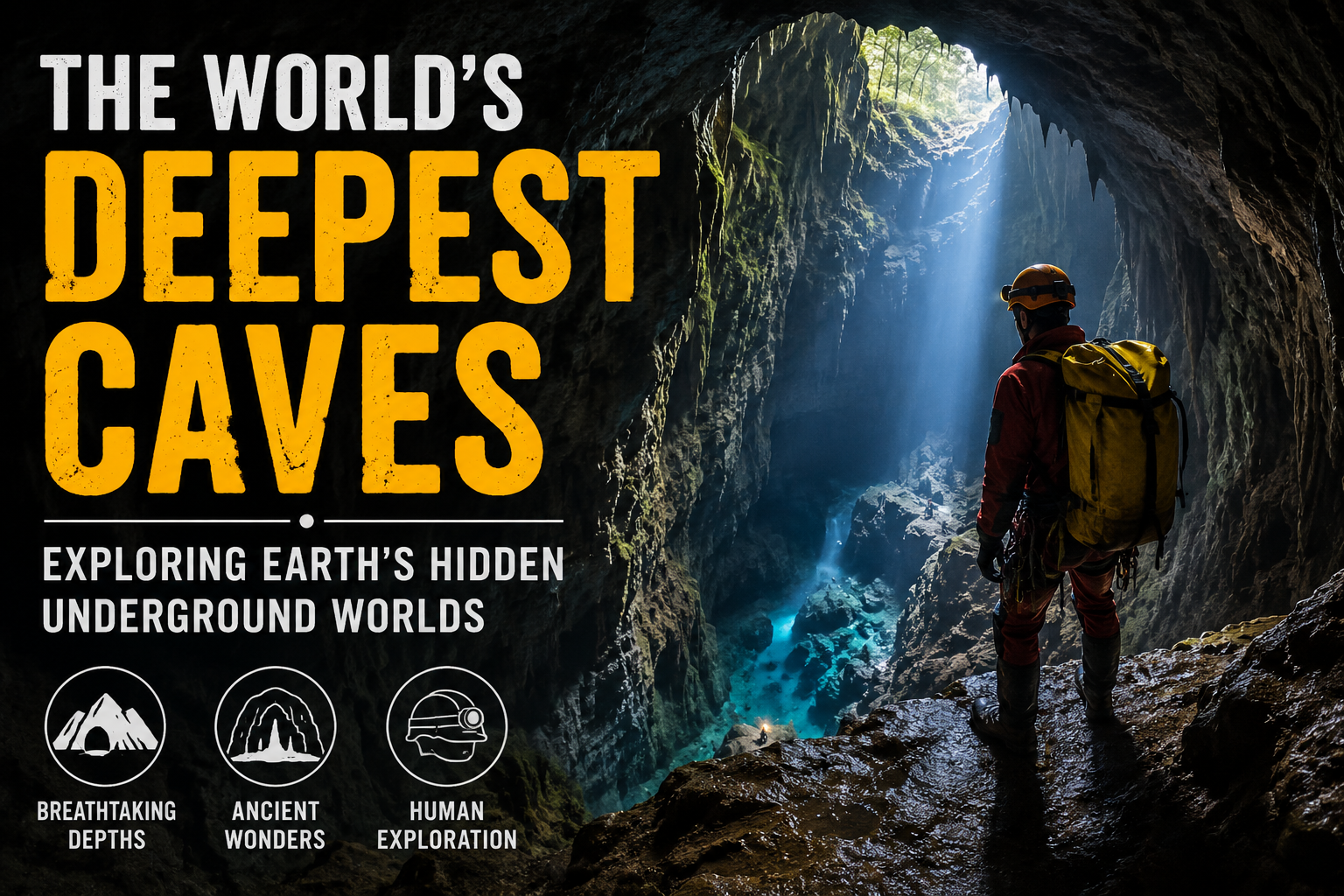
The World’s Deepest Caves: Exploring Earth’s Hidden Underground Worlds
Beneath mountains, forests, and valleys lies a hidden world that few people will ever see. Stretching thousands of meters below the Earth’s surface, the world’s deepest caves are among the planet’s greatest natural wonders. These mysterious underground systems contain enormous chambers, crystal-clear rivers, spectacular rock formations, and rare creatures that have adapted to complete darkness over millions of years.
Unlike mountains or oceans that are visible to everyone, deep caves remain largely unexplored. Many passages have never been mapped, and scientists continue to discover new tunnels, underground lakes, and hidden ecosystems every year. These remarkable underground worlds provide valuable information about Earth’s geological history, climate changes, groundwater systems, and even the possibility of life in extreme environments.
Exploring these caves is one of the most challenging adventures on Earth. Professional cave explorers, also known as speleologists, spend years training to safely navigate narrow passages, vertical shafts, underground rivers, and enormous chambers that can reach depths exceeding 2,000 meters (6,500 feet). Every expedition requires advanced climbing equipment, careful planning, and teamwork to overcome the extreme conditions found deep underground.
Among the most famous caves are Veryovkina Cave, currently recognized as the deepest known cave on Earth, Krubera Cave, which held the world record for many years, and Son Doong Cave in Vietnam, the largest cave by volume. Together, these incredible cave systems reveal the astonishing diversity and beauty hidden beneath our feet.
In this comprehensive guide, you’ll discover the world’s deepest caves, learn how they formed, explore their unique ecosystems, meet the rare animals that live in complete darkness, and understand why these underground worlds remain one of the greatest frontiers of scientific exploration.
What Are the World’s Deepest Caves?
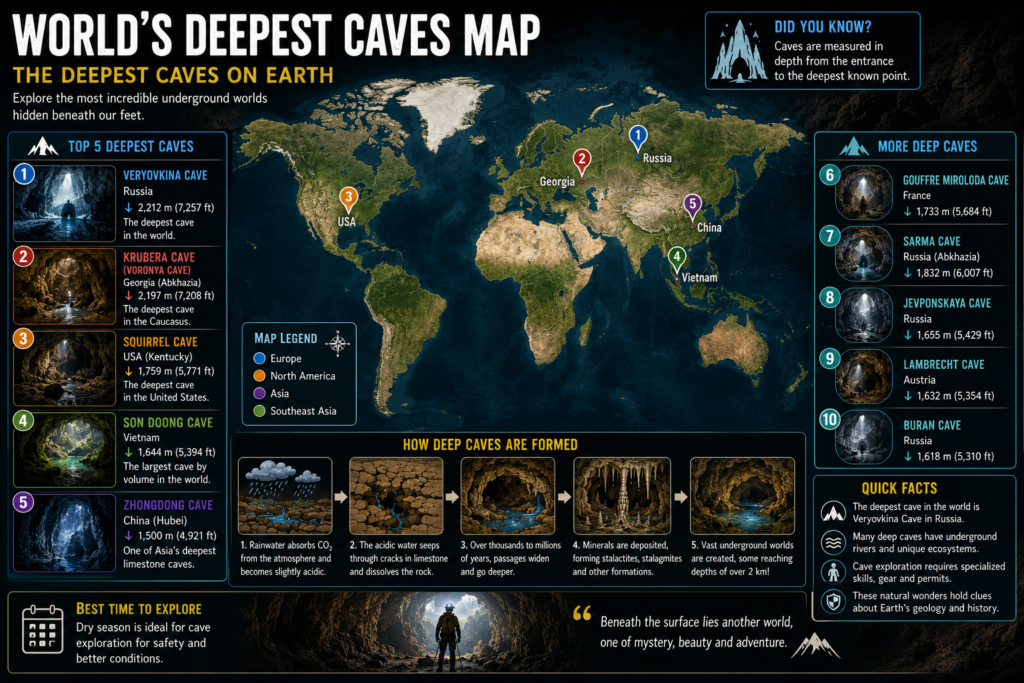
The world’s deepest caves are natural underground passages that extend farther below the Earth’s surface than any other known cave systems. Unlike ordinary caves that may only stretch a few hundred meters, these extraordinary formations descend for more than one or even two kilometers into the Earth.
The depth of a cave is measured from its highest natural entrance to its deepest explored point. Reaching these depths often requires explorers to descend numerous vertical shafts connected by winding tunnels, underground rivers, and massive chambers.
Most of the world’s deepest caves are located in mountainous limestone regions where water has slowly dissolved the rock over millions of years. Rainwater absorbs carbon dioxide from the atmosphere and soil, creating a weak carbonic acid that gradually dissolves limestone. Over countless generations, tiny cracks widen into passages, tunnels, and eventually some of the largest underground cave systems on Earth.
These deep cave systems are much more than empty spaces beneath the ground. They contain underground waterfalls, rivers, lakes, mineral formations, fossils, and fragile ecosystems that exist nowhere else on the planet. Many scientists consider them natural laboratories because they preserve geological records that are millions of years old.
The deepest caves also help researchers understand groundwater movement, climate history, earthquake activity, and the evolution of species that have adapted to permanent darkness. Every new expedition increases our understanding of these hidden environments while revealing that much of the underground world still remains unexplored.
How Are Deep Caves Formed?
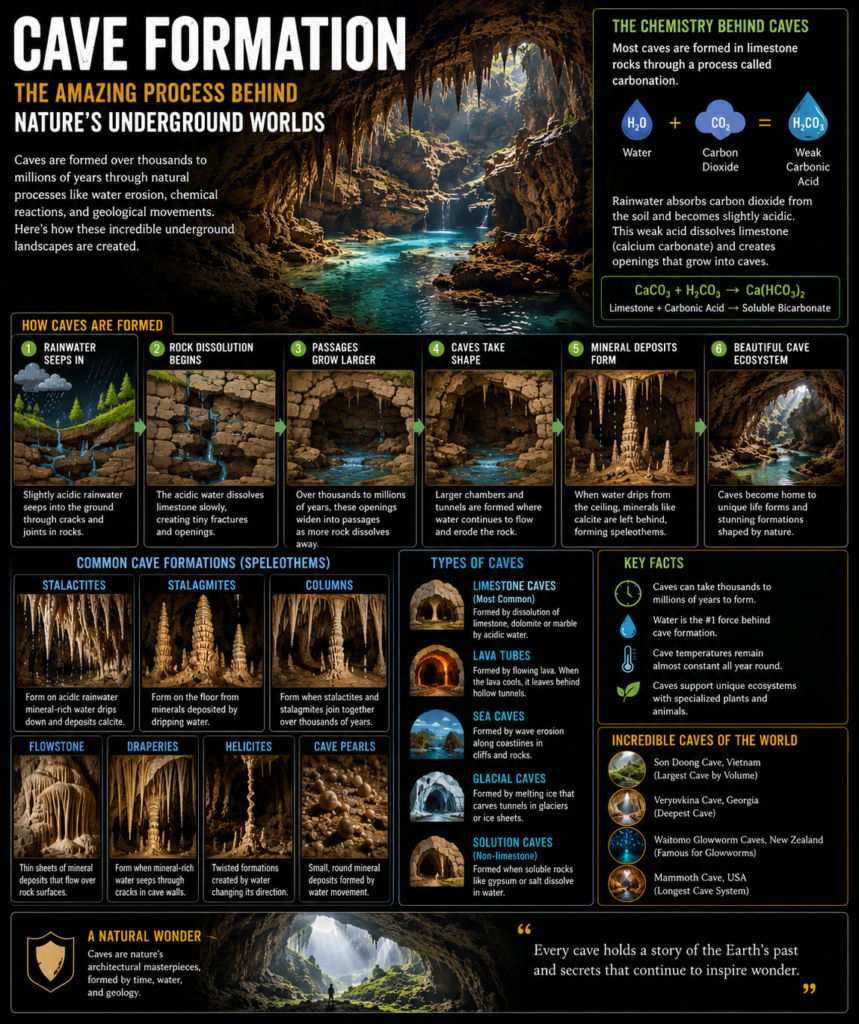
The formation of deep caves is an incredibly slow natural process that takes thousands or even millions of years. Most caves develop in limestone, dolomite, or marble rocks through a process known as chemical weathering or karst formation.
The journey begins when rainwater falls onto the Earth’s surface. As it passes through the atmosphere and soil, the water absorbs carbon dioxide, forming a weak solution of carbonic acid. Although this acid is very mild, it slowly reacts with limestone, dissolving tiny amounts of rock over long periods.
Initially, the water enters microscopic cracks within the rock. Over thousands of years, these cracks become larger as more limestone dissolves. Eventually, they develop into narrow tunnels through which underground streams begin to flow.
As water continues moving through these passages, erosion and chemical dissolution enlarge them even further. Small tunnels gradually transform into enormous chambers capable of holding entire forests, rivers, and even their own underground weather systems, as seen in Son Doong Cave.
The same flowing water also creates many of the beautiful formations found inside caves. When mineral-rich water drips from the ceiling, it leaves behind tiny deposits of calcite. These deposits slowly grow into stalactites, which hang from the ceiling, and stalagmites, which rise from the cave floor. Over thousands of years, they can merge to form towering stone columns.
Other remarkable formations include flowstones, cave curtains, soda straws, cave pearls, and delicate helictites. Each formation grows at an extremely slow rate, often only a few millimeters per century, making them incredibly fragile and valuable.
Underground rivers continue shaping cave systems long after they are formed. During floods, water can carve new passages, deepen existing tunnels, and create spectacular underground waterfalls and lakes. This constant process means that cave systems continue evolving even today.
Scientists estimate that some of the world’s deepest caves have been developing for several million years. Their immense size and complexity demonstrate the incredible power of water, time, and geological processes working together beneath the Earth’s surface.
Top 10 World’s Deepest Caves
The world’s deepest caves are among the most extraordinary natural formations on Earth. Hidden beneath mountains and forests, these caves stretch thousands of meters underground and continue to challenge explorers and scientists. While some are famous for their incredible depth, others are known for their vast chambers, underground rivers, or unique ecosystems.
Below are ten of the deepest and most remarkable caves discovered so far.
1. Veryovkina Cave – The Deepest Cave on Earth
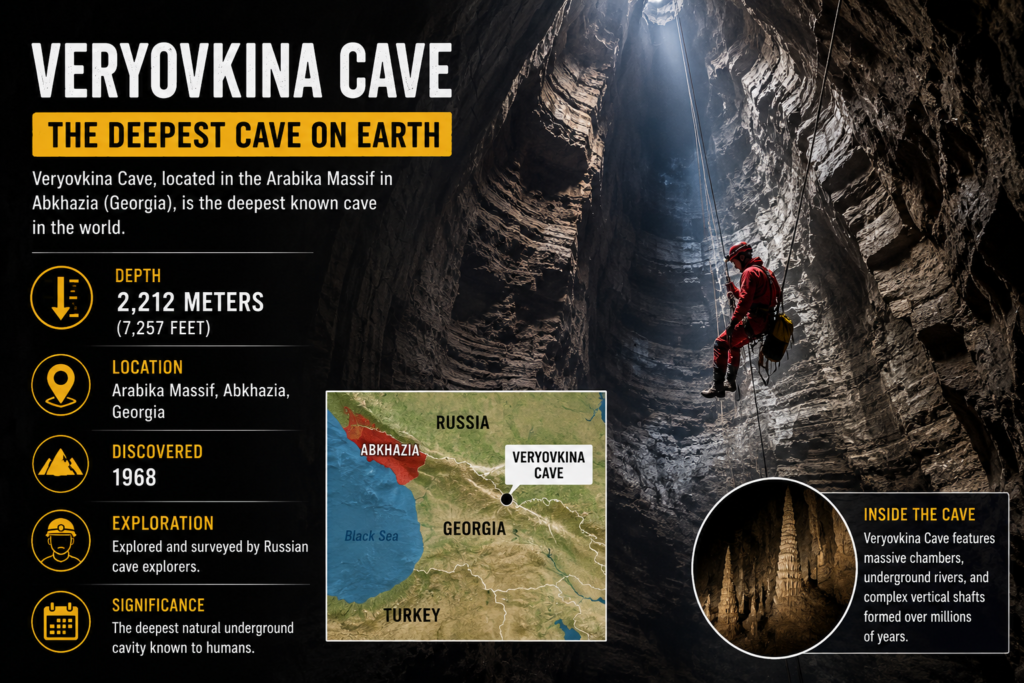
Located in the Arabika Massif of Abkhazia (Georgia region), Veryovkina Cave is currently recognized as the deepest known cave in the world. It reaches an astonishing depth of 2,212 meters (7,257 feet), making it one of the greatest achievements in cave exploration.
Discovered in 1968 and explored extensively over several decades, the cave consists of narrow passages, massive vertical shafts, underground waterfalls, and deep chambers. Reaching the bottom requires weeks of careful exploration, advanced climbing techniques, and specialized equipment.
Scientists have also discovered unique microorganisms and rare cave-dwelling species inside Veryovkina Cave, proving that life can survive even in complete darkness and extreme conditions.
Its incredible depth continues to attract experienced speleologists from around the world, who hope future expeditions may uncover even deeper passages.
2. Krubera Cave (Voronya Cave)
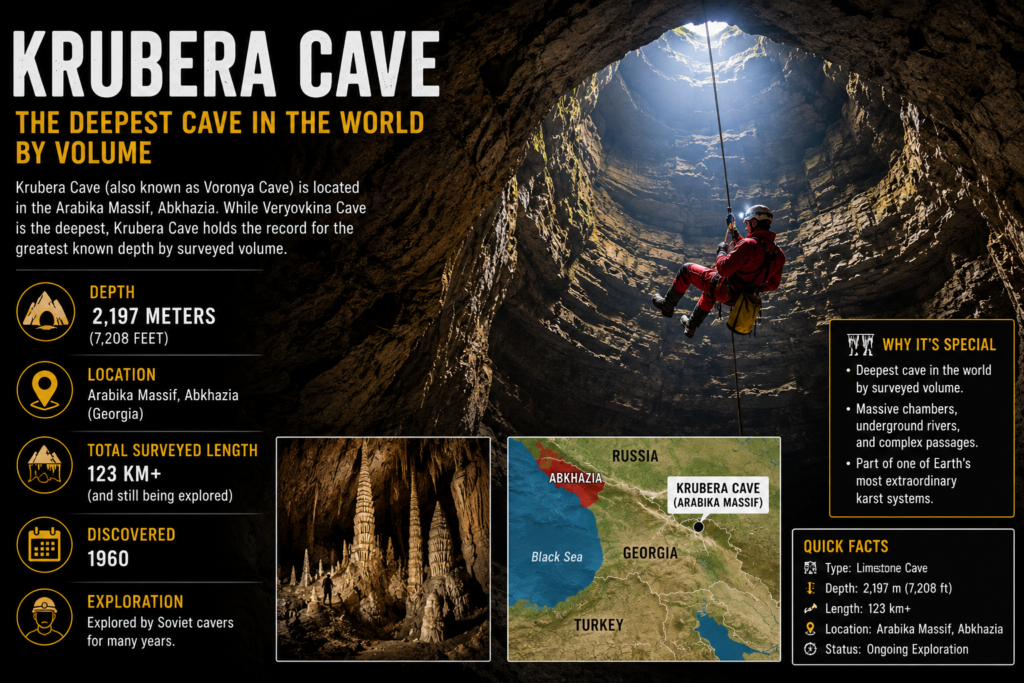
Before Veryovkina Cave claimed the world record, Krubera Cave, also known as Voronya Cave, was considered the deepest cave on Earth.
Also located in the Arabika Massif, Krubera reaches a depth of approximately 2,199 meters (7,215 feet). It became the first cave where explorers successfully descended beyond the 2,000-meter mark.
Krubera Cave is famous for its underground rivers, deep vertical shafts, flooded passages, and challenging climbing routes. Expeditions often last several weeks, requiring teams to establish underground camps while mapping unexplored sections.
Even today, Krubera remains one of the most important caves for scientific research and geological studies.
3. Sarma Cave
Another remarkable cave in the Arabika Massif is Sarma Cave, one of the deepest caves ever explored.
With a depth exceeding 1,830 meters, Sarma Cave contains an extensive network of vertical shafts, underground streams, and limestone passages. Exploration continues today as researchers search for new chambers that could extend its known depth.
The cave demonstrates how interconnected underground systems can be, with many caves in the region sharing similar geological origins.
4. Illuzia-Snezhnaja-Mezhonnogo System
This enormous cave system is one of the longest and deepest underground networks in the world.
The interconnected passages extend for many kilometers while reaching depths of approximately 1,760 meters. Underground rivers, flooded tunnels, and giant chambers make exploration extremely challenging.
Researchers believe additional unexplored sections may still exist deep within the system.
5. Lamprechtsofen Cave
Located in Austria, Lamprechtsofen Cave is one of Europe’s most famous deep cave systems.
The cave extends to a depth of more than 1,730 meters and features spectacular waterfalls, underground streams, and enormous limestone chambers.
Its relatively accessible entrance has made it an important destination for scientific studies and experienced cave explorers alike.
6. Gouffre Mirolda
Situated in the French Alps, Gouffre Mirolda reaches a depth of around 1,730 meters.
The cave contains deep shafts, narrow tunnels, and underground water systems that require advanced rope techniques to navigate safely.
Its complex layout continues to challenge exploration teams attempting to fully map its passages.
7. Torca del Cerro del Cuevón
Located in Spain, this impressive cave system descends to more than 1,580 meters.
Steep vertical drops, winding tunnels, and underground chambers make it one of Europe’s most technically demanding cave explorations.
Despite decades of exploration, researchers believe additional passages may still remain undiscovered.
8. Sistema Huautla
Mexico’s Sistema Huautla is one of North America’s largest and deepest cave systems.
Reaching depths of approximately 1,560 meters, the cave contains hundreds of kilometers of mapped passages.
It is especially famous for its enormous underground river systems and breathtaking limestone formations.
9. Chevé Cave System
Also located in Mexico, Chevé Cave is considered one of the most promising caves for future exploration.
Current surveys place its explored depth at more than 1,480 meters, but scientists believe it could eventually become one of the deepest caves on Earth once hidden passages are connected.
Several international expeditions continue exploring the cave every year.
10. Son Doong Cave – The World’s Largest Cave
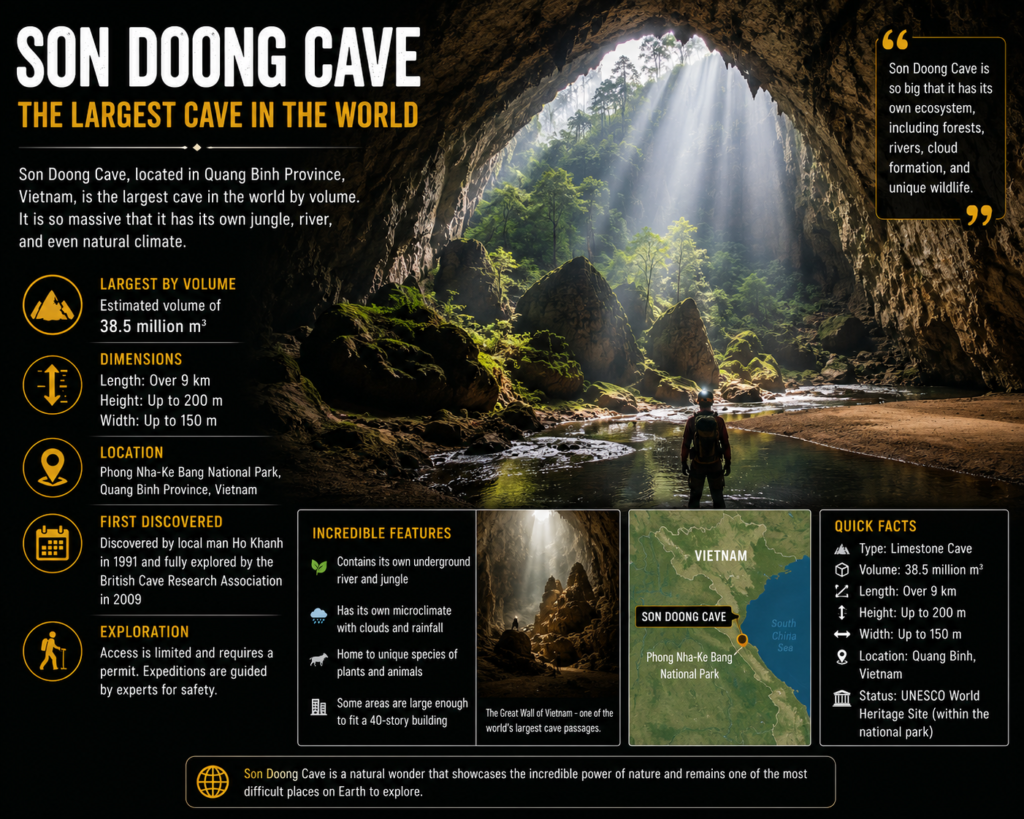
Although Son Doong Cave in Vietnam is not the deepest cave, it deserves a place among Earth’s greatest underground wonders because it is the largest cave by volume.
Discovered by a local resident in 1991 and fully explored in 2009, Son Doong contains chambers so enormous that they could fit entire city blocks.
Inside the cave are underground rivers, dense rainforests, giant stalagmites, and natural skylights where sunlight enters through collapsed sections of the ceiling.
The cave even has its own clouds and localized weather conditions due to its immense size.
Today, Son Doong is regarded as one of the world’s most spectacular natural attractions and remains a dream destination for adventurers and nature lovers alike.
These incredible cave systems remind us that much of our planet remains unexplored. While satellites have mapped nearly every corner of Earth’s surface, vast underground worlds continue to hide countless secrets waiting to be discovered.
Underground Rivers: The Lifeblood of Deep Cave Systems
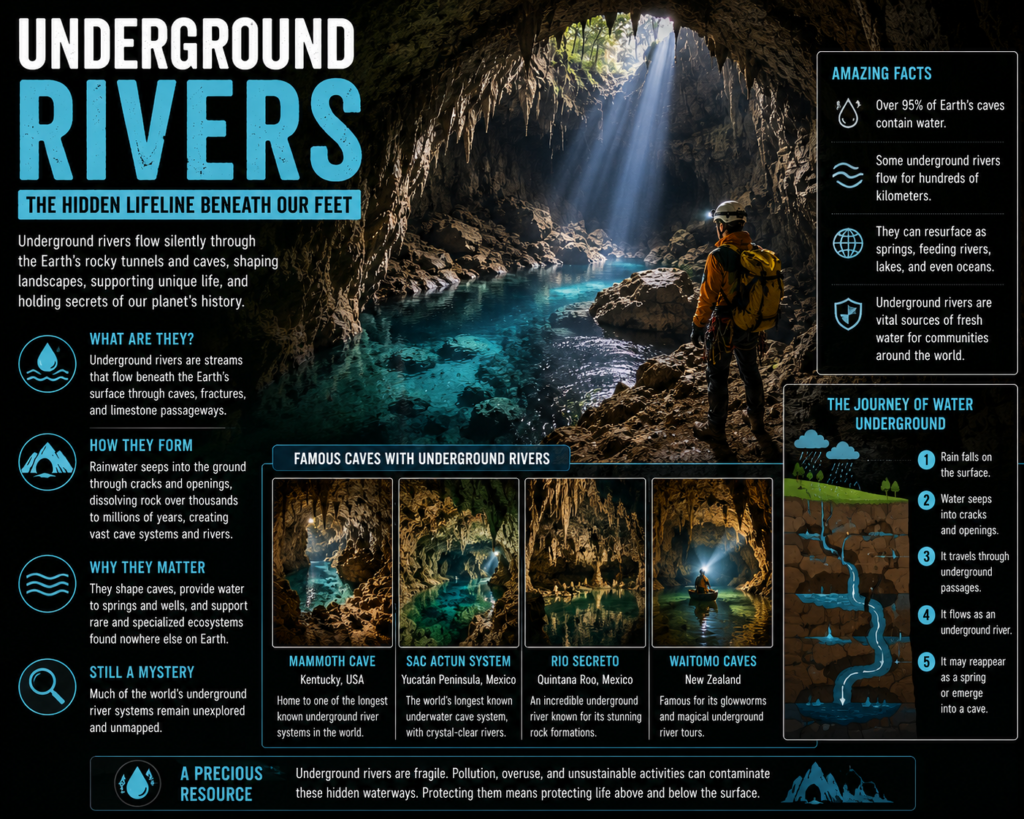
One of the most fascinating features of the world’s deepest caves is the presence of underground rivers. Hidden beneath mountains and forests, these rivers quietly flow through dark passages, shaping enormous cave systems over millions of years.
Underground rivers begin when rainwater seeps through cracks in limestone and other soluble rocks. As the water slowly dissolves the rock, it creates tunnels that gradually become large enough for streams and rivers to flow through. Over thousands and even millions of years, these rivers carve out vast underground chambers, deep shafts, and winding passageways.
Some underground rivers eventually emerge as springs, supplying fresh water to nearby communities and ecosystems. Others remain hidden beneath the Earth’s surface, flowing through cave systems that have never been fully explored.
Several famous caves are known for their spectacular underground rivers. Son Doong Cave in Vietnam contains a large underground river that winds through enormous chambers and supports a unique ecosystem. Sistema Huautla in Mexico and Krubera Cave also contain powerful underground waterways that continue shaping the caves today.
These rivers are not only geological wonders but also valuable freshwater resources. Scientists study them to better understand groundwater movement, climate change, and water quality. Since many cities depend on underground aquifers for drinking water, protecting cave systems is essential for preserving these hidden natural resources.
Underground rivers also create breathtaking scenery. Crystal-clear pools, underground waterfalls, and mirror-like lakes make many caves among the most beautiful places on Earth.
Rare Cave Animals: Life in Complete Darkness
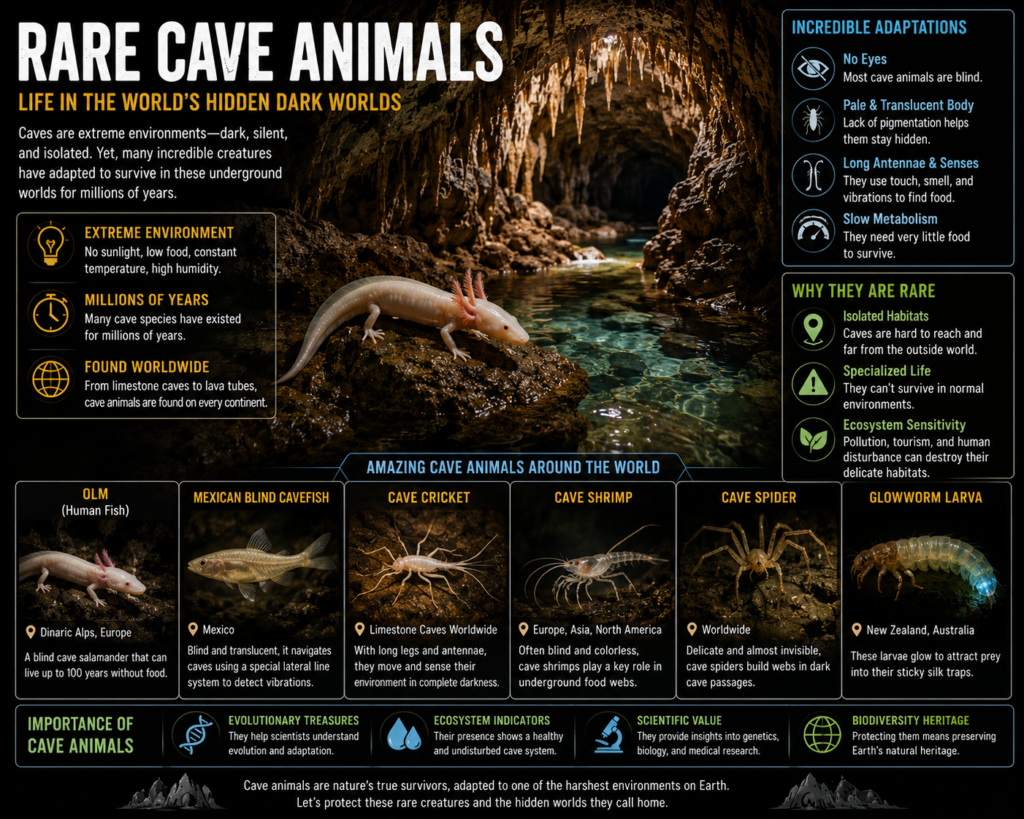
Although caves may appear lifeless at first glance, they are home to an incredible variety of animals specially adapted to survive in total darkness.
Many cave animals spend their entire lives underground and have evolved unique characteristics over millions of years. Since sunlight never reaches the deepest caves, these creatures no longer rely on vision. Instead, they depend on highly developed senses of touch, smell, and vibration to navigate their surroundings.
One of the most famous cave animals is the olm, also known as the blind cave salamander. Native to parts of Europe, the olm can live for decades and survive long periods without food. Its pale skin and tiny eyes are perfect examples of evolution in dark environments.
Another remarkable species is the Mexican blind cavefish. Unlike surface fish, it has no functional eyes and uses specialized sensory organs to detect water movement and nearby objects. Scientists study this fish to better understand evolution and genetics.
Other fascinating cave creatures include blind cave shrimp, cave spiders, cave beetles, cave crickets, and tiny microorganisms that thrive in extreme conditions. Some caves are also home to colonies of bats, which play an important role in maintaining healthy ecosystems by pollinating plants and controlling insect populations.
Because cave ecosystems are extremely delicate, even small changes caused by pollution or tourism can threaten these rare species. Protecting underground habitats is essential to preserving biodiversity and supporting ongoing scientific research.
Cave Exploration Teams: Discovering Earth’s Hidden Underground Worlds
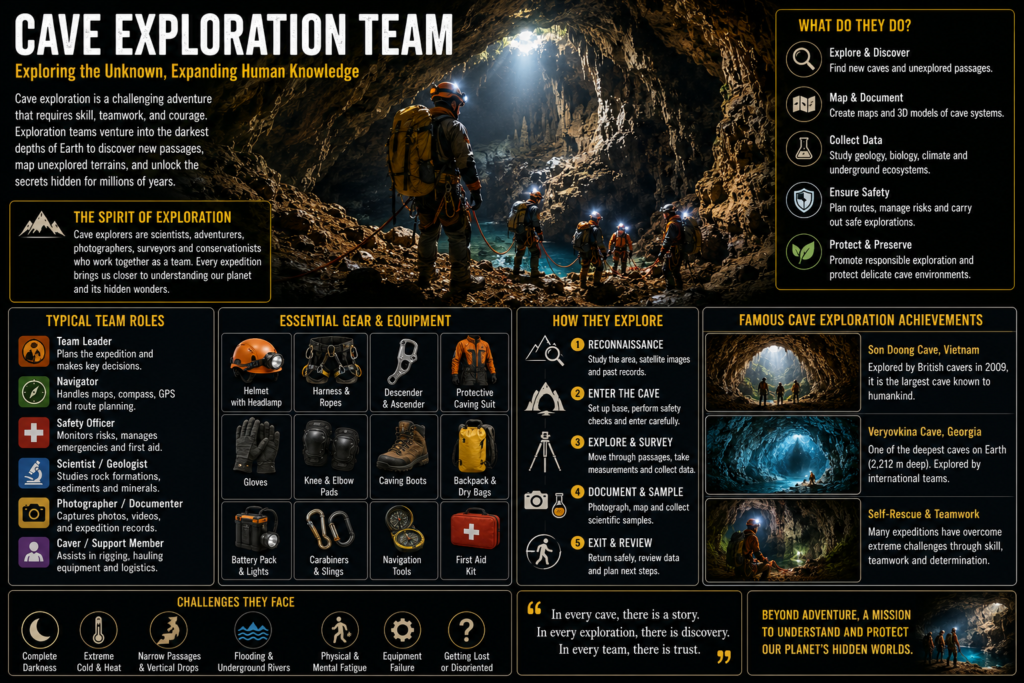
Exploring the world’s deepest caves is one of the most demanding forms of scientific exploration. Professional cave explorers, known as speleologists, work in specialized teams to map, study, and document underground environments.
A typical cave exploration team includes climbers, surveyors, photographers, geologists, hydrologists, biologists, and rescue specialists. Each member plays an important role in ensuring the expedition is both successful and safe.
Before entering a deep cave, explorers spend months planning every detail. They carefully study maps, weather conditions, water levels, and potential hazards. Since some expeditions last several weeks, teams establish underground camps where they can rest before continuing deeper into the cave.
Specialized equipment is essential during every expedition. Explorers wear durable helmets with powerful headlamps, waterproof clothing, climbing harnesses, ropes, ascenders, descenders, protective gloves, and sturdy boots designed for slippery terrain.
Communication inside deep caves presents another major challenge. Radio signals often cannot travel through thick rock, so teams rely on carefully planned schedules, guide ropes, and advanced communication systems to stay connected.
Safety remains the highest priority throughout every expedition. Sudden flooding, falling rocks, narrow passages, and extreme temperatures can quickly turn an exploration into a dangerous situation. As a result, cave explorers undergo extensive training in climbing, rescue techniques, first aid, and survival before attempting deep expeditions.
Despite these challenges, cave exploration continues to expand our understanding of Earth’s hidden underground worlds. Every expedition contributes valuable scientific information while inspiring future generations of explorers.
Why Scientists Study the World’s Deepest Caves
The world’s deepest caves are much more than exciting destinations for adventurers. They serve as natural laboratories where scientists can study geology, biology, hydrology, archaeology, and climate history.
Rock formations inside caves preserve valuable records of Earth’s past climate. By analyzing minerals deposited over thousands of years, researchers can reconstruct ancient rainfall patterns, temperature changes, and environmental conditions.
Caves also contain fossils, ancient human artifacts, and evidence of extinct animals that once lived nearby. These discoveries help archaeologists better understand the history of human civilization and prehistoric ecosystems.
Biologists are particularly interested in cave organisms because many species have evolved in complete isolation. Studying these unique animals provides important insights into evolution, genetics, and adaptation to extreme environments.
Hydrologists use cave systems to better understand groundwater movement and freshwater resources. Since millions of people rely on underground aquifers for drinking water, protecting cave systems has become increasingly important.
Some scientists even believe cave research could help future space missions. The harsh, isolated conditions found deep underground resemble environments that astronauts might encounter on the Moon or Mars. Technologies developed for cave exploration may one day assist in exploring other planets.
As technology continues to improve, researchers expect many more discoveries within Earth’s underground worlds. Countless caves remain only partially explored, and some may still contain hidden rivers, new species, or passages leading even deeper beneath the surface.
Famous Cave Discoveries That Changed Science
The world’s deepest caves are more than natural wonders—they are scientific treasure troves that have transformed our understanding of geology, biology, archaeology, and climate history. Every major cave expedition has the potential to uncover discoveries that remain hidden from the rest of the world for thousands or even millions of years.
One of the most significant discoveries made inside deep caves is the identification of entirely new species. Because caves are isolated environments with no sunlight, animals living there evolve differently from surface species. Scientists have discovered blind fish, colorless insects, tiny crustaceans, rare spiders, and microscopic organisms that exist nowhere else on Earth. These unique life forms help researchers understand evolution and how species adapt to extreme environments.
Another remarkable discovery is the presence of ancient fossils. Bones of extinct animals such as cave bears, giant hyenas, and prehistoric mammals have been preserved in cave chambers for tens of thousands of years. Some caves have also revealed evidence of early human activity, including stone tools, pottery, cave paintings, and human skeletons that provide valuable clues about ancient civilizations.
Caves also preserve geological records that cannot be found elsewhere. Layers of minerals deposited over thousands of years allow scientists to study past rainfall, temperature changes, and climate patterns. These natural records help researchers better understand how Earth’s climate has changed over time.
Underground lakes and rivers discovered inside deep caves have provided important information about groundwater systems. These hidden water sources often connect to rivers and springs on the surface, making them essential for freshwater conservation and environmental studies.
Modern technology has made cave discoveries even more exciting. Laser scanners, 3D mapping systems, drones, and underwater robots now allow researchers to explore areas that were once impossible to reach. As a result, scientists continue discovering new chambers, hidden passages, and geological formations in cave systems around the world.
Every expedition proves that much of Earth’s underground world remains unexplored. Future discoveries may reveal even deeper caves, unknown ecosystems, or entirely new geological formations waiting beneath the surface.
Biggest Challenges of Exploring Deep Caves
Exploring the world’s deepest caves is one of the most demanding activities on Earth. Unlike hiking or mountain climbing, cave exploration combines technical climbing, navigation, survival skills, and scientific research in a completely dark environment.
One of the greatest challenges is navigating vertical shafts. Many deep caves contain drops hundreds of meters deep, requiring ropes, harnesses, and advanced climbing techniques. Even experienced explorers must move slowly and carefully to ensure safety.
Darkness presents another major obstacle. Since no natural sunlight reaches the deepest sections of caves, explorers depend entirely on artificial lighting. Every expedition carries multiple backup headlamps and batteries because losing light underground can quickly become life-threatening.
Underground rivers create additional risks. Heavy rainfall on the surface can suddenly flood cave passages without warning, trapping explorers deep underground. Expedition teams constantly monitor weather conditions before entering caves to reduce this danger.
Cold temperatures also make exploration difficult. Deep caves often remain between 2°C and 10°C throughout the year. Spending several days in these conditions requires specialized clothing and sleeping equipment to prevent hypothermia.
Communication is another challenge. Radio signals rarely pass through thick rock, making it difficult to contact rescue teams or surface support crews. Many expeditions rely on scheduled check-ins and specialized communication systems.
Physical exhaustion becomes increasingly serious during long expeditions. Carrying heavy equipment while climbing, crawling, and descending for several days requires exceptional fitness and endurance. Explorers often establish underground camps to recover before continuing deeper.
Despite these risks, careful planning, teamwork, and modern equipment allow scientists and explorers to safely investigate some of Earth’s most extraordinary underground environments.
Essential Equipment Used by Cave Explorers
Professional cave explorers rely on specialized equipment to safely navigate the world’s deepest caves. Every item is carefully selected to withstand harsh underground conditions.
The most important piece of equipment is a protective helmet fitted with a powerful LED headlamp. Since caves are completely dark, reliable lighting is essential for navigation and safety.
Climbing gear includes harnesses, static ropes, carabiners, ascenders, descenders, and safety anchors. These tools allow explorers to climb steep shafts and safely descend vertical drops.
Waterproof clothing protects explorers from cold temperatures and underground streams. Durable boots provide traction on wet rocks, while gloves improve grip during rope work.
Navigation equipment such as digital maps, compasses, laser rangefinders, and GPS devices used at cave entrances helps explorers accurately map underground passages.
Scientific expeditions also carry cameras, drones, environmental sensors, water testing equipment, and sample containers for collecting geological and biological data.
Emergency kits include first-aid supplies, food, water purification systems, thermal blankets, emergency shelters, and spare batteries. Since rescue operations inside caves are extremely difficult, every team must be prepared for unexpected situations.
Together, this equipment enables explorers to safely investigate some of the most remote places on Earth.
Amazing Facts About the World’s Deepest Caves
The world’s deepest caves continue to surprise scientists with their incredible features and mysteries.
Veryovkina Cave is currently the deepest known cave on Earth.
Krubera Cave was the first cave where explorers reached depths greater than 2,000 meters.
Son Doong Cave is the largest cave by volume and contains its own rainforest.
Some caves have underground rivers stretching for many kilometers.
Cave temperatures remain nearly constant throughout the year.
Many cave animals are completely blind because they evolved without sunlight.
Stalactites and stalagmites often take thousands of years to grow just a few centimeters.
Certain caves contain air that is millions of years old.
Some underground chambers are large enough to fit skyscrapers.
New cave passages are discovered almost every year.
Scientists continue finding previously unknown species inside caves.
Many of Earth’s cave systems remain only partially explored.
Underground caves play a major role in storing freshwater.
Some caves contain prehistoric artwork created by ancient humans.
Modern laser scanning technology is helping researchers create highly accurate 3D maps of cave systems.
These fascinating facts demonstrate why deep caves continue attracting scientists, explorers, and adventurers from around the world.
Protecting the World’s Deepest Caves
The world’s deepest caves are extremely fragile environments that require careful protection. Even small disturbances can damage formations that took millions of years to develop.
Tourism, pollution, vandalism, and climate change all threaten these underground ecosystems. Visitors who leave litter, touch delicate mineral formations, or disturb wildlife can cause long-lasting damage.
Governments and conservation organizations have introduced protective measures such as limiting visitor numbers, establishing guided tours, restricting access to sensitive areas, and promoting responsible cave exploration.
Scientists also encourage public education about cave conservation. Understanding the importance of these underground worlds helps ensure they remain protected for future generations.
By respecting cave environments and following conservation guidelines, everyone can help preserve these extraordinary natural wonders.
The Future of Cave Exploration
The future of cave exploration is becoming increasingly exciting thanks to advances in technology. Researchers now use drones, robotic vehicles, underwater robots, laser scanners, and artificial intelligence to explore dangerous or inaccessible sections of caves.
Three-dimensional mapping allows scientists to create incredibly accurate digital models of underground systems. These maps improve safety while helping researchers better understand cave formation and groundwater movement.
Artificial intelligence is beginning to analyze geological data, predict hidden passages, and assist with navigation inside complex cave networks.
Many scientists believe deeper cave systems remain undiscovered. Future expeditions could reveal new underground rivers, giant chambers, rare animal species, and perhaps even caves deeper than Veryovkina.
As technology continues improving, humanity will gain an even greater understanding of the hidden underground worlds beneath our feet, ensuring that the exploration of Earth’s deepest caves remains one of science’s most exciting frontiers.
Why the World’s Deepest Caves Fascinate People
For centuries, caves have inspired explorers, scientists, and storytellers. Hidden beneath mountains and forests, these underground worlds remain some of the least explored places on Earth. Unlike oceans or outer space, caves are physically accessible, yet many of their passages remain completely unknown.
One reason deep caves capture people’s imagination is their mystery. Every expedition has the potential to reveal something that no human has ever seen before. Whether it is a hidden chamber, a crystal-clear underground lake, or a new species, every discovery reminds us that our planet still holds countless secrets.
Deep caves also represent the ultimate test of human endurance and teamwork. Explorers must overcome darkness, cold temperatures, underground rivers, and dangerous vertical drops while carrying heavy equipment. Success depends on trust, communication, and careful planning, making cave exploration one of the world’s most demanding adventures.
The breathtaking beauty found inside these caves is another reason they attract attention. Giant chambers, glowing mineral formations, underground waterfalls, and towering stalagmites create landscapes unlike anywhere else on Earth. Some caves are so large they contain forests, rivers, and their own unique weather systems.
For photographers and filmmakers, caves provide spectacular natural scenery. Images captured inside famous caves have amazed millions of people worldwide and inspired greater appreciation for Earth’s hidden underground environments.
As technology advances, more discoveries are expected, ensuring that the fascination with the world’s deepest caves will continue for generations.
Can Humans Explore Every Cave on Earth?
Although scientists have mapped thousands of caves worldwide, experts believe many more remain undiscovered. Dense forests, remote mountains, deserts, and unexplored wilderness continue hiding cave entrances that may lead to entirely new underground systems.
Modern technologies such as satellite imagery, LiDAR scanning, drones, and artificial intelligence help researchers identify areas where unknown caves may exist. However, technology cannot replace human exploration. Many cave passages are too narrow or complex for machines, requiring experienced speleologists to continue the search.
Some caves are impossible to fully explore because they contain flooded passages. Divers equipped with specialized breathing equipment investigate these underwater tunnels, but extreme depths and limited visibility make exploration incredibly dangerous.
Scientists also believe some of the world’s known caves may connect to nearby cave systems, creating even larger underground networks. If these connections are confirmed, the rankings of the world’s deepest caves could change in the future.
Despite decades of exploration, Earth’s underground world remains one of the planet’s final frontiers. Every year, researchers discover new passages, underground rivers, and previously unknown chambers that expand our understanding of the natural world.
Why the World’s Deepest Caves Continue to Inspire Exploration
The World’s Deepest Caves remain one of the greatest frontiers of scientific exploration and adventure. Every year, researchers and experienced cave explorers travel to the World’s Deepest Caves to map new passages, study rare underground ecosystems, and uncover geological secrets hidden beneath the Earth’s surface. As technology continues to improve, scientists believe the World’s Deepest Caves could reveal even more discoveries, including previously unknown chambers, underground rivers, and unique species. Protecting the World’s Deepest Caves is essential so future generations can continue exploring these extraordinary natural wonders while preserving their fragile environments for scientific research and education.
Exploring the World’s Deepest Caves Responsibly
Exploring the World’s Deepest Caves is both an exciting adventure and a great responsibility. The World’s Deepest Caves contain delicate rock formations, rare wildlife, and underground rivers that have developed over millions of years. Visitors and researchers should always follow conservation guidelines, avoid damaging cave formations, and respect protected areas. Responsible exploration helps preserve the World’s Deepest Caves for future scientific research, education, and sustainable tourism. By protecting the World’s Deepest Caves, we ensure these remarkable underground worlds continue inspiring explorers and scientists for generations to come.
Frequently Asked Questions (FAQs)
Which is the deepest cave in the world?
Veryovkina Cave, located in the Arabika Massif, is currently recognized as the deepest known cave in the world, with a depth of 2,212 meters (7,257 feet).
Which is the largest cave in the world?
Son Doong Cave in Vietnam is the world’s largest cave by volume and contains enormous chambers, an underground rainforest, and flowing rivers.
How are deep caves formed?
Most deep caves form when slightly acidic rainwater slowly dissolves limestone over millions of years, creating underground tunnels and chambers.
Why are cave animals often blind?
Because they live in complete darkness, many cave animals evolved without functional eyesight and instead rely on enhanced senses of touch, smell, and vibration.
Is cave exploration dangerous?
Yes. Cave exploration involves risks such as flooding, falling rocks, narrow passages, cold temperatures, and vertical shafts. Professional training and specialized equipment are essential.
Why are caves important to scientists?
Caves help scientists study geology, climate history, groundwater systems, fossils, rare species, and the evolution of life in extreme environments.
Can new caves still be discovered?
Yes. Researchers continue discovering new caves and unexplored passages every year, especially in remote mountainous regions.
Why You Should Learn About the World’s Deepest Caves
Learning about the World’s Deepest Caves helps us appreciate the incredible diversity of our planet and the importance of protecting these fragile underground ecosystems. Every expedition into the World’s Deepest Caves contributes valuable scientific knowledge while inspiring future explorers to uncover the many mysteries that still lie hidden beneath Earth’s surface.
Conclusion
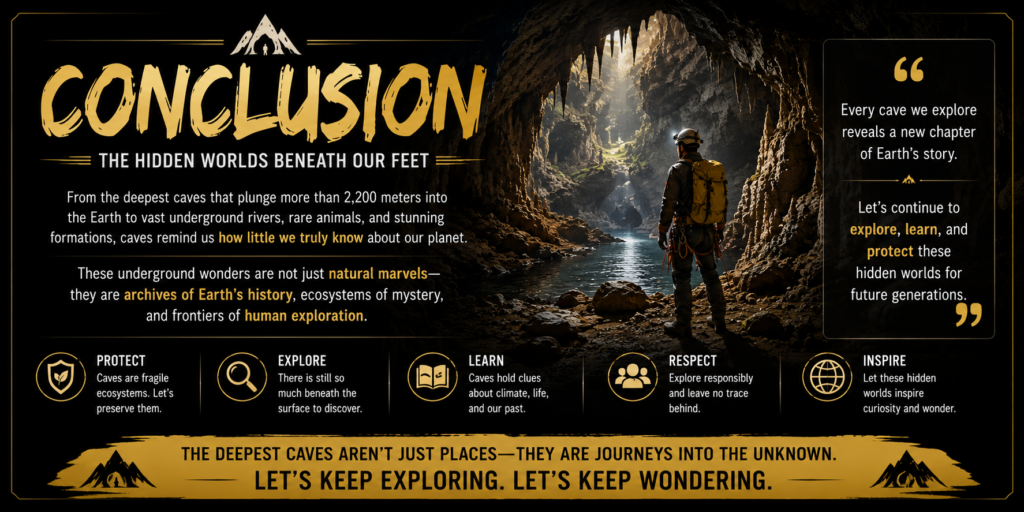
The World’s Deepest Caves are among the most extraordinary natural wonders on our planet. From the record-breaking depths of Veryovkina Cave and Krubera Cave to the enormous underground chambers of Son Doong Cave, these hidden worlds showcase the incredible power of nature over millions of years.
Exploring the World’s Deepest Caves helps scientists uncover new geological discoveries, rare cave animals, underground rivers, and valuable clues about Earth’s history. These underground ecosystems also play a crucial role in freshwater conservation, biodiversity, and climate research, making them important natural laboratories.
Although remarkable progress has been made, much of the World’s Deepest Caves remains unexplored. New technologies, including 3D mapping, drones, robotic explorers, and artificial intelligence, are helping researchers discover previously unknown passages and hidden chambers. Future expeditions may even reveal caves deeper than those known today.
Whether you’re fascinated by adventure, geology, or natural wonders, the World’s Deepest Caves remind us that our planet still holds countless secrets beneath its surface. Protecting these fragile underground environments ensures that future generations can continue exploring and learning from Earth’s hidden underground worlds.
To learn more about cave exploration, speleology, conservation efforts, and scientific research on underground cave systems, visit the https://caves.org/. The organization provides valuable resources, educational materials, and updates about cave science, responsible exploration, and the protection of the World’s Deepest Caves and other underground environments around the world.
If you enjoy discovering Earth’s hidden natural wonders, you may also like our article on the Hidden World Beneath Antarctica, where we explore the mysterious landscapes buried beneath Antarctica’s massive ice sheet, including hidden lakes, mountain ranges, and fascinating scientific discoveries. Together with the World’s Deepest Caves, these incredible places reveal just how much of our planet remains unexplored.https://itshk.in/hidden-world-beneath-antarctica/